
A lead named Priya fills out a form at 11:40pm. She wants a demo. The rule reads her form, drops her into "Track A," and schedules a nurture email for the following Tuesday. By Tuesday, Priya has already talked to two competitors. Nobody on your team notices. The workflow reports itself as green. Every step ran exactly as designed, and the deal is already gone.
This is how rule-based journeys fail: quietly, on schedule, with the dashboard still showing success. It is why teams are moving to smart campaign orchestration platforms that decide from live data instead of firing pre-set branches. The shift has a name. It is called adaptive journey orchestration, and it changes what "the workflow ran" actually means.
Priya was never a mystery. She was a hot lead your rules mistook for a scheduled task.
What is adaptive journey orchestration?
Adaptive journey orchestration is a method of moving a customer through a buying journey where each next step is chosen in real time from live conversation and behavior data, instead of following a fixed if-then branch built in advance. A trigger fires. A decision engine reads the current context. The best next action is computed on the spot, then executed across whatever channel the customer is actually on.
Read that definition again. The word doing the work is "chosen." Old automation executes a path you drew months ago. Adaptive orchestration decides the path as the moment unfolds. One follows a map. The other reads the road.
See the difference? Everything below is a consequence of it.
The rule-debt problem: why static if-then branches decay
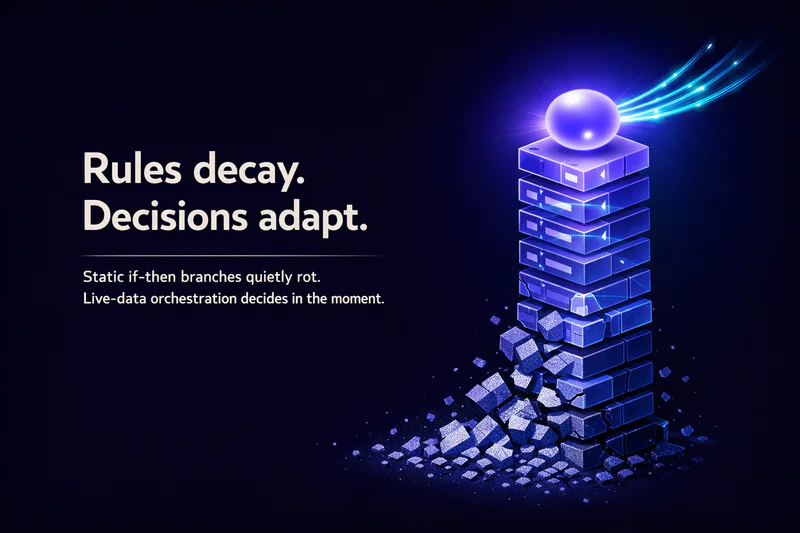
Every rule you write is a promise about the future. "If a lead does X, do Y." The promise holds until reality stops matching X. Then the rule does not break loudly. It keeps running, on a version of the world that no longer exists. This is the quiet decay behind the death of the static sequence.
Call it "rule-debt." It is the compounding maintenance tax you take on every time you add another branch to cover another edge case. One rule is clean. Two hundred rules, layered over three years by four people who have since left, is a haunted house. Nobody remembers why the Thursday exception exists. Everybody is afraid to delete it.
The numbers are not kind to the rule stack. Roughly 34% of automation projects are abandoned within the first six months, and 67% fail to deliver the results teams expected. More than half of companies use less than half the features of the platform they bought. The tools are not weak. The approach is brittle. A single unaccounted-for click stalls the whole flow, and MarTech has said it plainly: too many workflows are breaking marketing automation.
Rule-debt has three tells. Branches multiply faster than anyone can audit them. Exceptions pile up until the exceptions outnumber the rule. And the failure is silent, because a rule that fires on stale logic still reports success. Your dashboard says green while your pipeline leaks.
Watch how the debt accrues. A launch starts with one clean flow: new lead, welcome email, wait three days, follow up. Then sales notices enterprise leads need a different track, so you add a branch. Then a holiday skews the timing, so you add a date exception. Then a channel breaks, so you add a fallback. Each fix is reasonable in isolation. Together they form a lattice nobody can hold in their head. The stack does not fail because any one rule is wrong. It fails because the rules stop agreeing with each other, and no single line of logic knows the whole customer.
The deeper flaw is temporal. A rule encodes a decision you made at design time, then executes it at runtime, and the gap between those two moments is where reality drifts. The customer who mattered on Tuesday is a different customer by Thursday. A branch cannot know that. It runs the Tuesday plan on the Thursday person and calls it done. More than half of teams already sense the mismatch and quietly abandon the effort: recall that 34% of automation projects are shelved inside six months, and the ones that survive often run on a fraction of what they were meant to do.
Nova IVF felt the weight of that tax and refused to pay it. Instead of scoring leads against one static rule, its qualification reads each live conversation as it happens. The result: Nova IVF's adaptive qualification filters 90% of pre-sales conversations before a human is involved, cuts cost from ad click to consultation by 40%, and answers in under 30 seconds across 88 locations. No branch built that. A decision did, every time, against what the person actually said.
Stop maintaining branches. Start making decisions.
Live-data workflows: triggers versus decisions
Here is the distinction most tools blur. A trigger fires. A decision chooses. They are not the same act, and conflating them is why so many "orchestration" platforms are really just automation with a nicer logo.
A trigger is an event. Form submitted. Cart abandoned. Message received. It answers one question: did something happen? A decision is judgment. Given everything we know about this person right now, what is the single best thing to do next? That is next-best-action, and next-best-action is real-time decisioning by another name. It is the capability that separates true workflow orchestration tools from schedulers. As the accepted definition puts it, next best action uses customer data, business rules, and AI to determine the most relevant action for each customer at any given moment.
The old way waits for a trigger, then runs a fixed response. The better way waits for a trigger, then thinks. The gap between "runs a response" and "thinks" is the entire product category.
Play it out with the same event two ways. Trigger: a lead replies "still thinking about pricing."
The rule engine: matches the reply to a keyword, tags the lead "pricing objection," and drops a pre-written discount email into the queue for tomorrow morning. Same email, every lead, every time that keyword appears.
The decision engine: reads that this lead viewed the enterprise plan twice, opened two of the last three messages, and asked about seat counts an hour ago. It concludes the hesitation is about scale, not price, so it offers a tailored walkthrough now, while the intent is warm. One reacts to a word. The other reasons over a person.
That is the whole shift, and it is why the same trigger can produce a lost deal or a booked meeting depending on what happens in the half-second after it fires. A trigger is cheap. Every tool has triggers. The decision is the moat.
Tata Motors put next-best-action inside the conversation itself, lifting test-drive bookings more than 35% with always-on, national coverage. The decision was not fetched from a pre-built branch. It was computed from what the buyer had just said, in the live thread, at the moment it mattered. When you read the room instead of the rulebook, the room says yes more often.
This payoff is not folklore. McKinsey finds that strong personalization lifts revenue 5 to 15%, improves marketing ROI 10 to 30%, and can cut acquisition cost by up to half. Decisioning from live data is where those numbers come from.
How do adaptive journey platforms handle customers who switch channels mid-flow?
They treat the customer as one continuous conversation, not one record per channel. Watch it work.
Meet Arjun. He opens your email on Tuesday and clicks the pricing link. A rule-based system logs "email clicked" and queues email two for Thursday. But Arjun does not wait. He has a question, so he texts the number in the email footer. Now there are two Arjuns in the system: an email Arjun on a nurture track, and an SMS Arjun starting from zero. The right hand does not know the left hand is mid-sentence.
An adaptive platform sees one Arjun. The email click, the pricing view, and the inbound text land on a single timeline. The SMS reply already knows he was looking at pricing thirty seconds ago, so it answers the real question instead of asking him to start over. When he later opens web chat to talk to a human, the agent inherits the whole thread. Email to SMS to chat, one memory, no repetition.
Now push the scenario one turn further. Two days later Arjun goes quiet. A rule-based system has no way to connect his silence to the pricing conversation, so it either spams him with the next scheduled email or forgets him entirely. The adaptive engine reads the silence against the full timeline: high intent, then a stall right after a pricing question. That pattern earns a specific move, a short check-in that references exactly where he left off, sent on the channel he last replied on. The follow-up is not scheduled. It is decided.
That continuous memory is what Zigment calls the Conversation Graph. It is why the channel can change without the context resetting. A rule-based flow gives every channel amnesia. Adaptive orchestration gives the customer one conversation that happens to travel. The channel is just the room. The conversation is the customer, and the customer is always the same person no matter which door they walk through.
Never let your channels forget the customer.
Decisioning versus rules: a capability comparison
Prose can blur the line. A table cannot. Here is where a live-data decision engine and a static rule engine actually diverge, capability by capability.
| Capability | Static rule engine | Adaptive decision engine |
|---|---|---|
| Adaptation | Follows the branch built in advance. Same path every time. | Chooses the next step live from current context. Path changes with the person. |
| Maintenance cost | Rises with every edge case. Rule-debt compounds. | Flat. You tune the objective, not a thousand branches. |
| Exception handling | Needs a new branch for every exception, or it breaks. | Reasons through the unexpected. No pre-built branch required. |
| Channel logic | Separate flow per channel. Records fragment. | One continuous journey across channels. Context carries. |
| Learning loop | None. It repeats until a human rewrites it. | Feeds outcomes back in. Decisions improve over time. |
| Data needs | Clicks and events. What happened. | Intent, sentiment, and state. What is happening now. |
| Failure mode | Silent. Runs on stale logic, reports success. | Visible. Surfaces the low-confidence moment for review. |
Read the last row twice. Silent failure is the expensive one, because you cannot fix what your dashboard refuses to show you. A rule that breaks loudly gets fixed by Friday. A rule that keeps running on stale logic bleeds pipeline for a quarter before anyone asks why the numbers slipped. Notice too that the two columns need different fuel. Rules run on events, the record of what already happened. Decisions run on state, the live read of what is happening now. Feed a decision engine nothing but clicks and it starves. This is the deeper split between journey orchestration and marketing automation, and it is also why the static sequence is dying as a way to run outbound.
Rules record what happened. Decisions understand what is happening.
From adaptive workflows to Conversational Revenue Orchestration
Adaptive workflows are the mechanism. Revenue is the point. A decision engine that reads live context is only worth building if it moves pipeline, and pipeline moves when every conversation triggers the right action at the right moment without losing the thread across your CRM and messaging tools.
That is the category Zigment builds in: Conversational Revenue Orchestration. It sits on top of HubSpot and Salesforce, powered by the Conversation Graph, and turns conversations into revenue for RevOps and growth teams. It does not replace your stack. It coordinates the decisions your stack was never designed to make.
Think about where a CRM actually helps and where it stops. It stores the record. It fires the workflow. It does not sit in the live thread and decide what to say next when a buyer changes the subject. That decision is the gap, and it is the gap adaptive orchestration exists to close. The record tells you a conversation happened. The decision engine acts inside it while it is still happening.
This is not a bet against automation. It is a promotion. The events, the triggers, the CRM updates all still run underneath. What changes is the layer that chooses. Instead of a lattice of branches guessing at every future, one reasoning layer reads the present and picks the next move, then hands the mechanics back to the tools you already own. You keep the stack. You gain the judgment.
The choice underneath every adaptive workflow is the same one Priya's deal came down to. Fire a branch, or make a decision. Teams evaluating revenue orchestration platforms for 2026 are really choosing between those two verbs, and the full case for turning conversations into revenue picks up where this leaves off.
Priya messaged you at 11:40pm because she was ready. The rule saw a task. A decision would have seen a buyer. Which one is running your pipeline tonight?