
TL;DR:
Getting started with AI decisioning and next best action means teaching your systems to choose the single most valuable move for each customer in real time. Start with one high-value decision. Write clear business rules as a baseline. Instrument the outcome you care about. Layer in AI scoring once you have interaction data. Then give the system state so it decides on intent, urgency, and context, not just clicks.
A lead named Meera fills out your demo form at 11:40 pm. She has already read three pricing pages, opened two emails, and asked one sharp question in chat: "Does this replace my CRM?" Your system does the same thing it does for everyone. It sends the welcome sequence. Step one of five.
That is the moment next best action is supposed to fix.
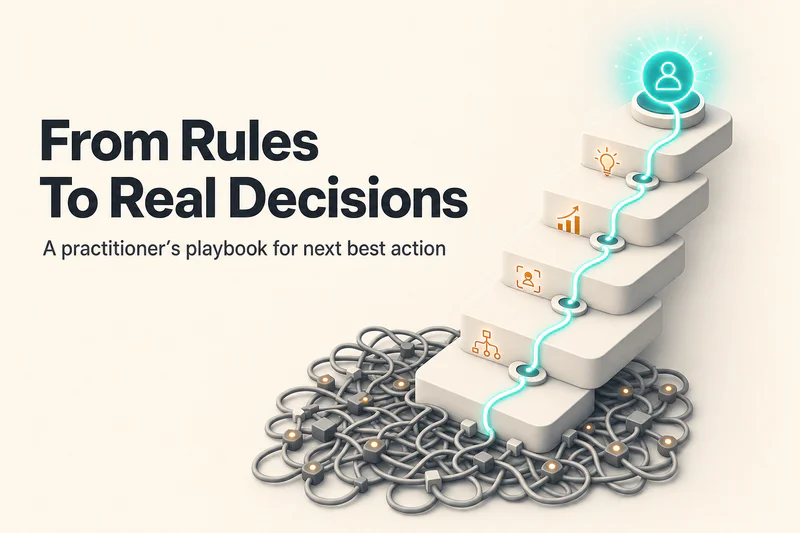
This is a practitioner's playbook, not a definition. It is the order of operations that actually works: one painful decision, hand-written rules, a measured outcome, then scoring, then state. Most teams skip that order. They buy a model, point it at messy data, and wonder why the recommendations feel random. So let us walk the ramp the way a working team should climb it.
What is AI decisioning, and where does next best action fit?
Automation follows a script. Decisioning makes a choice.
That is the whole distinction, and it is worth sitting with. Automation records a trigger and fires a pre-written response. AI decisioning weighs the options for a specific person at a specific moment and picks the one with the highest expected payoff. Next best action is the output of that choice: the single most valuable thing to do next, whether that is a message, an offer, a human handoff, or a deliberate pause.
The word "single" matters. Two or three sharp recommendations beat a long menu every time. A next best action engine is not a suggestion firehose. It is a decision.
For the concept in full, our team has written the next best action engine deep-dive, a companion piece on AI decisioning and autonomous agent coordination, and a walkthrough of real-time AI decisioning across the customer journey. This playbook assumes you already believe in the idea. Now you want to ship it.
Decide on meaning, not menus.
Why do most next-best-action rollouts stall?
Picture the first version most teams build. A wall of if-then rules. "If cart abandoned, send discount." "If demo booked, send prep email." It works on day one. It rots by day ninety.
Call it The Rules Ceiling. Every new edge case is another branch. The tree grows faster than anyone can prune it. Soon nobody remembers why rule forty-seven exists, and no one dares delete it. The logic hardens into debt.
Here is the trap underneath the ceiling. Static rules cannot tell the difference between Meera at 11:40 pm and a browser who wandered in by accident. Both "abandoned a cart." One is ready to buy. One is gone. The rule treats them the same because a rule only sees the event, never the intent behind it.
Teams that rush past this stall for a second reason. They bolt an AI model onto dirty recommendation logic and end up debugging two problems at once: a model that misfires and rules that already made no sense. Fix the logic first. Score second.
The rollout does not fail because the technology is weak. It fails because the sequence is wrong.
What does a next-best-action decision loop actually look like?
Strip away the branding and every serious decisioning system runs the same loop. Learn it once and you can evaluate any vendor on earth.
The seven steps of the decision loop
- Perceive. Take in the signals: clicks, chats, forms, calls, plus the meaning inside them.
- Propose. Generate the candidate actions that are eligible right now.
- Score. Rank each candidate by expected business outcome, subject to policy and cost.
- Decide. Pick the one action, or choose to wait.
- Act. Execute it in the right channel, at the right time.
- Observe. Watch what happened. Did she reply? Did she convert?
- Learn. Feed the outcome back so the next decision is sharper.
That is the engine. Perceive, propose, score, decide, act, observe, learn. Notice that "decide to wait" is a first-class action. A restless system that pings every lead every hour is not intelligent. It is anxious.
When you evaluate a tool, ask it to show you all seven steps. Most products are strong at Act and thin at Perceive and Learn. They can send. They cannot understand or improve. That gap is where next best action quietly becomes next best guess.
How do you get started with AI decisioning? The five-step ramp
You do not launch a decisioning brain on a Monday. You climb to it. Here is the crawl-walk-run ramp that keeps rollouts under four weeks instead of four quarters.
- Pick one decision that hurts. Not the whole journey. One moment. Abandoned checkout, stalled trial, a re-engagement window. A narrow decision with a clear outcome is easy to measure and hard to argue with.
- Write the rules by hand. Yes, rules. Encode the obvious eligibility logic and the guardrails you would never break. This is your baseline. You cannot prove a model is smart until you know what "dumb but correct" looks like.
- Instrument the outcome. Decide, before you automate anything, what success means. Reply rate. Booked demos. Completed onboarding. If you cannot measure the action, you cannot improve it, and you certainly cannot defend it to finance.
- Layer in scoring. Once real interactions accumulate, let a model rank the candidates the rules made eligible. Rules decide what is allowed. Scoring decides what is best. Keep the guardrails. Add the judgment.
- Give it state. This is the step that separates a clever campaign from real decisioning. Connect the decision to a running memory of the customer across every channel and session. Now the system knows Meera asked about the CRM last night. The next action answers her, instead of restarting the welcome tour.
Start small. Score later.
Skip a step and you feel it. Jump straight to a model and you get The Rules Ceiling with extra math. Skip the outcome instrumentation and you can never tell whether the AI helped or just looked busy.
What signals should feed your next best action?
Most systems are built click-first. They watch what a customer tapped. They miss what she meant.
Call it The Meaning Gap. A click tells you a page loaded. It does not tell you the visitor was frustrated, ready, price-shopping, or about to churn. Two customers can take the exact same path through your site for opposite reasons. Decisioning that only reads clicks will confidently serve the wrong action to one of them.
The fix is to feed the loop richer fuel. The strongest inputs are qualitative.
The four inputs that sharpen a decision
- Intent. What is she actually trying to do?
- Urgency. Does this need to happen now or next week?
- Sentiment. Is the mood curious, annoyed, or hesitant?
- History. What has already been said across chat, email, and call?
This is where a Conversation Graph earns its place. It holds one timeline per customer that includes the events and the meaning behind them. Workflows react to intent, not just to triggers. An agent opens a thread already knowing the full story. The decision improves because the perception improved.
Garbage in, guesswork out. Feed the loop meaning and the next best action stops guessing.
Read the intent, not just the impression.
How do you measure whether next-best-action is working?
Here is the honest test. Turn the system off for a slice of your audience and watch the gap.
Prove the lift with a holdout
A holdout group is the only measurement that survives a skeptical CFO. Everything else is a story. With a holdout, you can point to a number: this cohort saw AI-chosen actions, that one saw business as usual, and the difference is the value.
Watch three things. Acceptance: did the customer take the recommended action? Outcome: did it move the metric you chose in step three, the reply, the booking, the completed onboarding? Effort: how much manual work did the team stop doing? Teams that instrument all three consistently report the pattern we see across deployments: roughly forty percent more conversion from inbound demand, up to eighty percent less manual follow-up, and response times under three seconds.
One caution. Do not optimize a single action to death while the journey leaks elsewhere. Next best action is a system property. A brilliant email that lands after a two-day silence is not brilliant.
Measure the lift, not the activity.
Do you need to rebuild your data stack to get started?
No. This is the myth that keeps teams stuck for a year.
The belief goes: "We cannot do next best action AI until we have unified all our data in one warehouse." So the project becomes a migration, and the decisioning never ships. Meanwhile the leads keep leaking.
Here is the more honest sequence. You do not need a customer data platform or a finished warehouse first. You need enough clean signal for one decision, not a perfect single source of truth for everything. Getting started with next best action means starting where the conversation already happens: your chat, your inbox, your WhatsApp thread. A decisioning layer that reads those live signals can act today, on top of the CRM you already trust, while the bigger data work continues in the background.
The rip-and-replace instinct is what turns a four-week win into a four-quarter platform project. Resist it. A decisioning layer earns the right to more data by proving value on the data you have.
Ship the decision. Grow the data.
Where does Zigment fit in your decisioning stack?
You do not need to rip out HubSpot or Salesforce to get started. That is the quiet relief in this whole exercise.
Zigment is a Revenue Orchestration Platform that sits on top of the stack you already run. Your CRM stays the system of record. Zigment adds the decisioning layer above it: it perceives conversational intent across WhatsApp, web chat, email, and social, scores the next best action, and orchestrates the follow-through, the agent, the handoff, the CRM update, the wait, without losing context as the conversation moves between tools.
The engine underneath is the Conversation Graph, our temporal knowledge graph that keeps one continuous timeline per customer. It is what lets the system remember Meera's CRM question at 11:40 pm and answer it at 8 am, instead of sending her step one for the fourth time. Teams like Tata Motors and Bajaj Auto run this loop in production, and rollout lands in under four weeks, not a rebuild.
Start with one painful decision. Prove the lift. Then let the loop widen.
Meera is still on your form at 11:40 pm. The question is simple. When she comes back tomorrow, does your system greet her like a stranger, or answer what she actually asked?