
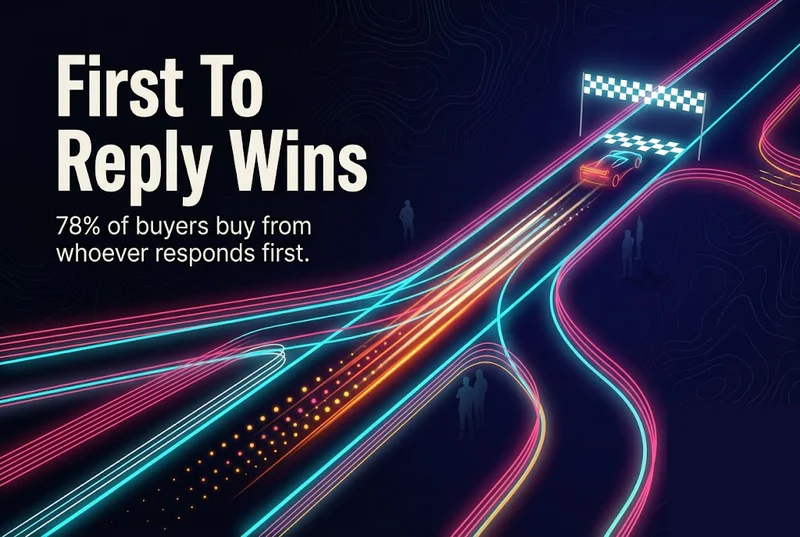
78% of car buyers purchase from the first dealership that responds to them. The average dealership takes 47 hours to follow up on an online lead. That gap is where revenue disappears.
AI for car dealerships is not a future-state technology. It is the operational layer that determines whether your BDC closes the weekend's leads or hands them to the competitor down the street. This guide walks through exactly how AI qualifies, routes, and converts automotive leads at scale, from the first website inquiry to the booked test drive.
What is AI for car dealerships? AI for car dealerships refers to software systems that automate lead qualification, follow-up, and scheduling across chat, SMS, and email channels. These systems engage inbound and outbound leads in real time, collect intent data through structured conversation flows, route qualified buyers to human reps, and book test drives without BDC staff involvement. They operate 24/7, respond in seconds rather than hours, and maintain conversation context across channels so no lead has to repeat themselves.
Why AI for Car Dealerships Is Now a Revenue Imperative
Automotive retail runs on volume and velocity. The economics are brutal: a dealership spends $600-$700 per online lead generated through paid search and third-party listings. Most of those leads go cold before anyone picks up the phone.
Three forces have made this a structural problem, not a staffing one.
First, the response-time window has collapsed. Research from Kixie and GreetNow shows that responding within 5 minutes makes a dealership 21 times more likely to qualify a lead compared to waiting 30 minutes. Sub-60-second response lifts close rates by 391%. Yet Fullpath's 2023 report found the average dealership response time sits at 47 hours.
Second, buyer behavior has shifted. Shoppers complete 70% of their purchase research online before contacting a dealership. When they do reach out, they expect a near-instant response. If they don't get one, they move to the next tab.
Third, BDC staffing has not kept pace. Turnover in automotive BDC roles runs above 60% annually. Hiring and training reps to cover every shift, every channel, and every overnight lead is not a scalable answer.
The structural gap: AI for car dealerships fills that gap structurally. It does not replace BDC reps. It ensures no lead waits more than 60 seconds for a first contact, regardless of time or volume.
See how AI closes the funnel gap.
What a 47-Hour Lead Response Time Costs Dealerships
47 hours is not a performance problem. It is a revenue model problem.
Here is what that number means in practice. A shopper submits a lead form on Saturday evening for a used SUV. The BDC is closed. Monday morning arrives. A rep calls. The shopper bought elsewhere Sunday afternoon. The dealer never had a chance.
The math compounds quickly. If a dealership generates 300 internet leads per month with a 4% close rate, that is 12 sales. Demand Local's research shows that 78% of buyers purchase from the first responder. Responding within 5 minutes vs. 30 minutes multiplies lead qualification rates by 21x.
Even a modest improvement in response speed translates to several additional sales per month at average gross profit. The problem is not individual rep effort. The funnel structure itself creates the delay.
Form leads arrive in a CRM queue. Reps work the queue in business hours. After-hours leads age until morning. Leads from channels like website chat or Facebook Messenger often never hit the queue at all.
The fix is structural: AI for car dealerships solves the structural delay. Leads are engaged in seconds rather than hours. Intent is captured before the shopper goes cold.
This same pattern plays out across industries, but the lead conversion problem is nowhere more financially visible than in automotive retail, where a single lost deal represents thousands in gross.

How Does AI Lead Qualification Work at the Dealership Level?
The qualification flow for an automotive lead looks different from a B2B SaaS pipeline. The conversation is shorter. The buyer signals are specific. And the call to action is always the same: book a test drive or schedule a call with a sales rep.
Here is the step-by-step flow a well-built AI qualification system runs:
Instant first contact. Within 60 seconds of a form submission or chat open, the AI sends a personalized message acknowledging the specific vehicle inquiry. Not a generic "thanks for reaching out." Something like "Hi Sarah, I saw you were looking at the 2024 Civic Sport in blue. Is that still on your radar?"
Intent capture. The AI asks 3-4 structured questions over the course of the conversation: Is this vehicle still available? What timeline are you working with? Are you financing, leasing, or paying cash? Do you have a trade-in? Each answer routes the conversation and flags the lead's readiness level.
Objection handling. If the shopper says the vehicle sold, the AI presents two alternatives from current inventory. If the lead is early-stage ("just looking"), it offers a no-pressure test drive or a 48-hour price hold.
Qualification scoring. Based on the answers collected, the AI assigns a lead score. Hot leads (ready to buy, has financing, wants a specific VIN) go immediately to a rep with full conversation context. Warm leads get a follow-up sequence. Cold leads enter a nurture track.
CRM sync. Every conversation, score, and data point syncs to the dealer's CRM in real time so reps walk into every call already knowing the buyer's situation.
This is closer to what scoring leads from conversation data looks like at the infrastructure level. The insight does not come from the form. It comes from the exchange.
From First Message to Booked Test Drive: The Full Qualification-to-Scheduling Flow
Getting a lead qualified is half the work. The other half is converting that qualification into a calendar booking before the shopper changes their mind. This is where AI for car dealerships earns its keep, by closing the loop inside the same conversation.
Only 16% of dealerships currently use AI for test drive scheduling, yet 66% of shoppers say they prefer to schedule their visit immediately rather than waiting for a callback. That mismatch creates obvious friction.
How scheduling closes the loop: Once the AI identifies a hot or warm lead, it transitions directly into availability. "I can see we have two open slots tomorrow at 11am and 3pm, or Saturday morning. Which works better for you?" The shopper picks a time. The system pushes the appointment to the dealership's scheduling tool. The rep receives a notification with the full conversation history.
The AI then sends a confirmation text with the vehicle details, the rep's name, and directions to the lot. A reminder fires 24 hours before the appointment and again 2 hours before.
Dealers using this model with Impel AI have reported 27% more showroom appointments and 26% higher lead-to-sale conversion versus their pre-AI baseline. Those numbers reflect the same structural reality: most dealerships are not losing leads because the vehicles are wrong. They are losing leads because the follow-up process is too slow.

After-Hours Leads: Where Overnight Response Gaps Cost Deals
Consider where automotive lead volume actually concentrates. Evening hours (7pm-10pm) and weekends account for the majority of online vehicle research activity. These are the windows when shoppers are off work, browsing inventory, and ready to engage. They are also the windows when no BDC rep is available.
The after-hours problem is not new. What has changed is the cost of ignoring it.
Always-on coverage: An AI BDC for car dealerships operates identically at 11pm on a Sunday as it does at 9am on a Monday. A shopper browsing inventory at 9:45pm submits a lead form. The AI responds in under 60 seconds. By the time a human rep arrives Monday morning, the lead has been qualified, scored, and in some cases, already booked for a test drive.
This is the same principle that conversational AI built for omnichannel systems addresses: the intelligence layer has to be always-on, not shift-dependent.
Dealership groups that run AI for car dealerships 24/7 report recovering a meaningful portion of previously lost after-hours volume. One common finding: 30-40% of incoming leads arrive outside business hours. Without an AI layer, most of those go cold.
Recover the overnight leads your BDC currently misses.

BDC vs. AI vs. Sales Floor: Which Lead-Routing Model Converts?
This question comes up in every dealership that considers deploying AI. The short answer: it is not a choice between models. It is about sequencing them correctly.
What each model does well
A traditional BDC excels at relationship-building calls, complex trade-in conversations, and high-value deals where a human touch matters. Sales floor reps excel at in-person engagement once the customer is on the lot.
AI BDC excels at first contact, qualification, after-hours coverage, and high-volume follow-up. It has no quota pressure, no shift constraints, and no inconsistency across reps.
The winning sequence: The lead-routing model that converts best looks like this: AI handles first contact and qualification for all incoming leads, 24/7. Qualified hot leads transfer to BDC reps with full context for a closing call. BDC reps focus their time on the leads that are actually ready to buy, not on re-qualifying cold inquiries.
This is what the human-in-the-loop model looks like in practice: AI does the volume work, humans close the deal.
Cox Automotive's 2025 Dealer Survey found 81% of US dealers plan to increase AI investment in 2025. The majority cite lead handling and follow-up as the primary use case. That signals a real shift in how dealers think about staffing versus systems.
The Warm Handoff: Preserving Conversation Context When AI Passes to a Human Rep
The warm handoff is where most AI systems break down. The AI qualifies a lead. A rep picks up the phone. The first words out of the rep's mouth: "Can you tell me which vehicle you were looking at?"
The shopper has already answered this question. They feel like they are starting over. The trust built during the AI conversation evaporates.
What a real handoff looks like: A proper warm handoff requires the AI to pass the full conversation context to the rep before the call happens. The rep's CRM view should show every question the AI asked, every answer the shopper gave, their lead score, their preferred vehicle, their timeline, and their trade-in status. The call starts with information, not discovery.
This is what stateful conversation architecture enables. The system does not forget. Every interaction, regardless of channel or time of day, builds on the last one.
Practically, this means the AI needs to write structured data back to the CRM, not just a free-text note. When the rep opens the record, they see a qualification summary, not a conversation transcript they have to read.
Done well, the warm handoff feels to the buyer like continuity. Done poorly, it is the moment they disengage.
How Do You Scale AI Across Multiple Rooftops and Dealer Groups?
Single-point deployments are relatively straightforward. The challenge for dealer groups with 5, 15, or 50 rooftops is maintaining consistency while preserving per-store inventory and staffing context.
The architecture question is: does the AI run as a single instance with store-level rules, or as separate instances per rooftop?
Single-instance wins at scale: Single-instance models with store-level configuration work better. They allow group-level reporting, unified lead scoring logic, and centralized compliance management across every location. Individual stores can have their own inventory feeds, their own rep routing, and their own appointment calendars while sharing the same AI qualification logic and conversation templates.
The operational dividend at scale is significant. Cox Automotive's data shows AI adopters averaging 30-50% reduction in BDC labor costs per lead while maintaining or improving qualification rates. For a dealer group processing thousands of leads per month across multiple stores, that is a structural cost advantage.
AI for car dealerships at the dealer group level also enables benchmarking across stores. Which rooftop has the highest lead-to-appointment rate? Which inventory segment generates the most qualified leads? That data is unavailable when qualification happens through individual rep activity in siloed CRM records.
How Zigment Applies to Automotive Lead Orchestration
The scenarios above describe the outcome. The Conversation Graph is the infrastructure behind them.
Zigment's Conversation Graph is the stateful layer that connects every touchpoint in a buyer's journey. When a shopper submits a form, opens a chat, responds to a text, and then calls the store, the Graph treats those as one continuous conversation rather than four disconnected events. It captures intent, urgency, and qualification signals over time. It routes, qualifies, and hands off based on real-time state, not static rules.
For automotive GTM teams, this means AI for car dealerships is not a separate tool bolted onto the CRM. It sits on top of your existing HubSpot or Salesforce stack, reads the data already there, and orchestrates the follow-up that the CRM alone cannot execute.
Zigment customers across high-velocity verticals have seen up to 40% higher conversions and 3x ROI attributed directly to improved lead response and qualification workflows. Up to 80% reduction in manual follow-up effort is achievable once AI agents absorb the first-contact and nurture layers.
The Conversation Graph does not replace your BDC. It makes every hour your BDC works more productive by handing them leads that are already qualified, already warmed, and already scheduled.
The Question Worth Asking Your Current Setup
47 hours is the industry average for lead response. What is yours?
If the answer requires checking a report, running a query, or asking your BDC manager, the answer is probably too high. The dealerships closing AI-native competitors are the ones where that number is measured in seconds, not hours. The technology behind AI for car dealerships exists today. The ROI math is documented. The remaining question is whether the current setup, with its overnight gaps and rep-dependent follow-up, is the one you want to run for the next five years.