
TL;DR
There is no single best customer engagement platform. The category splits by job, so the article maps ten tools to the work they were built for. Braze, MoEngage, Insider, and CleverTap for consumer lifecycle and mobile retention, Zendesk and Intercom for support, Klaviyo for ecommerce, HubSpot and ActiveCampaign for all-in-one, Sprinklr for enterprise CX.
It compares them on the things that matter, core channels, pricing model, real-time versus batch, AI and autonomy, and approximate G2 rating, rather than the omnichannel channel count every vendor leads with.
The shared blind spot is what the article calls the intelligence axis. Most platforms send and store but skip memory, autonomy, and real-time decisioning, so they speak at a customer instead of conversing with her.
Choose for your hardest problem, not the feature grid. Zigment sits in a separate category as a Conversational Revenue Orchestration layer on top of your CRM, holding live conversation state in a Conversation Graph so it answers, qualifies, and decides the next step in the moment.
Priya opened the app on a Tuesday and was greeted like a stranger she had been seeing for months.
She had churned three weeks earlier. Cancelled, gave a reason, closed the tab. And yet here came the messages, perfectly timed, beautifully designed, firing on a schedule somebody had set with real care. A win-back nudge. A "we miss you" coupon. A push notification celebrating a streak she no longer had. Every one of them landed. Every one of them was wrong.
The platform sending them was not broken. It was doing exactly what it was built to do. It just did not remember the one conversation that mattered.
That gap is the whole story of customer engagement in 2026. Brands have never had more channels, more triggers, more ways to reach a person. What they keep losing is the thread.
A small thing to fix. A large thing to ignore.
When did "engagement" come to mean message volume?
Somewhere along the way, engagement stopped meaning a relationship and started meaning throughput.
The dashboards taught us this. They counted sends, opens, clicks, push delivery rates, the green-arrow vanity of a campaign that "performed." More messages looked like more engagement, so teams optimized for more messages. Add a channel, add a cadence, add a flow. The number went up and everyone felt busy.
But volume is not understanding. A platform that fires a hundred well-timed messages at a customer it does not comprehend is not engaging that customer. It is talking at her with excellent production values.
Real engagement is the opposite motion. It listens, it remembers what was said, it changes what it does next because of what it just learned. That is a different machine entirely, and most of the category was never built to be it.
We mistook reach for relationship. The bill comes due as churn.
Stop counting sends. Start counting whether anyone listened back.
What is a customer engagement platform?
A customer engagement platform is software that helps a business communicate with customers across multiple channels, email, SMS, push, in-app, WhatsApp, and chat, from a single system, using customer data and behavior to time and personalize each message. It centralizes the data, the segmentation, and the delivery so a brand can run coordinated campaigns and lifecycle journeys at scale instead of bolting together disconnected tools.
That definition is accurate. It is also where the trouble begins, because almost every platform reads it as a delivery problem and almost no buyer needs only delivery.
Is the channel count actually the trap every vendor sells?
Walk into any demo and count how fast someone says the word omnichannel.
The pitch is always the same shape. Email and SMS and push and in-app and WhatsApp and RCS and web and a webhook for whatever comes next. More channels, more surfaces, more places to be present. It sounds like power. It photographs beautifully in a feature grid.
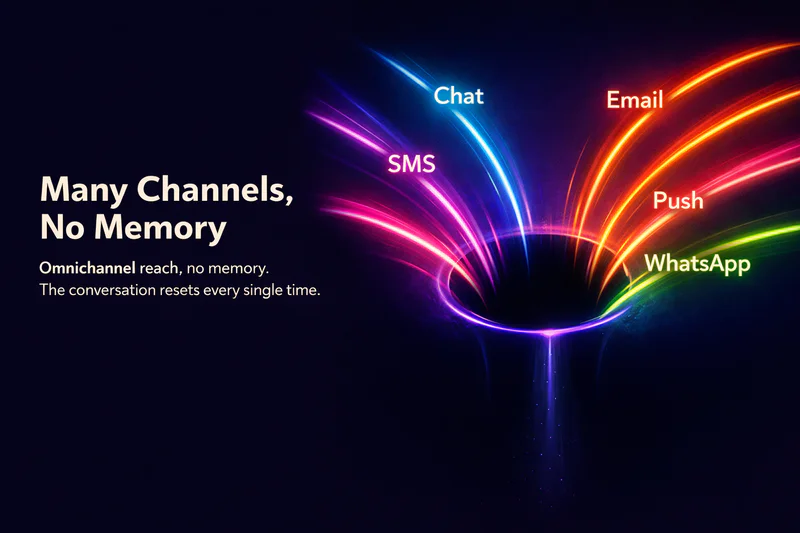
Here is the part the grid hides. Adding a channel adds a place to broadcast. It does not add a brain. Ten channels with no memory between them is one forgetful conversation, repeated ten times in ten different fonts. The customer experiences it as noise that follows them around the internet.
Channel breadth is table stakes now. Every serious vendor on this list has it. So breadth tells you almost nothing about which platform will actually move your numbers, because the hard part was never reaching the customer. The hard part is knowing what to say when you do, and remembering it next time.
The channel count is a distraction dressed as a capability.
Count the intelligence, not the icons.
So which are the best customer engagement platforms in 2026?
The major players at a glance
The honest answer is that the best customer engagement platform depends on what you are actually trying to do, and the category quietly splits into camps that get lumped together on every listicle.
Some are lifecycle marketing engines built to orchestrate email and push at consumer scale. Some are support-led platforms where engagement means resolving a ticket or a live chat. Some are ecommerce-native, wired tight to a store and its revenue. Some are sprawling experience suites that try to hold social, service, and marketing in one place. Each is genuinely excellent at the job it was designed for. Each gets stretched thin the moment a buyer asks it to be the others.
So read the table as a map of strengths, not a leaderboard. The ratings below are directional, drawn from the broad consensus on public review sites rather than a single decimal anyone should treat as gospel.
One row on that table is not like the others. Zigment runs customer engagement agents across the same channels, so it belongs in the conversation, but it is more than an engagement platform. It is a Conversational Revenue Orchestration layer that sits on top of HubSpot and Salesforce and holds one memory of every conversation in a Conversation Graph, which is the intelligence axis the rest of the list skips.
Braze is the engine a consumer brand reaches for when lifecycle messaging has to run at enormous volume without falling over. MoEngage earns its following on insight, the way it turns behavior into segments a marketer can actually act on, with particular strength across B2C in growth markets. Insider has built a reputation on cross-channel personalization that feels coordinated rather than stitched. Sprinklr is the wide-angle lens, holding social, service, and marketing together for enterprises that need one pane of glass across a sprawling customer presence.
Zendesk and Intercom approach engagement from the support side of the house, and both are very good there. Zendesk is the steady backbone for ticketing and omnichannel service. Intercom lives inside the product, where in-app conversations and its Fin agent resolve questions before they become churn. ActiveCampaign gives smaller teams marketing automation that punches well above its price. Klaviyo is close to default for ecommerce, wired so tightly to store data that email and SMS feel like extensions of the storefront. HubSpot remains the all-in-one a growing company adopts to keep marketing, sales, and service speaking the same language. CleverTap anchors the mobile-first camp, built for retention and engagement where the app is the relationship.
Every one of these is a good product. None of them is wrong. The question is what they share, and what they all leave on the table.
Pick the one whose best day matches your hardest problem.
What is the intelligence axis they all skip?
Line them up and the differences look enormous. Step back and a strange sameness appears.
Almost all of them treat a message as an event that fires and ends. A trigger trips, a campaign goes out, a flow advances a step. What happens inside the customer, the reply, the hesitation, the half-finished question at 11pm, mostly falls outside the system or gets logged as a data point for the next batch. The platform speaks. It does not converse.
Three capabilities sit on that missing axis, and they are the ones that actually decide whether engagement works.
Memory. Whether the system holds the state of an individual conversation over time, so the next message knows what the last exchange revealed. Most platforms remember attributes and events. Far fewer remember the thread.
Autonomy. Whether the system can act on its own inside a live exchange, ask a clarifying question, qualify, reschedule, answer, rather than only firing pre-set steps and waiting for a human or a click.
Real-time decisioning. Whether the next move is decided in the moment, against everything known a second ago, instead of being baked into a flow somebody drew last quarter.
This is the difference between a platform that records the customer and one that understands her. Recording is solved. Understanding is the frontier nobody put on the feature grid, because it does not fit in a checkbox.
A system that cannot reply cannot truly engage.
See the difference between sending and answering.
Why treat engagement as a layer on top of HubSpot and Salesforce, not a rip-and-replace?
The instinct, when the numbers disappoint, is to tear it all out and start again.
That instinct is expensive and usually wrong. The CRM is not the problem. HubSpot, Salesforce, the marketing suite you already run, they hold your data and your system of record, and ripping them out to chase a smarter conversation means a year-long migration that solves nothing about intelligence. The data was never the gap. The conversation on top of it was.
This is where Zigment sits, and it is a deliberately different category from everything in that table. Zigment is a Conversational Revenue Orchestration Platform, an orchestration layer that runs on top of the CRM and engagement stack you already own. The platforms above send and store. Zigment converses, remembers, and decides, then writes the result back to the systems you already trust.
The mechanism is the Conversation Graph, which holds the live state of every conversation. A lead replies at midnight with a half-formed question and the system answers, qualifies, books, and updates the record, because it remembers the thread instead of treating each touch as a cold event. That is agentic orchestration rather than scheduled messaging. The campaign-centric world waits for the next batch. The conversation-centric one acts now.
The proof is in outcomes, not adjectives. Teams running Zigment on top of their existing stack have seen more than 3x ROI, conversion rates climbing toward 40 percent, and up to 80 percent less manual effort as the system handles the back-and-forth that used to sit in a rep's inbox. Bajaj, Tata, and Nova IVF did not replace their engagement platforms to get there. They added the layer that finally remembered the customer.
Do not rebuild the stack. Teach it to listen.
How should you actually choose?
Start from the problem you lose sleep over, not the feature you saw in a demo.
If your job is high-volume consumer lifecycle messaging, the marketing engines on that list will serve you well, and you should weigh deliverability, scale, and how cleanly they handle your channel mix. If engagement means support and resolution, the support-led platforms are the right home. If you live and die by a store, the ecommerce-native tools will feel like they were made for you, because they were.
Then ask the harder question the table cannot answer for you. When a customer replies, what happens? Does the conversation get remembered, or does it reset to a stranger on the next touch? Can the system act in the moment, or only wait for the next scheduled step? If the honest answer is that your stack sends beautifully and listens poorly, you do not need a different sender. You need a layer that converses on top of the one you have.
And keep the words straight, because most buyers cannot tell engagement, orchestration, and messaging apart, and vendors are happy to keep it that way. A messaging tool moves a message. An engagement platform coordinates many of them across channels. An orchestration layer decides what to do next based on a conversation it actually remembers. They are not the same purchase, and confusing them is how teams end up with ten channels and zero memory.
For the adjacent decisions, two of these come up constantly. If your shortlist centers on consumer lifecycle, see our breakdown of Braze alternatives in 2026. If you are weighing mobile-first retention, the CleverTap alternatives guide goes deeper. And if your real problem is sequencing the whole journey rather than picking a sender, the top journey orchestration platforms in 2026 covers that adjacent category.
Choose for the conversation, not the feature grid.
Priya is still out there, by the way, getting messages from a brand that forgot her. The platform that sends them is excellent. It was simply never asked to remember.
So the next time a vendor shows you another channel, ask the only question that matters. When she finally replies, will anything be listening?