
TL;DR
Braze and Iterable are both strong customer engagement platforms, so the real choice is operating model rather than a feature winner. Braze is engineer-first with real-time segment refresh, SQL-grade depth, and production-proven AI. Iterable is marketer-first with a no-code journey canvas, faster time-to-value, and a newer Nova agentic layer launched around April 2026.
Pick Braze if you have engineering support, global channels like RCS and LINE, and real-time AI as a strategic must. Pick Iterable if a lean marketing team needs to ship journeys this quarter without a developer queue.
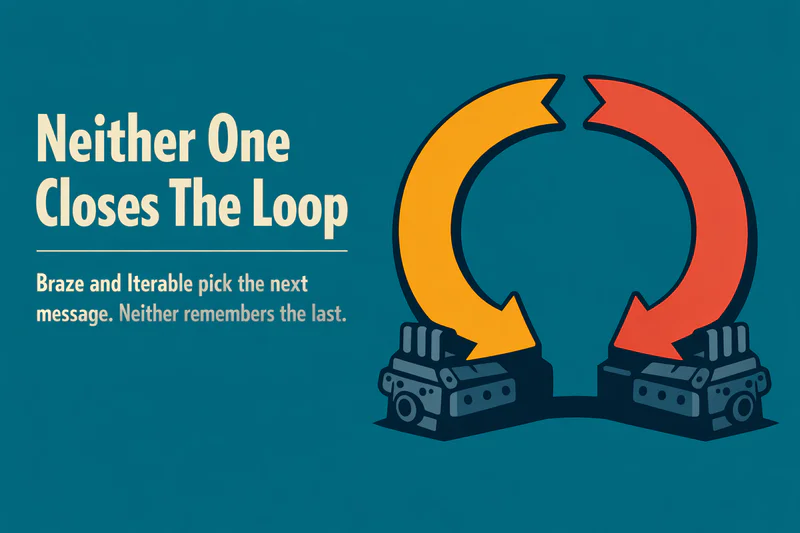
Neither one actually closes the loop. Both only decide which message to send next, and a branching journey is still a one-way flowchart. Across an email, an SMS reply, and an in-app question, the thread resets every time because the funnel has no memory.
Closing the loop is a memory problem, not a messaging problem. Zigment sits on top of these tools as an orchestration layer, and its Conversation Graph holds conversation state across every channel so each touch knows what came before.
Maya runs RevOps at a Series C fintech. It is 4 p.m. on a Thursday and she has just sat through her second vendor demo of the day.
Both were beautiful!
The Braze rep showed real-time segments refreshing on stage, two years of behavioral data sliced six ways, an AI model nudging send-times by the minute. The Iterable rep, an hour earlier, dragged a customer journey across a canvas in ninety seconds flat and never once opened a code editor. Two strong platforms. Two confident pitches. Maya wrote one line in her notes after both: "Neither one answered the actual question."
That is the Tie-Breaker Trap. You stack two good tools beside each other, hunt for the feature that breaks the tie, and never notice that both are answering a question you stopped asking three quarters ago.
This is the most expensive blind spot in a platform search. So before you score another feature matrix, let's reframe what you are actually choosing between.
A customer engagement platform is software that unifies behavioral data and sends coordinated messages across email, push, SMS, and in-app, triggered by what a user does. Braze and Iterable are two of the strongest. Braze is the deeper real-time data and AI engine with a steeper learning curve. Iterable is the faster, more marketer-friendly, email-strong platform with shallower decisioning. Neither is a bad tool. That is exactly why the choice is hard.
See the difference in framing? The question is not which one is better. The question is which operating model is yours.
Map your team before you map the features.
What Are You Actually Choosing Between?
Start with the category, because the category is where most of these searches go wrong.
Both Braze and Iterable belong to the same shelf: the customer engagement platform. Both ingest events, build segments, and fire multi-channel campaigns off user behavior. Both are trusted by serious brands. Neither one is the villain in this story, and any comparison that paints one as a disaster is selling you something.
Here is the honest split. Braze leans engineer-first. It rewards teams that want depth, real-time control, and a data model they can push hard. Iterable leans marketer-first. It rewards teams that want speed, a visual canvas, and a person in marketing who can ship a journey without filing a developer ticket.
One platform optimizes for control. The other optimizes for autonomy.
That single contrast decides more deals than any feature on either roadmap. So the work is not to find a winner. The work is to find the mirror.
Know which kind of team you are.
Where Does Braze Pull Ahead?
Real-time orchestration at scale
Picture the moment a high-value user abandons a cart, and you have ninety seconds before the intent goes cold.
Braze is built for that ninety seconds. Its real-time segment refresh moves the moment data lands, not on the next batch cycle. Segmentation goes deep: nested conditions, SQL-grade logic, roughly two years of behavioral history to query against. You can ask hard questions of your data and get answers fast.
Then there is the AI. BrazeAI has been running in production deployments for years, handling channel choice, send-time tuning, and predictive churn at enterprise scale. This is not a preview. It is a track record!
The channel breadth runs wide too. Email, push, SMS, in-app, plus RCS, LINE, KakaoTalk, and Content Cards for brands operating across messy global markets. Liquid personalization gives you near-infinite control over every message. Attribution is mature. There are 180-plus integrations. It scales to the largest brands without flinching.
Think of Devon, a lifecycle lead at a global gaming brand. He needs a win-back flow that fires only for players who spent over a threshold last quarter, churned for fourteen days, and sit in a market where RCS beats SMS. In Braze, that is a single segment built once and refreshed live. The depth pays him back every day.
The catch is the curve. All that power asks for fluency. Liquid templating, API-driven data, complex segment logic. Hand Braze to a marketer with no technical support and the depth becomes a wall. Devon can wield it because he has a marketing engineer two desks over. Strip that support away and the same engine that rewarded him starts collecting tickets instead of shipping campaigns.
Braze gives you a deep engine. It also asks you to learn how to drive it.
Buy power only if you have hands to wield it.
Where Does Iterable Win the Room?
Now picture a different room. A marketer who needs a re-engagement journey live by Friday, with no developer on the calendar until next sprint.
Iterable wins that room.
Its no-code canvas is genuinely accessible. You drag a journey, branch it, and watch it as a visual flow that a marketing lead can read at a glance and edit without a ticket. Time-to-value is fast. Onboarding lands sooner. The email depth is real, and email-first lifecycle teams feel at home from week one. The analytics read more intuitively for a non-technical operator.
And the AI gap is closing. Iterable launched its Nova platform with an agentic AI agent around April 2026. That is a real and recent step toward goal-directed assistance inside the canvas, and it deserves an honest hearing. Where Braze brings years of production AI maturity, Iterable brings a newer, fast-moving agentic layer that is still expanding its surface area.
Watch the difference play out in a single Friday request. The Old Way: marketing files a ticket, the segment lands in next sprint, the campaign ships eleven days late into a window that already closed. The Better Way: the marketer opens the canvas, drags the branch, sets the entry rule, and the journey is live before lunch. Same goal. One path waits on engineering. The other does not.
Iterable removes the engineering tax that Braze quietly charges. For a lean marketing org, that tax is the whole decision.
Braze hands the keys to engineering. Iterable hands them to marketing.
Choose the platform your team can actually run.
So Which One Wins?
Neither. Not as a blanket verdict, anyway. A blanket verdict is the Tie-Breaker Trap wearing a conclusion's clothes.
The honest answer comes by operating model, not by checklist.
If you run a large enterprise with engineering muscle, global channels, and real-time AI as a strategic must, Braze fits the operating model. If you run a leaner, email-strong, marketer-led team that needs to move this quarter without a developer queue, Iterable fits the operating model. Same shelf, two different teams.
Here is the side-by-side, so you can hold both honestly in one view.
Read that table as a mirror, not a scoreboard. The winner is the row labeled "operating model," and the answer is whichever line describes your team.
For a wider field of options beyond these two, our guide to Braze alternatives maps the broader category, and our breakdown of Iterable alternatives does the same from the other side.
Pick the mirror, not the trophy.
What Does Neither One Fix?
Now the turn Maya was circling at 4 p.m. without the words for it.
Both platforms are exceptional at one thing: deciding which message to send next. Braze decides with deeper data. Iterable decides with a friendlier canvas. But both are still deciding messages, and a message is a monologue.
Watch what happens to a real buyer. They open an email on Tuesday. They reply to an SMS on Thursday with a real question. They land in the in-app inbox on Monday and ask the same question again, slightly angrier. Across all three touches, the system remembers the events but not the conversation. The thread resets every time. Your channels have amnesia.
That is the Amnesiac Funnel. Branching journeys make it look intelligent, but the logic still runs one-way: trigger fires, message ships, next trigger waits. Even the smartest branch is still a broadcast that learned to fork. The buyer is trying to have a conversation. The platform is running a flowchart.
A journey is not a conversation. A flowchart that branches is still a flowchart.
This is the gap no engagement platform closes, because it is not a messaging problem. It is a memory problem. Decisioning is not the same as autonomous, goal-directed orchestration toward a revenue number, and a better message engine cannot become one by adding a node.
This is where Zigment sits, and it does not sit beside Braze or Iterable on the same shelf. It sits on top of them. Zigment is a Conversational Revenue Orchestration Platform, an orchestration layer above your engagement and CRM stack. Its Conversation Graph engine holds conversation state across every channel, so the SMS reply on Thursday knows about the email on Tuesday and the in-app question on Monday. One memory, many channels, persisting through the whole buying motion. It runs on top of HubSpot and Salesforce rather than replacing them.
The proof is in the revenue line, not the open rate. Brands running this orchestration layer have seen more than 3x ROI, conversion rates near 40 percent, and up to 80 percent less manual effort, with Bajaj, Tata, and Nova IVF among the names putting it to work.
You can read the deeper mechanics in our explainer on journey orchestration versus marketing automation, and in the Conversation Graph breakdown that walks through how conversation state actually persists.
Stop sending messages. Start holding conversations.
How Should You Actually Decide?
Forget the trophy. Run four questions, in order.
First, scale. Are you an enterprise with engineering capacity and global channel needs, or a leaner team that has to move without one? Enterprise complexity leans Braze. Lean velocity leans Iterable.
Second, real-time. Is sub-minute segment refresh and production AI decisioning a strategic requirement, or a nice-to-have you will rarely use at full depth? If it is core, Braze. If it is not, you are paying for an engine you will idle.
Third, marketer autonomy. Does your marketing team need to ship journeys without a developer queue, or do you have technical hands to support a deeper build? Autonomy leans Iterable. Support leans Braze.
Fourth, and this is the one the demos never ask: is your real problem choosing a better message engine at all, or is it that your funnel cannot remember a conversation across channels? If it is the first, pick the mirror above. If it is the second, no engagement platform on the shelf is your answer, and the orchestration layer is.
Three questions sort the two tools. The fourth tells you whether the tools were ever the question.
Answer the fourth question first.
Maya never did break the tie. She stopped trying.
At her next meeting she crossed out "Braze vs Iterable" and wrote one question underneath: can our funnel remember a conversation across channels? The two demos had answered everything except that. So which question is your search actually asking?