
CleverTap handles retention analytics well. It tracks mobile events, segments cohorts, and fires push notifications based on what users clicked. For mobile-first teams running engagement campaigns, it works. But as marketing automation evolves beyond click-based logic, the gaps become harder to ignore.
But here's what 638 G2 reviewers keep circling back to. The segmentation window caps at 30 days for real-time. And when your revenue operations span CRM workflows, WhatsApp conversations, and human handoffs, CleverTap's event-based model starts to feel like a ceiling.
If you're evaluating clevertap alternatives, this guide skips the vendor bias. We'll walk through 8 platforms, compare them across 10 dimensions, and help you match your actual gap to the right tool.
What Is CleverTap and Who Is It Built For?
CleverTap is a customer engagement and retention platform built for mobile-first product and growth teams. It ingests behavioral events (opens, clicks, purchases, custom events), builds real-time user segments, and triggers multichannel campaigns across push, email, SMS, in-app, and WhatsApp.
The platform scores 4.6 out of 5 on G2 across 638 reviews. Its strongest marks come in mobile app analytics, push notification management, and cohort-based retention tracking.
CleverTap's sweet spot is B2C companies with a mobile app at the center of their growth model. Think fintech, e-commerce, gaming, and media apps in India, Southeast Asia, and MENA.
Where CleverTap Genuinely Wins
Let's give honest credit.
Retention analytics depth. CleverTap's RFM analysis, cohort comparison, and funnel visualization are genuinely strong. Few platforms make it this easy to see a 7-day retention curve by acquisition source.
Mobile SDK quality. The native SDKs for iOS, Android, and React Native are mature. Event tracking setup is straightforward for engineering teams who've done it before.
APAC presence. For teams operating in India, MENA, and Southeast Asia, CleverTap offers local support, data residency options, and WhatsApp Business API integration that Western-first platforms don't match.
4 Signals You've Outgrown CleverTap
Not every team needs to switch. But these four patterns show up consistently across review sites and buyer conversations when a team is hitting the edges.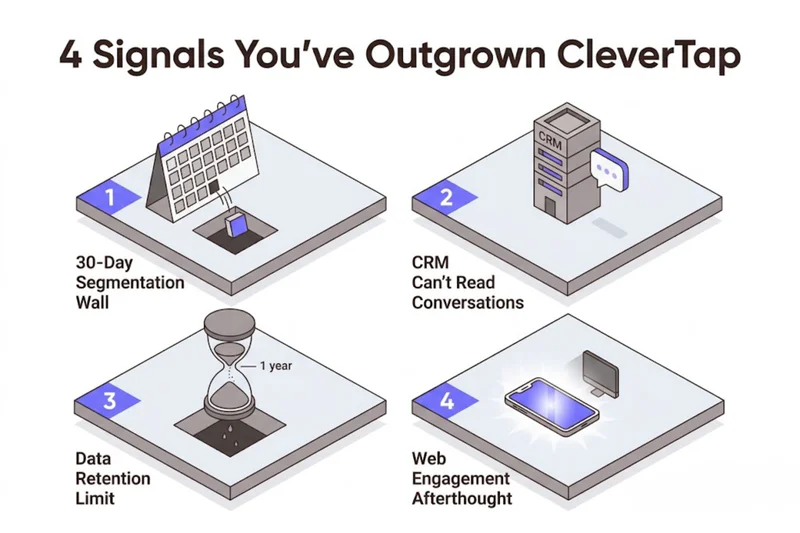
1. Your real-time segmentation has a 30-day wall.
CleverTap's real-time filter queries only work within a 30-day lookback. If you need to trigger a campaign based on what a user did 45 days ago, you're working outside the platform's real-time window. Analytics can look back further. Segmentation for action can't.
2. You need your CRM to respond to conversations, not clicks.
CleverTap's triggers are event-based. A user opened the app. A user clicked a button. That works for engagement campaigns. It doesn't work when the next best action depends on what someone said in a WhatsApp thread, what a sales rep promised on a call, or where a deal sits in your HubSpot pipeline.
3. Your data retention limit is showing.
CleverTap does not store data beyond a fixed retention period. Multiple users on TrustRadius and G2 report that historical data older than one year becomes inaccessible.
4. Your web engagement feels like an afterthought.
CleverTap's DNA is mobile events. Web personalization, on-site nudges, and cross-device journey stitching are areas where reviewers consistently rate competitors like Insider and MoEngage higher.
See how Zigment preserves full conversation history across channels →
8 CleverTap Alternatives Worth Evaluating
1. MoEngage
MoEngage is the closest head-to-head competitor. It's mobile-first, APAC-strong, and earned the Gartner Peer Insights Customers' Choice badge in 2026. Reviewers consistently rate its setup experience above CleverTap's. The AI-driven send-time optimization (Sherpa) is a genuine differentiator.
Best for: Mobile-first teams in APAC who want easier onboarding and stronger AI-based engagement timing.
Watch out for: Data retention limits (50-150 data points per user per month). Real-time segmentation window also capped at 30 days.
2. Braze
Braze is the enterprise standard for cross-channel engagement in the US and Europe. (We covered this in depth in our Braze alternatives guide.) Canvas (its journey builder) supports sophisticated branching logic. Reviewers call its mobile SDKs the gold standard. Content Cards give product teams an in-app content layer that most competitors lack.
Best for: Enterprise B2C teams with engineering resources.
Watch out for: Implementation requires developer support. The learning curve is real.
3. Iterable
Iterable wins on email. The drag-and-drop workflow builder makes complex lifecycle campaigns accessible to marketers without engineering support. The template system is mature, and the API handles high-volume sends reliably.
Best for: Marketing teams where email and lifecycle messaging drive the majority of engagement.
Watch out for: Segmentation complexity increases fast. Users report hidden fees for additional senders.
4. WebEngage
WebEngage targets retention and engagement for consumer brands in India and APAC. It offers a journey designer, cohort analytics, and multichannel campaign execution.
Best for: Indian and APAC companies looking for a full engagement stack.
Watch out for: Smaller engineering team means slower feature releases. International support outside India is limited.
5. Insider
Insider markets itself as a Growth Management Platform with heavy emphasis on AI-powered web personalization and predictive segments. The Sirius AI layer handles audience discovery, content generation, and journey optimization.
Best for: E-commerce teams that need deep web personalization alongside mobile engagement.
Watch out for: The breadth of features means depth suffers in specific areas. CRM integration complexity is a recurring reviewer complaint.
6. Customer.io
Customer.io is built for product and engineering teams that want full control over their messaging logic. The API-first architecture supports event-triggered campaigns with branching logic.
Best for: Product-led growth teams with technical resources who want granular control.
Watch out for: No built-in mobile analytics. Push notification support exists but isn't the platform's strength.
7. OneSignal
OneSignal dominates the push notification space. The free tier covers up to 10,000 subscribers.
Best for: App-first teams where push notifications are the primary channel.
Watch out for: Limited journey orchestration. This is a channel tool, not a platform.
8. Zigment
Zigment approaches the problem from a different angle entirely. Instead of replacing your engagement stack, it sits on top of your existing HubSpot or Salesforce instance and orchestrates revenue actions based on conversational intent.
The core engine (Conversation Graph) maintains a single timeline per customer that includes messages, clicks, CRM state, and agent interactions. Workflows trigger based on what someone said and meant, not what button they pushed.
Best for:RevOps and growth teams running on HubSpot or Salesforce who need orchestration across conversations, CRM actions, and human handoffs.
Differentiator: Zigment doesn't compete with CleverTap on push or retention analytics. It fills the gap between engagement tools and revenue outcomes.
Book a walkthrough to see Zigment on your stack →
How Do These CleverTap Alternatives Compare?
Here's a 10-dimension comparison across the platforms that matter most for this decision.
The first four rows reveal the real split. CleverTap, MoEngage, Braze, and Iterable all operate on events. They watch what users do and react. Zigment operates on conversations. It understands what users say, maintains that context across systems, and orchestrates the next action accordingly.
These are different architectural decisions. One isn't better than the other in absolute terms. The question is which model matches your team's actual bottleneck. (For a deeper comparison across the category, see our journey orchestration platforms guide.)
Which CleverTap Alternative Should You Choose?
Stay with CleverTap if your growth depends on mobile app retention, your team runs primarily in APAC, your MAU count is under 50K, and your engagement campaigns are event-driven push and in-app messaging. CleverTap is genuinely strong here.
Choose MoEngage if you want a similar mobile-first stack with easier onboarding, better AI-driven timing, and you're OK with the same data retention trade-offs.
Choose Braze if you're an enterprise B2C operation with engineering resources and you need the most mature mobile SDKs and Content Cards in the market.
Choose Iterable if email and lifecycle messaging drive most of your revenue and you want marketer-friendly workflow tools without heavy engineering dependency.
Choose Zigment if your bottleneck isn't engagement. It's orchestration. Your leads come through WhatsApp and web chat. Your CRM needs to respond to conversations, not form fills. Your team spends hours routing leads, updating deal stages, and coordinating handoffs between AI agents and human reps. That's the gap Zigment fills.
See how Zigment orchestrates revenue on top of your existing stack →
When Retention Analytics Hit a Ceiling
Most teams evaluating clevertap alternatives start with a feature comparison. Which platform has better push delivery? Which one has smarter segmentation?
Those questions matter. But they miss the bigger shift happening across revenue operations.
The job has changed. Five years ago, growth teams needed engagement platforms that react to clicks. In 2026, they need orchestration layers that respond to conversations, coordinate across CRM and messaging tools, and trigger the right action without losing context.
CleverTap, MoEngage, Braze, and Iterable all solve the engagement problem well. They differ on geography and channel depth. But they share the same architectural assumption. User behavior is a sequence of events.
Zigment starts from a different assumption. Customer interactions are conversations with state, intent, and context that persists across time and systems. The Conversation Graph maintains one timeline per customer. Workflows trigger based on meaning. AI agents and human reps operate from the same context.
This isn't a replacement for CleverTap. Teams run both. CleverTap handles the mobile engagement layer. Zigment handles the revenue orchestration layer that sits above it.