
It is the Q3 review. Your CEO looks up from the slide. "We signed the agentic AI deal in January. Why are we still calling this a pilot?" You start to answer. Procurement mentions the SLA sheet. IT mentions the training data. Ops mentions the escalation queue nobody staffed. The room goes quiet in the way rooms go quiet when a leader realises the vendor sold a demo and left the operating manual blank.
That is the real fear. Not hallucinations, not model drift. The ninth-month pilot that never shipped. Knowing how to implement agentic AI in the enterprise is really about closing that gap on paper before you sign. Real timeline. Real SLA sheet. Real training plan.
Why "when will it be live" is the wrong first question
Every enterprise buyer opens the same way. They ask when it will be live. The vendor answers with a range. Six weeks if simple, twelve if complex. The room nods. The contract gets signed. Nine months later everyone is still calling it a pilot.
The evidence is not anecdotal. Gartner has projected more than 40% of agentic AI projects will be cancelled by the end of 2027, off a poll of over three thousand organisations. IDC has tracked roughly 88% of AI agent proofs-of-concept never reaching production. This is not a technology problem. It is a contracting problem.
"When will it be live" is a proxy for a harder question the buyer does not know how to ask yet. That question is who owns what, in which week, under what SLA, and where the human stays after go-live. A vendor who cannot answer that on one page is selling you a science project.
How to implement agentic AI in the enterprise, week by week
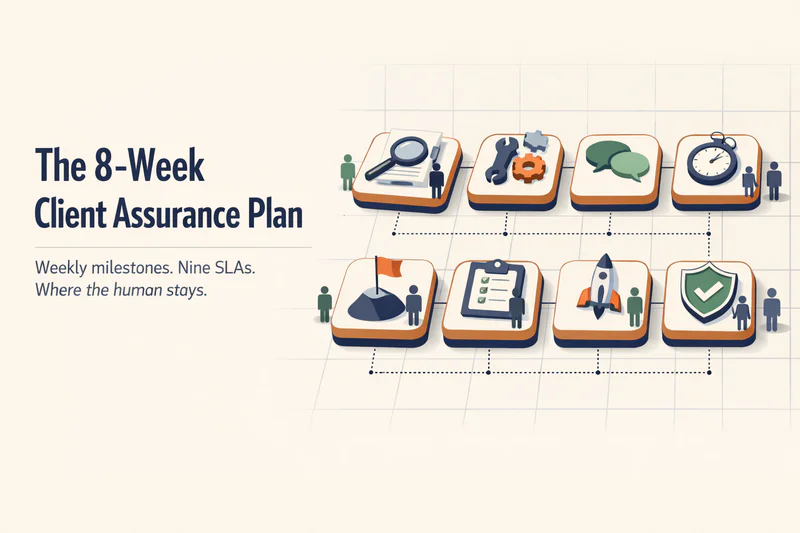
Here is the honest eight-week window a mature vendor should be willing to commit to in your MSA when you tell them you want to implement agentic AI in the enterprise properly, with named owners on both sides. Call it the Eight-Week Client Assurance Plan. Every week is a milestone the buying committee can point to.
Weeks 1 to 2. Discovery and data audit
The vendor's solutions engineer sits with your ops lead and your data owner. They inventory every source the agent will read from and write to. CRM, helpdesk, order system, product catalogue, knowledge base, past call transcripts. They map what leaves your tenant and what does not. Deliverable: a signed data-flow diagram and a shortlist of the first three intents.
Weeks 3 to 4. Build and train
The agent gets stood up in a sandbox. Retrieval indexes are built against your knowledge base. Tools are wired to your CRM and helpdesk. A pilot corpus of your real past conversations teaches the agent your language and your policies. Deliverable: a working agent in staging plus the first draft of the escalation matrix.
Weeks 5 to 6. Shadow mode
The agent runs beside your team on live traffic. It generates a response for every inbound conversation. Humans still answer. Every agent response is scored against what the human sent. Your CX lead reviews the diff every morning. Deliverable: a shadow-mode scorecard with accuracy, a containment estimate, and every escalation case.
Week 7. Pilot subset
A narrow slice of live traffic routes to the agent. Choose the slice by channel or intent, not by customer. Ten to fifteen percent is a common target. Humans monitor a review queue. Deliverable: the first real containment number and escalation SLA reading.
Week 8. Full launch, with a rollback
The agent takes the intents it earned. The rollback lever is a single flag change that returns traffic to humans within minutes. Your team gets a runbook. Your incident channel is wired. Deliverable: production status, a signed SLA sheet, and a scheduled thirty-day review.
Eight weeks is not the ceiling for every deployment. A voice agent on top of a mainframe will take longer. Eight weeks is the honest floor for a chat or messaging agent on a modern stack. Ada is one of the few vendors publicly committing to an eight-to-sixteen-week enterprise arc. Most keep the timeline inside the sales cycle. Ask why.
How does the agent actually get trained on your data?
Every serious plan to implement agentic AI in the enterprise runs into this question next. What does the agent see, when does it forget, where does the data live. Roughly 77% of failed agent deployments trace back to data quality, not to model choice.
Three training moves, and every serious agent uses some combination. Retrieval is the default. Your documents and past conversations sit in a vector index inside your tenant. The agent fetches the relevant chunk at each turn. Delete a document and the agent forgets it the next day. Prompt anchoring is the second move. Your policies, tone, and escalation rules are injected into the system prompt on every call. Change the policy in your admin console at 10 a.m. and the agent honours it at 10.01. Fine-tuning is the third, used sparingly, for domain language or tone. It changes the weights of a model instance dedicated to you, powerful and expensive to refresh.
A vendor who cannot draw this three-layer picture on a napkin has not thought about your compliance officer.
The next question is what leaves your tenant. Ask three sub-questions. Does the model provider see your raw data. Does the vendor's central retraining pipeline see your raw data. Where do the embeddings live. The right answer for most enterprises: nothing raw leaves the tenant, no central retraining pipeline touches your data without explicit opt-in, embeddings sit in a region named in the contract. Zero LLM retention is now baseline across the mature cohort.
One more piece. Refresh cadence. Your knowledge base changes every day. Your CRM schema changes every quarter. Ask the vendor how often the retrieval index rebuilds, how a broken document gets flagged, and how a policy update propagates. Nova IVF runs across eighty-eight locations, filters ninety percent of pre-sales inquiries, and answers in under thirty seconds. Possible only because the refresh loop was designed, not improvised.
What SLAs should you demand from an agentic AI vendor?
Enterprise buyers know how to read a SaaS SLA: uptime, response time, credits for breach. To implement agentic AI in the enterprise, you need a longer list. Nine numbers a mature vendor will commit to in writing.
- Uptime. Standard is 99.9%. Premier is 99.95% or 99.99%. Read the exclusions list before you sign. The denominator shifts more than the number.
- First-response latency. Chat under five seconds. Voice under five hundred milliseconds. Slower is a bad user experience masquerading as engineering constraint.
- Containment or deflection rate. The share of conversations the agent resolves without a human. Ask for the number they will commit to for your intents after week eight, not an industry average.
- Accuracy floor. A composite of policy adherence, factual correctness, and grounding. Ask how it is measured, who scores the samples, and what happens when a monthly reading falls below.
- Escalation SLA. When the agent hands off, how fast the handoff lands in a human queue and what context travels with it. Bajaj Allianz runs across twenty countries with context-preserving handoff because the SLA was contracted, not hoped for.
- Retraining cadence. How often the retrieval index rebuilds, how often fine-tuning refreshes, how a policy change reaches production. Weekly for retrieval is normal. Quarterly for fine-tuning is common.
- Model version pinning. A promise that the model powering your agent will not silently swap under you. Version changes arrive with a notice window and a regression test set.
- Drift detection SLA. How accuracy is monitored over time, how often the sampled review runs, how quickly you are told when accuracy dips below the floor.
- Incident notification and MTTR. Minutes to page your on-call. Mean-time-to-recover by severity. Under thirty minutes to page is the mature bar. Under fifteen is premier.
A vendor who will only commit to uptime is a vendor whose SLA sheet was written by legal, not by ops.
Where the human stays when you implement agentic AI
Human oversight is often described as if it were a single dial. It is not. It is Tiered Oversight, a design pattern that assigns a different flavour of human involvement to different agent actions based on the blast radius of a mistake.
Four tiers. Read-only observation for the low-blast-radius stuff: the agent answers, the human sees the transcript in a dashboard, the audit is post-hoc. Sampled audit for the next tier: every day a percentage of transcripts gets a human review, errors feed back into the training corpus. Confirmation gate for actions that can cost real money or upset a customer: the agent proposes, a human clicks yes. Full human-in-the-loop for the top tier: the agent drafts, the human owns the reply. Reserved for legal, medical, or financial actions where a mistake is public.
Aim for ten to fifteen percent of conversations touching a human in the first three months. Adjust as your accuracy numbers earn you more autonomy. One warning. LLM self-reported confidence is systematically miscalibrated by RLHF. A model that says ninety percent confidence is often closer to seventy-five percent right, so a good escalation policy combines the score with rule-based validators, historical accuracy for similar intents, and blast-radius tiering. If your vendor's escalation is "based on model confidence", ask to see the composite. Our earlier piece on the human-in-the-loop paradox walks the design deeper.
The seven questions that separate a serious RFP from theatre
Most RFPs to implement agentic AI in the enterprise read like SaaS RFPs with a chapter on model choice bolted on. A serious one forces the vendor to disclose the operating architecture, not the demo. Seven questions belong in every one.
- Walk us through the eight-week plan for our top three intents, with named owners on both sides.
- Draw the three-layer training picture for our tenant. Where does each layer live. What leaves.
- Give us your SLA sheet with all nine numbers. Uptime alone will not do.
- Show us the escalation composite signal, not the confidence threshold.
- Show us the audit trail for one live conversation. Every tool call. Every prompt. Every retrieved chunk.
- What does "go-live" mean to you, and what is the rollback lever if we hit it in month two.
- Name the incident on your platform in the last six months you are most embarrassed about, and what changed after.
Watch the answers. Vague answers are not evidence of a bad vendor. They are evidence of a vendor whose operating maturity has not caught up to their demo. Zigment's own accountability gap post unpacks question seven in more depth.
What do mature vendors publish, and what do they hide?
You can tell a lot about a vendor by what they will put in writing on their own website versus what stays inside the sales cycle.
Sierra AI maintains a trust centre covering SOC 2, ISO 27001, ISO 42001, PCI DSS Level 1, HIPAA, GDPR, and FedRAMP High, with an explicit "customer data is never used to train" pledge. It does not publish a numeric uptime or a week-by-week plan. Decagon commits to zero-day LLM retention, multi-region auto-failover, and SOC 2 Type II, with a white-glove onboarding of roughly ninety days. No public uptime number. Ada is one of the few vendors publicly committing to an eight-to-sixteen-week deployment window, holds SOC 2 Type II, HIPAA, GDPR, PCI DSS, and AIUC-1 (first CX AI platform to earn it), and commits to zero LLM retention. Cresta holds SOC 2 Type II, ISO 27001, 27701, and 42001 (first CX AI to earn 42001), HIPAA, and TISAX, with PII auto-redacted before any training. Salesforce Agentforce ships a Trust Layer of secure data retriever, zero retention, a toxicity filter, and a confidence-threshold escalation. Marketing claims four to six weeks. Third-party analysis of live customer deployments reports a twenty-two-to-forty-four-week reality, with 40% adoption abandonment inside ninety days when data readiness was skipped.
What almost none of them publish, and what your buying committee should ask for in writing, is a signed eight-week plan with weekly deliverables, the nine-number SLA sheet, the escalation composite, and a named incident review policy. Extract those four artefacts from a vendor before you sign, and you have moved from "we bought an AI agent" to "we deployed an agent operating rhythm".
What does "go-live" actually mean for an agentic AI system?
Go-live is not the day the agent handles its first conversation. That was week five. Go-live is the day four gates close.
The first is an accuracy floor, a committed number agreed during weeks five and six. The second is escalation coverage. Every tier and every escalation trigger has a named human owner, a staffed queue, and a response SLA. The third is a rollback lever, one flag change your on-call engineer can execute to return traffic to humans within minutes. The fourth is an incident runbook. Written on both sides. Rehearsed once. Signed.
Miss any one on day one and you are still in pilot with a new label. The enterprise guardrails layer sits underneath all four and should be tested well before week eight.
TIQS moved activation from twelve to twenty-six percent. Scripbox saw a twenty-eight percent lift. Hope for Ukraine orchestrated its donor journey end to end. None of those numbers happened because the agent was clever. They happened because the deployment was operated like a product from week one, with weekly milestones, named owners, and a real SLA sheet the committee could read.
The eight-week plan is not a promise that everything will work. It is a promise that when something breaks, you and your vendor will know where to look, who owns the fix, and how long you have. That is what your buying committee actually wants when they ask how to implement agentic AI in the enterprise. Give them the plan, in writing, before you sign. Book a Zigment walkthrough of the eight-week plan for your top three intents.