
TL;DR
Click to WhatsApp fills the pipeline with junk because there is no qualification between the ad tap and the CRM. A qualification layer asks the two questions your best rep asks, scores intent, filters non-buyers, and hands the CRM a fully qualified record. The pipeline stops being a firehose and starts being a queue worth working.
Monday, 9:14 AM. Priya, an inside sales rep at a mid-sized D2C brand, opens the WhatsApp inbox and finds 214 new conversations from the weekend's Click-to-WhatsApp campaign. She scrolls. "Price?" "Send catalog." "Interested." "Where is your store?" A few actually want to buy. Most do not. By lunch she has typed the same five replies eighty times, disqualified half the list, escalated nine leads to sales, and lost the pulse on the three real buyers who came in at 10:04.
Her CTWA campaign is working. Her pipeline is drowning.
Somewhere between the ad click and the CRM there is a gap. Ads pour warm curiosity into WhatsApp. Reps pour cold coffee into keyboards. And the CEO reads the dashboard on Tuesday and asks why cost per qualified lead has doubled while cost per click has fallen.
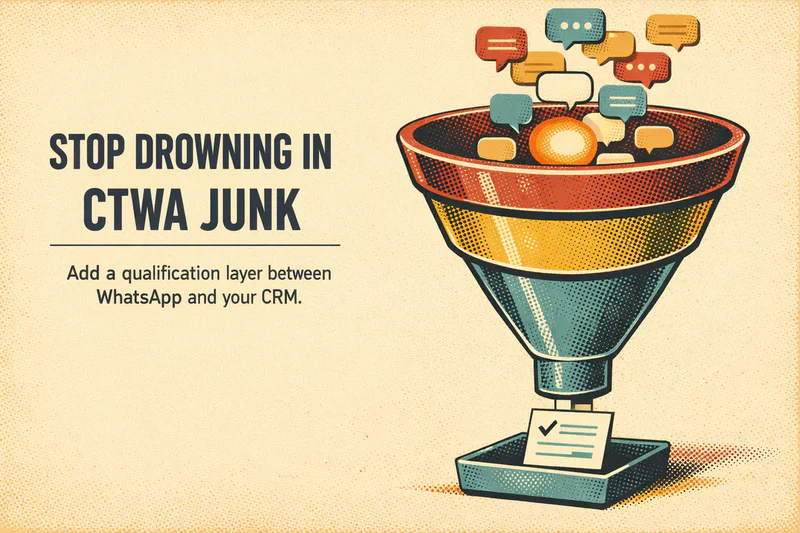
The fix is not another form on the landing page. The fix is a qualification layer that sits between the WhatsApp inbox and the CRM and turns the flood into a filtered stream.
Why does Click to WhatsApp fill your pipeline with junk?
Click to WhatsApp is the highest-intent paid surface most brands have ever bought. A tap opens a private conversation with your brand in the app the buyer already lives in. There is no login, no form, no friction. That same absence of friction is the reason click to whatsapp junk leads exist in the first place.
A landing form makes people work. A form filters out the tourist who wanted a price on a Sunday, the student writing a case study, the neighbour who saw your billboard and got curious. WhatsApp does none of that. It welcomes every tap the same way.
The old advice was to add fields until the wrong people stop replying. That works, and it also kills the campaign. Every field added to a WhatsApp opener suppresses the exact behaviour the ad was designed to trigger. You now have a form disguised as a chat, and the ad economics collapse.
The pipeline does not have a lead problem. It has an unqualified-lead problem, and it is a routing failure, not a targeting failure.
The comforting lie about lead forms
Most teams tell themselves the same story after a bad CTWA month. The targeting was off. Try a new audience. Try a new creative. Try a new time of day.
The targeting is usually fine. The audience is fine. The problem is that the moment a stranger says "hi" on WhatsApp, no one is doing the quiet work a good human SDR would do in the first ninety seconds of a discovery call. No one is asking the two questions that separate a buyer from a browser. No one is capturing the answer in a field the CRM can score. And no one is deciding, in real time, whether this conversation belongs with a bot, a human, or the recycle bin.
Reps end up doing that work by hand for every single conversation. That is why the pipeline feels full and empty at the same time.
The comforting lie is that better ads produce better leads. Better ads produce more leads. Only qualification produces better leads.
What is a qualification layer, and why is it not another chatbot?
A qualification layer is a thin, opinionated piece of software that sits inside the WhatsApp conversation, ahead of any human, and does five things a rep should never have to do at nine on a Monday morning.
It reads intent from the very first message. "Send price" is one intent. "I need this for my wedding in November" is a different intent. A qualification layer separates them without asking either sender to fill anything in.
It asks two or three intent-first questions in the buyer's language and captures the answers as structured fields. Not fifteen fields. Two or three. The ones your reps actually use to decide whether to call.
It answers the questions a bot can honestly answer, so a rep never wastes a Monday morning on catalog and store-locator questions.
It routes what is left. A high-intent lead goes to a human within seconds. A medium-intent lead goes into nurture. A tourist gets a polite goodbye and a browsing link, and the CRM never sees it.
It hands the CRM a fully qualified record, with the WhatsApp thread, the transcript, the captured fields, and a confidence score attached. The sales team opens a lead that already looks like a lead.
None of this is a chatbot. A chatbot is a script the buyer has to survive. A qualification layer is a listener the buyer never notices is there.
What does a working qualification layer actually do?
The mechanics look small on paper and feel enormous in the pipeline. Four beats hold the whole thing together.
It qualifies in the buyer's language, not yours
A shopper in Coimbatore does not want to type in English at 10 PM. A borrower in Tier-3 India does not want to be handed a form in a language their phone barely renders. Godrej ran multi-vernacular CTWA precisely because a qualification question asked in the buyer's language gets answered honestly, and a question asked in the wrong language gets ignored or lied to. Language is qualification.
It filters before the human ever sees the thread
Nova IVF built a WhatsApp qualification layer that filters 90% of enquiries pre-sales, replies in under 30 seconds, and does this across 88 locations. Their sales team no longer opens conversations that begin with "How much." Their sales team opens conversations that begin with "I have a report from a previous cycle and want to know if you can help." Same inbox. Different pipeline.
It preserves context on the way to a human
When a rep does step in, the transcript, the captured fields, the intent score, and the previous touchpoints have to travel with the conversation. Bajaj Allianz runs this across 20+ countries with context-preserving handoff, which is a polite way of saying the human never opens a blank thread and never asks a returning customer to introduce themselves again. Every dropped context is a dropped lead.
It converts the intent, then hands it to the CRM
Savvy saw roughly 40% higher conversion from CTWA once the qualification layer started closing warm intents inside WhatsApp and only pushing the qualified subset to the CRM. The CRM stopped being a graveyard of low-intent chats. It started being a queue of real deals.
There is a fifth beat that most teams miss. Once the layer has decided a lead is qualified, it fires that event straight back into Meta's Conversions API. Meta stops optimising for cheap chat starts and begins optimising for the kind of buyer who actually clears qualification. Cost per qualified lead becomes a number you can move.
Four beats plus the feedback loop. One quiet piece of software. The pipeline you already have starts behaving like the pipeline you thought you were buying.
Which two questions should the layer actually ask?
Every team wants the answer to be a checklist. It is not. The two questions the layer asks are the two questions your best rep asks in the first minute of a live call. Nothing more.
For a D2C brand selling mid-ticket jewellery the two questions are usually a use-case anchor and a timeline anchor. Is this for you or a gift. When do you need it by. Everything else can wait for the human.
For a fintech running loan CTWA the two are usually purpose and eligibility. What is the loan for. Do you have a salary account with any bank. Two questions. Two structured fields. The rep opens the thread already knowing whether this applicant should be walked into the onboarding flow or sent off with a polite goodbye.
For a healthcare provider the two are usually urgency and history. Is this new or ongoing. Have you been treated before. The layer never diagnoses. It only reserves the right slot with the right specialist.
The trap is asking five. Five questions is a form pretending to be a chat, and the reply rate collapses. Two questions is a conversation, and the reply rate holds. The discipline is knowing which two questions are worth the friction.
What separates a chatbot from a qualification layer?
Old chatbots were built to answer FAQs. A qualification layer is built to ask them.
A chatbot is a menu. Press one for pricing. Press two for support. It survives the buyer, and the buyer survives it. Nobody enjoys the exchange.
A qualification layer is a conversation. It asks two intent-first questions, listens to the answer, decides what to do next, and either resolves the thread or hands it to a human with everything the human needs. The buyer feels heard. The rep feels helped.
The difference shows up on a single line of a spreadsheet. A chatbot's success metric is deflection. A qualification layer's success metric is qualified conversation percentage. One is measured by how many humans it kept away. The other is measured by how many humans it invited in at the right moment.
Deflection is a cost story. Qualification is a revenue story.
What does this look like when it is working?
The teams already doing this look boringly different from the teams still fighting the Monday morning inbox.
Savvy's revenue team stopped optimising the ad and started optimising the first three messages after the click. Conversion via CTWA moved roughly 40% higher. Nothing changed on the media plan.
Nova IVF's sales team went from opening 100 threads a day to opening the 10 that mattered. Pre-sales filtering climbed to 90%. Response time collapsed under 30 seconds. Coverage spread to 88 locations without a proportional headcount hike.
Godrej ran CTWA across languages the CRM had never seen a full sentence in. The qualification layer captured intent in the vernacular and translated it into structured fields English-speaking reps could act on.
Bajaj Allianz ran the same pattern across 20+ countries. Every escalation carried its history. Every handoff felt continuous. The customer did not know a layer had done the qualifying. The customer only knew the human on the other side already understood the problem.
None of these teams removed the chat. All of them added a layer between the chat and the CRM.
The pipeline you want on Monday morning
Priya's Monday morning is fixable, and it does not need a new ad account.
It needs the sixty seconds between the click and the reply to stop being empty. It needs the two questions no rep has time to ask 214 times a day to be asked once, by software, in the buyer's language, in the buyer's app. It needs the CRM to receive fewer records that are more real. It needs the sales team to open a thread and see a customer, not a scroll of price-checkers.
That is what qualifying WhatsApp leads looks like when the layer does the work. The pipeline stops being a firehose of curiosity and starts being a queue of conversations worth having.
Book a walkthrough of the Zigment qualification layer for Click to WhatsApp and see the WhatsApp inbox your reps should have been opening all along.