# Customer Lifecycle Management: The Complete Guide to Managing Every Customer Stage
Author: Team Zigment
Author URL: https://zigment.ai/blog/author/team-zigment
Published: 2025-12-17
Category: Lifecycle marketing
Category URL: https://zigment.ai/blog/category/lifecycle-marketing
Tags: Customer Stage, Customer Lifecycle Management
Tag URLs: Customer Stage (https://zigment.ai/blog/tag/customer-stage), Customer Lifecycle Management (https://zigment.ai/blog/tag/customer-lifecycle-management)
URL: https://zigment.ai/blog/customer-lifecycle-management-guide
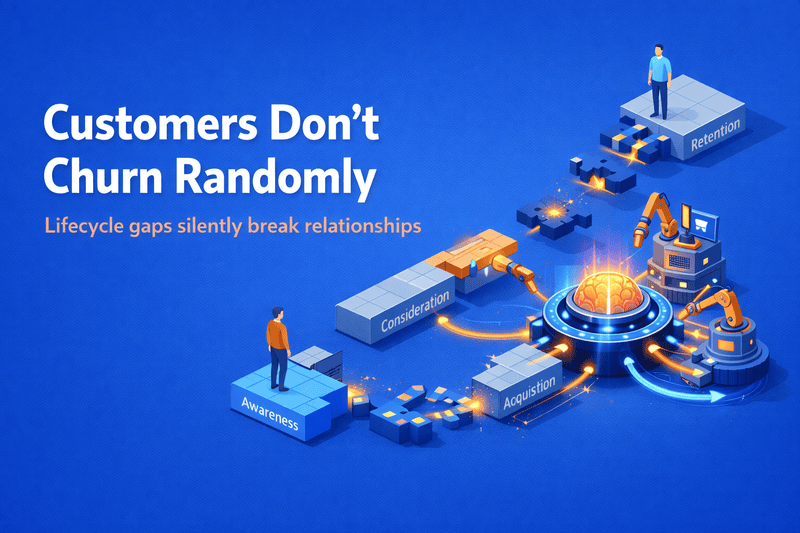
Working with Skybound Entertainment's loyalty program, I've learned that effective customer lifecycle management means understanding what keeps customers coming back and using that insight to turn buyers into lifelong advocates.
This perspective from a HubSpot operations expert captures what most companies miss.
Most companies lose 20-30% of their customers annually, according to Bain & Company research.
The brutal truth? They were never really managing the relationship. Customer lifecycle management isn't another marketing buzzword. It's the systematic approach to nurturing relationships from first contact through advocacy.
Here's the reality. According to Salesforce, 80% of customers now say the experience a company provides is as important as its products or services.
Yet most organizations struggle. Fragmented tools. Disconnected data. Teams working in silos. Customer lifecycle management requires treating every interaction as part of a continuous journey.
## **What Is Customer Lifecycle Management?**
**Customer lifecycle management** (CLM) is the strategy and process of managing customer relationships across every stage of their journey with your business. From initial awareness through purchase, onboarding, retention, and eventual advocacy.
They capture transactions. They miss context. They store support tickets but forget sentiment.
**Client lifecycle management** (the B2B term for the same discipline) takes this further. Multiple stakeholders. Longer sales cycles. Complex buying committees.
> According to research from Forrester, companies with mature CLM practices see 2.5x higher customer retention rates than those without.
The difference matters. Customers don't think in channels or departments. When they reach out on chat, they expect you to remember their email conversation from last week. When they call support, they shouldn't explain their entire history again.
## **The Customer Life Cycle: Understanding Every Stage**
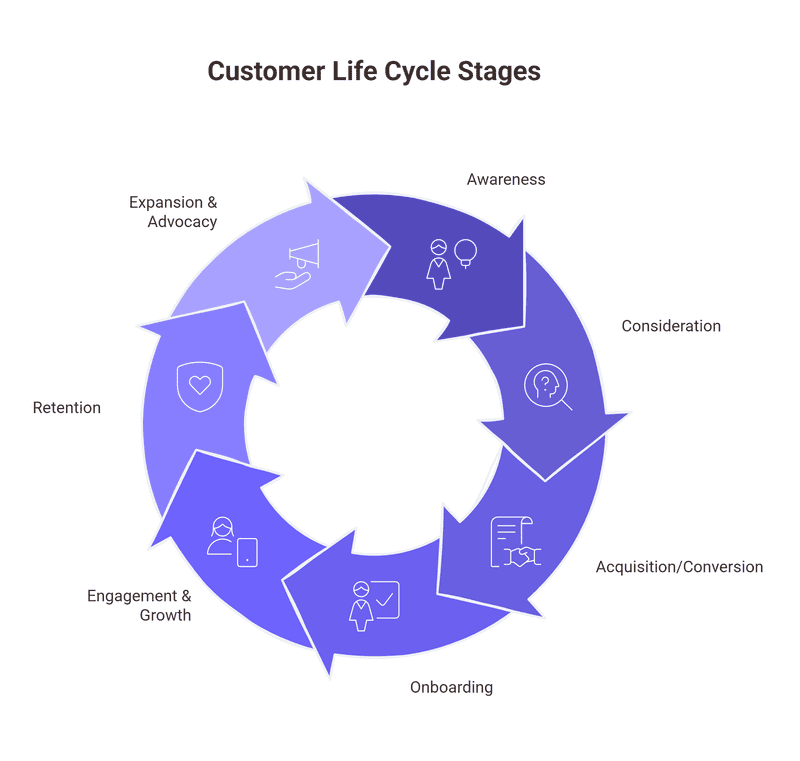
The **customer life cycle** breaks down into seven distinct phases. Each requires different strategies. Different messaging. Different metrics.
### **1\. Awareness**
Your prospect discovers you exist. Through search, social media, referrals, or advertising. They're researching their problem. Not necessarily looking for your solution yet.
**Business focus:** Educational content that builds trust and demonstrates expertise.
### **2\. Consideration**
They're evaluating options. Comparing vendors. Reading reviews. They know their problem. Now they're narrowing down solutions.
**Business focus:** Differentiation through case studies, product comparisons, and proof points.
### **3\. Acquisition/Conversion**
Decision time. They're ready to commit. Whether making a purchase, signing a contract, or starting a trial. This stage requires removing friction.
**Business focus:** Clear pricing, easy onboarding, and risk reduction.
### **4\. Onboarding**
First impressions after purchase. They're learning your product. Setting up accounts. Forming opinions. According to Wyzowl research, 86% of customers say they're more likely to stay with a company that invests in onboarding.
Here's an alarming stat. Over 20% of voluntary churn is linked to poor onboarding, according to Recurly. The first 30 days are where retention paths are set.
**Business focus:** Fast time-to-value and clear success milestones.
### **5\. Engagement & Growth**
They're active users now. Exploring features. Integrating your solution. This is where customer engagement becomes measurable.
**Business focus:** Ongoing education, feature adoption, and value reinforcement.
### **6\. Retention**
The silent killer of growth. According to Statista, media and professional services companies had the highest customer retention rates at 84%, while hospitality, travel and restaurants had the lowest at 55%.
**Business focus:** Proactive health monitoring and intervention before problems escalate.
### **7\. Expansion & Advocacy**
Your best customers become champions. They upgrade. They refer. They review. This stage generates the highest ROI in the entire customer lifecycle stages because acquisition costs drop to near zero.
**Business focus:** Identifying upsell opportunities and making advocacy easy.
## **The Goals of Customer Lifecycle Management**
Effective CLM drives measurable business outcomes. Real numbers that matter to your bottom line.
### **Better Customer Experience**
When you manage the entire customer life cycle, every interaction feels connected. According to McKinsey & Company, enhancing customer experience can decrease customer churn by almost 15%, along with potential increases in win rates of nearly 40%.
### **Higher Conversion Rates**
Understanding where prospects are allows you to deliver the right message at the right time. No more generic campaigns. Customers who enjoyed exceptional past experiences exhibited a remarkable 140% increase in spending compared to those who encountered less favorable experiences.
### **Reduced Churn**
The customer success management market tells us everything we need to know. The global customer success management market was valued at USD 2266.83 million in 2024 and is projected to reach USD 16563.7 million by 2033, exhibiting a CAGR of 24.73%. That explosive growth reflects how critical retention has become.
### **Increased Lifetime Value**
According to research from Bain & Company, increasing customer retention rates by just 5% increases profits by 25% to 95%. That's not a typo. CLM maximizes value from every relationship.
### **Consistent Omnichannel Engagement**
Customers switch channels constantly. Chat today. Email tomorrow. Phone call next week. Customer lifecycle management ensures context persists.
## **Why Most CLM Strategies Fail in Practice**
Here's the uncomfortable reality. Most CLM strategies look great in PowerPoint. They fall apart in execution.
### **Data Lives in Silos**
Your CRM has transactions. Your marketing automation tracks emails. Your support system logs tickets. Your product analytics show usage. None talk effectively.
These information silos create blind spots everywhere. According to Segment survey, 63% of marketing leaders say creating a unified customer view is one of their biggest challenges.
### **Static Segmentation Doesn't Scale**
Most platforms group customers by demographics or past behavior. These segments update slowly. They definitely don't capture real-time intent or emotional state.
A customer researching competitors right now gets treated the same as a happy account. That delay costs you customers.
### **Conversational Intelligence Gets Lost**
Think about signal in actual customer conversations. Chat transcripts. Support calls. Sales emails. Most of this qualitative data disappears into unstructured archives.
According to CallMiner, average avoidable churn costs US businesses about $136 billion every year. You can't manage what you don't measure.
### **No True Single Customer View**
This is the core problem. You might have customer records in multiple systems. You might even have integration. But do you have a single customer view that unifies behavioral data, transactional history, conversational context, and real-time intent?
Probably not. 44% of companies still don't measure their customer retention rate, according to CustomerGauge. You can't manage the lifecycle if you don't recognize the customer consistently across it.
## **The Foundation: Achieving a Single Customer View**
Real customer lifecycle management requires what we call a single customer view. Not just aggregated data. True unified intelligence.
### **What Makes a True Single Customer View**
A real SCV goes beyond [basic data](https://zigment.ai/blog/what-is-customer-data-management-benefits-types-challenges) aggregation. It creates a **unified customer profile** with multiple dimensions.
**Quantitative Data** \- Transactions. Engagement metrics. Product usage. Support tickets. The numbers that traditional systems handle well.
**Qualitative Signals** \- Sentiment from conversations. Intent expressed in inquiries. Urgency in support requests. The human context that explains the numbers.
**Temporal Context** \- How relationships evolve. How intent shifts. How satisfaction changes. The trajectory matters as much as the current state.
**Cross-Channel Continuity** \- A customer who chats today, emails tomorrow, and calls next week is the same person. Your systems should recognize that automatically.
### **Why Most Single Customer Views Fail**
Many platforms claim to offer an SCV. They sync data between systems. They create dashboards. They might even use the term "360-degree customer view."
But data aggregation isn't understanding. Most SCVs suffer from fundamental limitations.
They update too slowly for real-time decision-making. They miss conversational signals that reveal intent and emotion. They break down when customers switch channels.
The result? Your customer lifecycle management software has all the data. It still can't deliver personalized experiences at scale.
## **What to Look for in Customer Lifecycle Management Software?**
Modern customer lifecycle management software and client lifecycle management software should provide specific capabilities traditional tools miss.
### **Essential Requirements**
**Unified Data Layer** \- True integration that creates a **single customer view**. Not just data syncing.
**Real-Time Profile Updates** \- Customer state changes should propagate immediately. They should trigger appropriate automations.
**Cross-Channel** [**Orchestration**](https://zigment.ai/blog/data-orchestration-tools-how-they-power-modern-business) \- Customers switch channels constantly. Your software should maintain context regardless of whether they're using chat, email, phone, or self-service.
**Memory and Context Persistence** \- Every interaction should inform future ones. Sessions shouldn't reset understanding.
**Conversational Intelligence** \- The ability to extract and act on signals from unstructured dialogue. Not just structured behavioral data.
**Integration with Existing Tools** \- Your **customer lifecycle management software** should enhance your current stack. It shouldn't require replacing everything you've already invested in.
## Customer Lifecycle Management Tools — Comparison Chart
Tool
Lifecycle Philosophy
Customer Memory Model
Conversational Intelligence
SCV Depth
Cross-Team Visibility
When to Use
Who Should Use
CLM Risk
**Userpilot**
Product usage → adoption → retention
Remembers in-app behavior only
None
Shallow (product data only)
Product & CS only
If your lifecycle is driven inside the product
Product, Growth, CS teams
Misses sales & support context
**ChurnZero**
Retention → renewal → expansion
Health scores + account history
Limited (notes, tags)
Medium (CS-centric view)
CS + RevOps
If CS owns renewals & churn
CS leaders, RevOps
Reactive to issues already surfaced
**HubSpot**
Funnel → lifecycle stages
CRM records + engagement history
Basic (emails, forms)
Medium (aggregated data)
Sales + Marketing
If you want one simple GTM stack
Marketing, Sales, Ops
Becomes a data dump without enrichment
**Encharge**
Journey automation
Event-based memory
None
Medium (behavioral only)
Marketing-led
If automation is your main goal
Marketing Ops
No understanding of intent or emotion
**EngageBay**
Pipeline progression
Basic CRM memory
None
Shallow
Small teams
If budget is limited
SMB founders, lean teams
Breaks as complexity grows
**Salesforce**
Opportunity-centric lifecycle
Object-based records
Add-ons required
Medium–Deep (with heavy setup)
Enterprise-wide
If you need scale & customization
Sales Ops, RevOps
Fragmentation across clouds
**Pega CDH**
Rule-driven customer journeys
Long-term decision memory
Structured signals
Deep (decision-focused)
Ops, Compliance
If governance & control matter
Enterprise CX teams
Slow to adapt, heavy setup
**Appian CLM**
Compliance-first lifecycle
Process & case memory
None
Medium (process view)
Ops, Risk
If onboarding & KYC are core
Risk, Compliance
Poor personalization
**Omnisend**
Purchase → repeat → loyalty
Campaign-level memory
None
Medium (commerce data)
Marketing only
If ecommerce is your business
D2C marketers
No B2B or service context
**SAP Emarsys**
Predictive lifecycle marketing
Segment-based memory
Indirect
Medium–Deep
Marketing-centric
If omnichannel retail is key
Enterprise marketers
Black-box intelligence
The question isn't whether client lifecycle management matters. It's whether your current architecture can actually support it before your competitors build the unified foundation first.
## FAQs
Q: What are the seven stages of the customer lifecycle in SaaS businesses?
A: In SaaS, the customer lifecycle typically includes seven connected stages:
- Awareness – The prospect discovers the problem and your solution
- Consideration – They evaluate options, features, and proof
- Acquisition – Conversion into a paying customer
- Onboarding – Time-to-value and product adoption
- Engagement – Regular usage and value realization
- Retention – Renewal, loyalty, and expansion readiness
- Advocacy – Customers promote and refer your product
Modern CLM treats these stages as dynamic and non-linear, driven by intent signals rather than fixed funnels.
Q: What is customer lifecycle management (CLM)?
A: Customer Lifecycle Management (CLM) is the practice of managing, measuring, and optimizing every interaction a customer has with a business—from first awareness to long-term loyalty and advocacy. CLM focuses on delivering the right experience at the right stage, using data, context, and intent to drive retention and growth.
Q: How does customer lifecycle management differ from CRM?
A: CRM systems primarily store customer records and sales activities. CLM goes further by orchestrating customer journeys across teams, tools, and channels. While CRM answers who the customer is, CLM answers what the customer needs next and when.
Q: How to improve onboarding in customer lifecycle management?
A: Effective onboarding improves CLM outcomes by:
- Reducing time-to-value
- Providing contextual guidance
- Setting clear success milestones
- Automating repetitive setup steps
Strong onboarding directly reduces early-stage churn.
Q: What metrics track retention in the customer lifecycle?
A: Common retention metrics include:
- Renewal and churn rates
- Customer lifetime value (CLV)
- Product usage frequency
- Net revenue retention (NRR)
- Customer health scores
These metrics reveal long-term customer value and risk.
Q: Why is advocacy the highest ROI stage in CLM?
A: Advocacy delivers the highest ROI because loyal customers:
- Cost less to retain
- Refer new customers
- Purchase more over time
- Strengthen brand credibility
Advocates turn lifecycle investment into compounding growth.
Q: Why do most CLM strategies fail due to data silos?
A: Data silos prevent teams from seeing a complete customer history. When marketing, sales, and support operate in isolation, experiences become inconsistent—leading to poor engagement, missed signals, and higher churn.
Q: How to achieve a single customer view in CLM?
A: A single customer view is achieved by unifying data from all touchpoints—CRM, product usage, support, billing, and conversations—into one real-time profile. This enables consistent, context-aware actions across the lifecycle.
Q: What are best practices for customer lifecycle management?
A: Best practices include:
- Lifecycle-based journey design
- Real-time data updates
- Cross-team visibility
- Automation with human oversight
- Continuous optimization based on behavior and intent
CLM succeeds when it is customer-centric, not tool-centric.
Q: What software is best for customer lifecycle management?
A: The best CLM software combines:
- CRM and behavioral data
- Journey orchestration
- Analytics and health scoring
- Omnichannel engagement
The ideal tool adapts to lifecycle stages rather than forcing customers into static funnels.
Q: What KPIs monitor churn in customer lifecycle stages?
A: Key churn KPIs include:
- Logo churn rate
- Revenue churn rate
- Product adoption decline
- Support escalation frequency
- Health score deterioration
Tracking these early signals enables proactive retention.
Q: How to optimize omnichannel engagement in CLM?
A: Omnichannel engagement is optimized by maintaining shared customer context across all channels. When interactions are connected, customers experience consistent messaging, faster resolutions, and smoother lifecycle transitions.
---
This blog is powered by Superblog. Visit https://superblog.ai to know more.
---