# Decoding Customer Signals: Intent and Sentiment Extraction in Conversational AI
Author: Team Zigment
Author URL: https://zigment.ai/blog/author/team-zigment
Published: 2025-11-26
Category: Agentic AI
Category URL: https://zigment.ai/blog/category/agentic-ai
Tags: Sentiment Analysis, conversational AI, Agentic AI
Tag URLs: Sentiment Analysis (https://zigment.ai/blog/tag/sentiment-analysis), conversational AI (https://zigment.ai/blog/tag/conversational-ai), Agentic AI (https://zigment.ai/blog/tag/agentic-ai)
URL: https://zigment.ai/blog/customer-signals-intent-and-sentiment-extraction-in-ai
> Customers don’t always say what they mean, but their conversations always show you.
Chatbots don’t freeze because customers are difficult. They freeze because they can’t _listen_.
That idea captures the shift we’re living through, the move from rigid, rule-based bots to dynamic **[Agentic AI](https://zigment.ai/blog/what-is-agentic-ai-a-definitive-guide)** systems that understand conversations the way humans do with nuance, context, and awareness.
This is where **Decoding Customer Signals** becomes essential. Every interaction contains two critical signals. **Intent,** the real action a customer wants to take, whether that’s upgrading a plan, fixing an issue, or simply exploring options. And **sentiment**, the emotional tone behind their words; frustration, relief, hesitation, or excitement.
When businesses learn to read both, something powerful happens. They stop delivering canned responses and start creating connected, real-time experiences that adapt as the conversation evolves. That’s the promise of Agentic AI: not just answering questions but understanding customers moment by moment.
## **Why Intent and Sentiment Extraction Matter in Modern Conversational AI**
> Every word a customer writes or speaks is a signal. Extracting intent and sentiment is the difference between guessing and knowing.
Intent and sentiment extraction matter because they reveal the two things every business needs to understand: _what customers want_ and _how they feel while asking for it_. Intent shows the goal behind the message, whether someone is trying to resolve a payment issue or explore a new feature. Sentiment exposes their emotional state, which can shift the entire approach a system should take. When combined, these signals give AI the ability to respond with precision instead of guesswork. Modern conversational experiences depend on this level of clarity. It’s how brands reduce friction, de-escalate issues early, and deliver responses that feel timely, relevant, and genuinely helpful.
### **How Agentic AI Goes Beyond Traditional Chatbots**
Traditional chatbots follow scripts. They wait for a keyword, match it to a predefined response, and hope it fits the moment. It works until the conversation gets messy, emotional, or ambiguous. Agentic AI doesn’t operate that way. It listens, interprets, and adapts in real time. Instead of reacting line by line, it tracks evolving goals, shifting sentiment, and the broader context of the conversation. This allows it to plan the next best action rather than simply answer the next question. The result? Interactions that feel natural, responsive, and fluid, closer to collaborating with a smart assistant than chatting with a decision tree. Agentic AI transforms conversations from static exchanges into dynamic, goal-driven journeys.
Discover how your conversations can reveal deeper customer insights.
## **A Simple Breakdown: How Intent and Sentiment Extraction Works**
Intent and sentiment extraction may sound complex, but the workflow is surprisingly structured.
Here’s the process:
**1\. Signal Capture**
The system collects raw inputs from text, voice, or chat every word, pause, and phrase becomes usable data.
**2\. Linguistic Parsing**
AI breaks the message down into parts: entities, keywords, context windows, and conversational cues.
**3\. Intent Modeling**
Specialized models classify what the customer is trying to _do_ track an order, change a plan, fix an issue, etc.
**4\. Sentiment Modeling**
AI evaluates emotional tone, detecting not just positive or negative sentiment but nuances like urgency, frustration, or confusion.
**5\. Context Fusion**
Intent + sentiment + conversation history are merged to form a complete understanding of what’s happening in the moment.
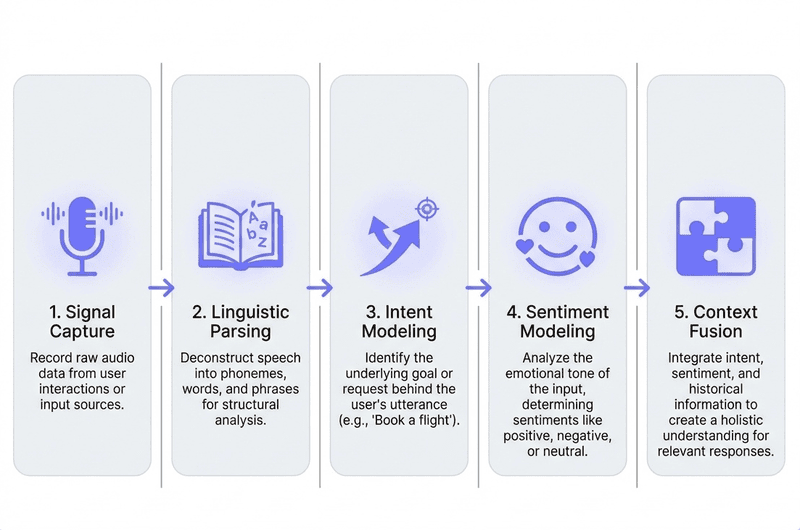
This layered approach transforms raw dialogue into structured intelligence. It helps AI interpret meaning beyond literal text and respond with accuracy that feels surprisingly human.
Learn how structured signals make every interaction smarter.
**Real-Time Intelligence: What Agentic AI Actually Does with These Signals**
Once intent and sentiment are extracted, Agentic AI doesn’t just store the information, It _acts_ on it in the moment. Here’s how it uses those signals to shape a smarter, more fluid conversation:
- **Adapts Tone Instantly**
If the system detects frustration, it shifts to a calmer, more empathetic style. If the customer is excited, it mirrors that energy to keep momentum high.
- **Chooses the Next Best Action**
Instead of simply replying, the AI decides what should happen next, clarify a detail, offer a shortcut, escalates to a specialist, or complete a task autonomously.
- **Predicts Customer Needs**
Real-time patterns allow the AI to anticipate follow-up questions or hidden blockers and address them proactively.
- **Detects Urgency and Responds Faster**
Sentiment spikes, abrupt phrases, or stress indicators trigger priority handling or escalation pathways.
- **Personalizes Interactions on the Fly**
Recommendations, responses, and workflows adjust dynamically based on both the customer’s goal and emotional state.
## **Enterprise Use Case: A Real Example Powered by Intent & Sentiment Extraction**
To see the impact clearly, let’s walk through a realistic enterprise scenario, one we often see across telecom, banking, and subscription-based businesses.
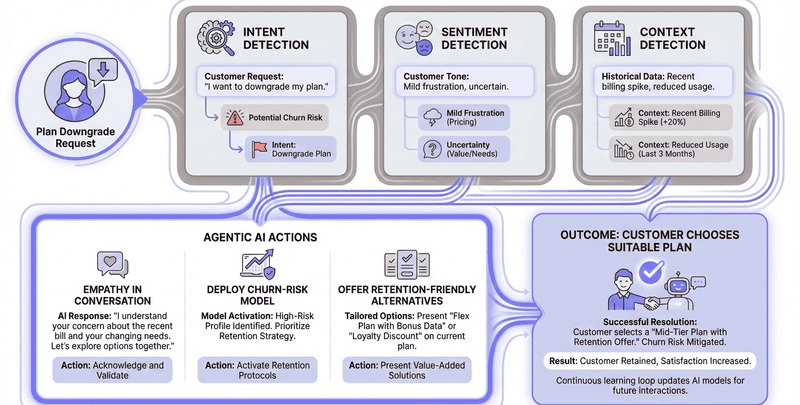
**Imagine a customer reaching out to downgrade their plan.**
On the surface, it’s a simple request. But Agentic AI uncovers the real story.
Here’s how the system interprets the conversation in real time:
- **Intent Detected:** “downgrade plan” → signals potential churn risk.
- **Sentiment Detected:** mild frustration about pricing + uncertainty about current value.
- **Context Detected:** recent billing spike and reduced usage.
From these signals, the AI doesn’t just process the downgrade, it recognizes a _save opportunity_.
So, it takes action:
- **Reframes the conversation** with empathy (“I understand why that feels frustrating…”)
- **Runs a churn-risk model** in the background using sentiment + history
- **Surfaces a retention-friendly alternative** such as a temporary discount, usage-based plan, or add-on removal
- **Explains the option clearly** without sounding salesy
- **Asks for confirmation** in a way that feels natural, not pushy
The outcome?
Customers who were originally on the verge of downgrading often choose a more suitable plan instead, reducing churn and improving satisfaction in one smooth exchange.
This is the power of combining intent, sentiment, and Agentic AI: the system doesn’t just resolve the request; it understands the underlying motivation and guides the conversation toward the best outcome for both the customer _and_ the business.
## **Evaluating Performance: Metrics That Matter**
To know whether intent and sentiment extraction are truly moving the needle, enterprises need clear, outcome-focused metrics. The goal isn’t to track everything, it’s to measure the signals that actually reflect intelligence, accuracy, and customer impact. Here are the metrics that matter most:
- **Intent Classification Accuracy**
How often the system correctly identifies what customers want. Higher accuracy means fewer loops, fewer clarifications, and smoother conversations.
- **Sentiment Precision & Emotion Detection Quality**
Measures how well the AI captures emotional nuance, not just “positive/negative,” but frustration, urgency, hesitation, or confidence.
- **Resolution Time & First-Contact Success**
When intent is understood quickly, problems get solved faster. This metric shows how well Agentic AI turns insight into action.
- **Escalation Quality (Not Just Rate)**
It’s not about _avoiding_ escalation, it’s about escalating at the right time, especially when sentiment signals indicate urgency.
- **Conversion & Retention Impact**
Whether AI-driven conversations lead to better outcomes: upgraded plans, recovered churn cases, higher sales acceptance.
- **CSAT or Effort Score Movement**
When customers feel understood, emotionally and practically satisfaction rises. These scores show the downstream effect of accurate signal extraction.
Together, these metrics provide a full picture of performance. They reveal whether your AI is simply responding or truly understanding.
Learn which metrics truly measure conversational intelligence.
## **Conclusion**
Intent and sentiment extraction aren’t just technical capabilities, they’re the foundation of conversations that actually _work_. When AI understands both the customer’s goal and their emotional state in real time, interactions become smoother, faster, and far more effective. Agentic AI takes this even further, guiding each exchange like a live decision engine rather than a scripted responder. The result is a customer journey that adapts moment by moment, instead of forcing people through rigid flows.
But intelligence needs structure and action. That’s where Zigment comes in.
**Zigment’s [Conversation Graph](https://zigment.ai/blog/the-conversation-graph) doesn’t just capture context; it organizes it into an intelligence layer that’s immediately usable across your entire customer ecosystem.**
Every intent, sentiment cue, escalation signal, and hesitation point is transformed into measurable inputs that systems can act on instantly. And because the Conversation Graph is built for **true omnichannel orchestration**, those insights don’t stay trapped in a single chat window. They flow across email, chat, WhatsApp, IVR, apps, and even in-store systems, ensuring every touchpoint responds with the same clarity, context, and awareness.
Whether you're resolving a support issue, recovering a churn-risk customer, or nudging a buyer toward their next step, Zigment ensures the AI acts consistently and intelligently everywhere your customers show up.
## FAQs
Q: What is the core difference between intent and sentiment extraction, and why do both matter together?
A: Intent extraction identifies what a customer wants to do, such as upgrading a plan, resolving an issue, or exploring options. Sentiment extraction measures how the customer feels while expressing that intent, detecting frustration, excitement, or uncertainty. Together, they give AI a full picture understanding not just the request, but the emotional context allowing for responses that are accurate, empathetic, and actionable. When combined, businesses can respond in real time with the right action and tone, improving the overall customer experience.
Q: What are the main challenges in intent and sentiment extraction?
A: Challenges include accurately interpreting ambiguous language, slang, or mixed emotions, and correctly merging intent with sentiment for context-aware actions. Another challenge is maintaining accuracy across different communication channels and formats, such as text, voice, and chat. Without proper context fusion, AI risks misclassification, leading to irrelevant or poorly timed responses.
Q: Can intent and sentiment extraction work effectively across multiple communication channels (chat, voice, email, WhatsApp)?
A: Absolutely. Modern Agentic AI systems, especially when paired with omnichannel orchestration tools like Zigment’s Conversation Graph, capture signals consistently across chat, voice, email, WhatsApp, apps, and even in-store interactions. This ensures a unified understanding of intent and sentiment, allowing for real-time, coordinated actions across all customer touchpoints.
Q: How does understanding sentiment and intent drive business outcomes like churn reduction, revenue retention, and customer lifetime value?
A: By interpreting both what customers want and how they feel, AI identifies opportunities to retain at-risk customers, offer timely upgrades, and resolve pain points proactively. For example, detecting frustration during a downgrade request can trigger personalized retention offers. These real-time, context-aware interventions reduce churn, improve satisfaction, and ultimately increase revenue and lifetime customer value.
Q: Why are intent and sentiment extraction important in customer experience?
A: They reveal the hidden signals behind every interaction. Intent tells you the goal; sentiment tells you the emotional state. By analyzing both, AI systems can reduce friction, de-escalate issues early, and deliver responses that feel personalized and timely. This level of understanding transforms routine exchanges into connected real-time experiences that build satisfaction and loyalty.
Q: Can Agentic AI act autonomously and collaborate with human agents?
A: Yes. Agentic AI not only interprets signals but also decides the next best action, whether to escalate an issue, clarify a detail, or complete a task autonomously. At the same time, it can work alongside human agents, providing recommendations, context, and sentiment cues so humans can intervene strategically. This collaboration ensures conversations remain fluid and outcomes are optimized.
Q: How is customer data privacy maintained in sentiment and intent analysis?
A: Privacy is maintained by anonymizing sensitive information and applying secure processing standards. AI analyzes patterns and signals without storing personally identifiable details unnecessarily. Organizations also enforce compliance with data protection regulations like GDPR or CCPA, ensuring that intent and sentiment analysis is both actionable and privacy conscious.
---
This blog is powered by Superblog. Visit https://superblog.ai to know more.
---