
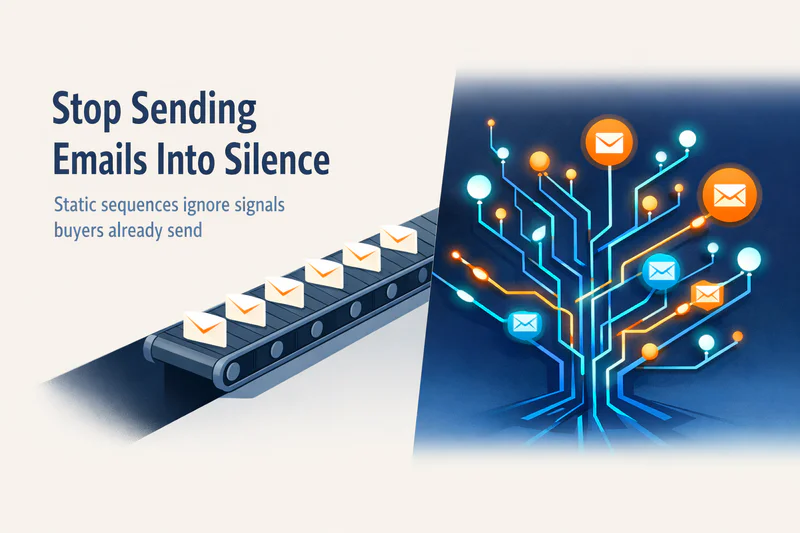
A rep sends 12 emails over 21 days.
No reply. The sequence keeps firing anyway.
That’s the quiet flaw in modern outbound. We built structured, timed, automated cadences inside every major sales engagement platform, then assumed buyer behavior would politely follow along. It doesn’t. Buyers reply late. They object early. They forward emails internally. They ask for next quarter. They show intent in subtle language most sequences ignore.
Sales engagement in 2026 demands something very different: outbound campaigns that adapt in real time based on reply sentiment, context, and buying signals. Linear automation worked when volume was the advantage. Today, responsiveness is.
If your outbound still runs on fixed steps triggered by time delays instead of conversation signals, you’re leaking opportunity. In this article, we’ll break down exactly why static sequences are fading and how to build “living” outbound campaigns that evolve with every interaction.
What Static Sequences Get Wrong About Modern Sales Engagement
Most traditional sales engagement systems are built on three assumptions:
Silence means continue.
Any reply counts as success.
Every prospect moves through the same steps.
Those assumptions no longer hold.
1. Silence Isn’t Neutral
A prospect who opens five emails but doesn’t reply is different from someone who never opens at all. Static sequences treat them the same. Living campaigns don’t.
Actionable shift:
Create branching logic based on engagement patterns (multiple opens, forwarded emails, repeat clicks).
Reduce message frequency when signals show passive interest instead of pushing harder.
2. All Replies Are Not Equal
“Not now.”
“Circle back next quarter.”
“Already evaluating alternatives.”
Those are not positive replies. Yet most dashboards celebrate them the same way.
Actionable shift:
Classify replies by sentiment: positive, neutral, objection, referral, timing delay.
Route objection replies into tailored follow-ups instead of continuing generic messaging.
3. Time-Based Logic Is Too Rigid
Traditional outbound is calendar-driven:
Day 1: Email
Day 3: Call
Day 7: Bump
Day 10: Breakup
Buyers don’t follow this rhythm. They respond based on internal triggers — budget approvals, leadership discussions, shifting priorities.
Your campaign logic should respond to behavior, not just time.
Why 2026 Buyers Expect Adaptive Outreach
Buyers today are overloaded. They evaluate vendors faster. They expect context immediately.
When someone replies with, “We’re reviewing vendors internally,” that’s a signal. A living outbound campaign adjusts tone and timing instantly.
Here’s what buyers expect now:
Acknowledgment of their exact response.
Adjusted pacing if they show hesitation.
Escalation if urgency appears.
Relevance based on what they actually said.
If your sales engagement platform continues pushing pre-written steps after a nuanced reply, you create friction. Adaptive campaigns reduce that friction by matching the energy and timing of the conversation.
What Is a Living Sales Engagement Campaign?
A living campaign evolves as the conversation evolves. It uses reply intelligence and behavior signals to determine the next step.
Let’s break it down.
Sentiment-Aware
Detects positive, neutral, and negative language.
Adjusts tone automatically.
Flags high-intent replies for immediate human follow-up.
Example:
If a prospect writes, “This aligns with what we’re exploring,” the campaign pauses automation and routes directly to a rep.
Intent-Responsive
Living campaigns listen for buying signals:
Budget mentions
Timeline references
Internal stakeholders
Competitor comparisons
These triggers change the follow-up path instantly.
Behavior-Adaptive
Not every signal lives inside a reply.
Living outbound reacts differently to:
Multiple clicks on pricing pages
Email forwards
Out-of-office responses
LinkedIn engagement patterns
Each action adjusts the next step.
Human-in-the-Loop Intelligent
Automation should step aside when nuance appears.
Escalate complex objections.
Pause sequences when negotiations begin.
Notify reps when decision-makers join threads.
Your sales engagement platform should enhance judgment, not override it.
Static vs. Living Campaigns: A Direct Comparison
Let’s simplify it.
Static Sequences
Linear.
Time-triggered.
Same path for everyone.
Optimized for volume.
Celebrate total replies.
Living Campaigns
Branching.
Signal-triggered.
Path changes per interaction.
Optimized for conversation quality.
Measure positive intent and opportunity creation.
The difference isn’t subtle. It changes how pipeline forms.
Static outbound scales touches. Living outbound scales relevance.
How Modern Sales Engagement Platforms Enable Adaptation
Adaptive outbound isn’t manual guesswork. It’s powered by smarter infrastructure.
Key components include:
Natural language processing to analyze reply sentiment.
Real-time routing rules.
CRM signal integration.
Behavioral tracking across email and site activity.
AI-driven branching recommendations.
When these capabilities work together, your sales engagement platform becomes a dynamic decision engine rather than a scheduling tool.
How to Transition From Static Sequences to Living Outbound
Shifting models doesn’t require rebuilding everything. Start here.
Step 1: Audit Your Current Sequences
Identify:
Where automation continues after replies.
Where objection responses are generic.
Where high-intent signals are ignored.
Step 2: Categorize Reply Types
Create simple buckets:
Positive intent
Timing delay
Objection
Referral
Closed/lost
Map each to a unique follow-up path.
Step 3: Build Branching Logic
For each reply type:
Define tone.
Adjust cadence speed.
Decide automation vs. human response.
Step 4: Add Escalation Triggers
Examples:
Mentions of budget.
Requests for pricing.
Introduction of new stakeholders.
These should notify reps immediately.
Step 5: Change Your Metrics
Stop optimizing for:
Total reply rate.
Total email volume.
Start measuring:
Positive reply rate.
Qualified conversation rate.
Pipeline created per engaged account.
This shift alone changes behavior inside your team.
The Competitive Advantage of Adaptive Sales Engagement
Teams that adopt living outbound see measurable benefits:
Faster objection resolution.
Lower unsubscribe rates.
Higher-quality conversations.
More accurate pipeline forecasting.
Reduced rep burnout from low-signal noise.
Adaptive outreach increases clarity. Reps spend time where interest actually exists.
The Future of Sales Engagement Is Smarter And Zigment Is Built for It
Outbound isn’t about sending more emails. It’s about making better decisions at the right moment.
That’s where Zigment stands apart.
Zigment isn’t just another sender layered onto a sales engagement platform. It functions as a decision engine, continuously analyzing prospect behavior and altering the sequence in real time.
Here’s what that means in practice:
High-intent reply? Automation pauses instantly and the rep is notified.
Multiple pricing-page clicks? The next message shifts to address budget and buying criteria.
Objection detected in a reply? Tone, timing, and follow-up path adjust automatically.
Engagement drops? Cadence slows to prevent fatigue.
Instead of forcing prospects through a fixed timeline, Zigment lets the campaign evolve with the conversation. Every signal, reply sentiment, engagement pattern, stakeholder addition, influences what happens next.
In 2026, strong sales engagement isn’t linear. It’s adaptive, contextual, and responsive.
Zigment turns outbound from a scheduled sequence into an intelligent system that reacts as fast as your buyers think.