
TL;DR:
Fintech AI onboarding works alongside your KYC and identity verification stack, connecting to those tools and handling a few steps inside the chat itself. Its main job is watching the account-opening flow to detect exactly where applicants stall, then conversationally guiding each person to finish, from document upload to first funded transaction. The payoff is fewer abandoned applications, gentler collections, and a clean handoff to a human when a case actually needs one. Zigment runs this layer on top of HubSpot and Salesforce, powered by the Conversation Graph.
Meet Arjun. It is 11:14pm. A new banking app is open on his phone, and a photo of his driver's license sits half-uploaded on the screen.
He taps submit. A spinner. Then a red error he does not understand. He sets the phone down.
He never picks it back up.
That account is gone. Now multiply Arjun by a few thousand and you have the quietest way fintech revenue dies. Not at the pricing page. At the paperwork.
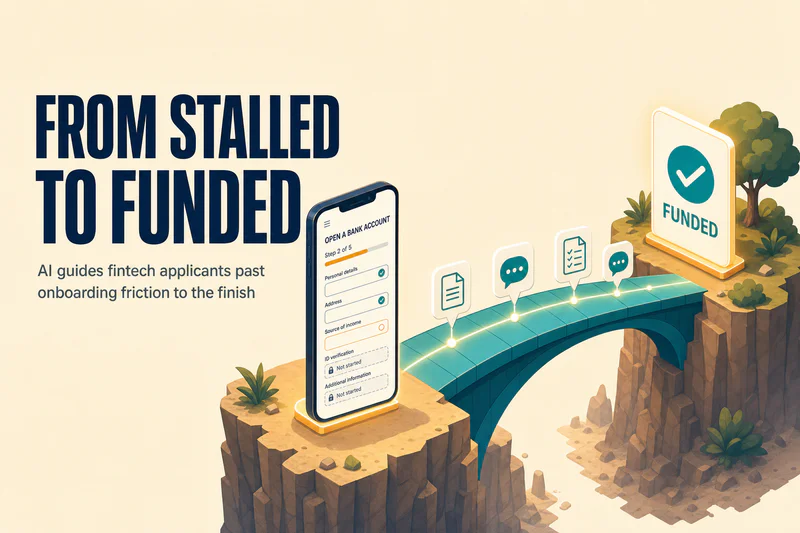
Fintech AI onboarding is the practice of using conversational AI agents to watch a financial account-opening flow, spot where applicants get stuck, and guide them to finish every step, from first tap to first transaction. They connect to the verification and eSign tools you already run rather than replacing them. They detect friction, answer questions in real time, clear blockers, send completion nudges, and hand the case to a human the moment one is needed.
Keep that distinction close. It is the whole point of this piece.
Where Does Fintech Onboarding Actually Break?
It does not break at the ad. It does not break at the landing page. It breaks in the middle, in the stretch nobody demos, where a real person meets a form and a wait.
The numbers are brutal. Signicat's research found that 68% of European consumers have abandoned a financial onboarding application in a single year, up from 40% in 2016. The trend is going the wrong way. And 38% of those who quit did so because they did not have the right identity credential to hand at that exact moment.
Read that again. More than a third walked away over a document they simply did not have open on the desk.
Call it the Paperwork Cliff. The applicant wants the product. The intent is real.
Then the flow asks for a passport, a selfie, a proof of address, and the moment stretches into silence. Silence is where good leads go to die.
Marketing measures sign-ups. Revenue measures funded accounts. The gap between those two numbers is the cliff, and most fintech teams have never looked over the edge. This is the same drop-off dynamic behind why half of applicants abandon at the document-upload step.
See where your funnel leaks.
Why Do Applicants Stall at the KYC Step?
Not because KYC is optional. It is the law. It protects the applicant, the platform, and the whole system from fraud and laundering. The checks have to happen, and they should.
The problem is not that KYC exists. The problem is the dead air around it.
An applicant hits the verification step, and suddenly the friendly onboarding turns into a customs desk.
Upload this. Retake that. Your selfie did not match.
Please wait while we review. No explanation, no reassurance, no sense of how long.
Fenergo found that 67% of banks have lost clients to slow, inefficient onboarding and KYC, and that abandoned KYC processes strip roughly 3.3 billion dollars a year out of the sector.
Call it the KYC Pause. It is the anxious gap between "I started" and "am I in?" A verification vendor can make that check fast and accurate. It cannot hold the applicant's hand while it runs.
A fintech AI onboarding agent cannot make KYC optional. It can make the pause bearable. Something has to fill the silence, and right now, for most fintechs, nothing does.
Turn dead air into guidance.
What Does a Fintech AI Onboarding Agent Actually Do?
Here is the line every fintech team needs to be clear about. Your KYC stack still owns the verdict. It runs the AML check, scores the selfie and approves the identity. Zigment connects to those tools, collects what they need inside the conversation, handles a few steps in the chat itself, and runs re-KYC journeys the same way.
What a fintech AI onboarding agent does is everything around that check. It watches the flow, notices the stall, and reaches out on the channel the applicant already uses, before the person is gone for good.
What the agent does, step by step
- Detects the friction. The applicant has been idle on the document screen for ninety seconds, or bounced back twice from the selfie step. The agent sees the stall as it happens.
- Reaches out in context. A message lands on WhatsApp or web chat that knows exactly where they are: "Looks like the address proof is giving you trouble. A recent utility bill or bank statement works too."
- Clears the blocker. It answers the real question, explains what a valid document looks like, and tells them what happens next so the wait stops feeling like a void.
- Nudges to completion. If they drop off anyway, it follows up later, on their schedule, with the flow saved exactly where they left it. No starting over.
- Escalates to a human. When the case is genuinely stuck or sensitive, it hands off to a person with the full thread attached.
Notice where the list stops. The agent works with the verifier and never replaces it.
It is the guide who walks the applicant to the verifier's door and waits with them until they are through. This is agentic AI doing coordination work, not scripted automation firing canned replies.
Guide applicants to the finish.
Can AI Handle Collections Without Sounding Like a Debt Collector?
Reframe what collections even means at onboarding. A stalled application is a collection problem. You are not collecting a debt. You are collecting the finish.
Meet Meera. She opened a credit line last Tuesday, got approved, and never set up her autopay.
The product is live. The revenue is not. A traditional system waits, then fires a cold reminder three weeks later that reads like a warning letter.
A dunning script demands. A conversation reminds.
The same agent that guided Meera through onboarding already knows her context, so the nudge sounds like a helpful tap on the shoulder: "You are almost set up. Want to finish adding your payment method so your card is ready to use?" One reply, done. For funded products like loans, cards, and pay-later plans, this is where quiet money hides, in the applications that were approved but never activated.
Call it the Completion Nudge. It works for the same reason good onboarding drop-off recovery works. It meets the person where they stopped, in the voice of the same assistant they already trust, with zero pressure and full memory.
Recover revenue without the pressure.
Where Do Humans Fit in the Human-AI Mix?
The mistake is treating this as a choice between AI and people. It never was.
Most stalls are simple. A wrong document, a confused step, a missed activation. The agent clears those in seconds, day or night, at a volume no support team could staff. That is the bulk of the queue, gone.
Then there is the hard 20%. The anxious first-time borrower with a real question about their limit. The flagged document that needs a compliance officer's eyes. The applicant who is upset and needs a person, now.
AI clears the queue. Humans win the hard ones.
What a clean handoff carries
The difference between a good handoff and a bad one is memory. When Zigment escalates, the human does not start cold. They inherit the entire conversation, the intent behind it, and where in the flow the applicant is stuck, all carried on the Conversation Graph. The agent picks up mid-thought, not from scratch.
That is the human-AI mix that actually works. The machine handles scale. The person handles nuance. Nobody repeats themselves.
This is the same coordination logic behind how conversational AI is reshaping banking journeys.
Escalate with full context, instantly.
How Does Fintech AI Onboarding Sit On Top of Your Stack?
You already bought a KYC vendor. You already run HubSpot or Salesforce. You do not need another platform demanding a rip-and-replace.
Zigment is a Conversational Revenue Orchestration Platform for GTM teams, and it sits on top of the stack you have. Your identity provider keeps doing verification. Your CRM keeps being the record of truth.
Zigment adds the missing layer between them: the real-time conversational intelligence that notices a stall, acts on it, and keeps every system in sync as the applicant moves. That is what fintech AI onboarding looks like as a layer, not a replacement.
The engine underneath is the Conversation Graph, one continuous timeline per applicant that holds every message, every step, and the intent behind it. That is why the onboarding agent, the collections nudge, and the human handoff all sound like one assistant instead of three disconnected tools. It is the fintech-specific application of conversational revenue orchestration, and most teams are live on it in under four weeks.
Add the layer, keep the stack.
What Should Fintech Teams Measure?
The old scoreboard lies. It counts app installs and sign-up taps, the vanity numbers that look healthy while accounts quietly die at the Paperwork Cliff.
Stop measuring sign-ups. Start measuring funded accounts.
The teams winning at fintech AI onboarding watch three real numbers instead. Completion rate, the share of starts that reach a funded, active account. Time to first transaction, how fast a new customer actually does something. And manual touches per application, the hidden cost of humans gluing the flow together by hand.
This is where the model earns its keep. Teams that put conversational orchestration on their inbound flows see around 40% higher conversions and up to an 80% reduction in the manual effort of chasing applications, with agents responding in under three seconds at any hour.
That is not a new headcount line. That is the same funnel, finishing.
Measure funded accounts, not clicks.
The Applicant Who Almost Joined
Go back to Arjun, phone face-down on the table at 11:14pm, one red error between him and a new account.
In the old flow, he is a lost lead, a line in a churn report nobody reads.
In a flow with a fintech AI onboarding agent watching, his phone buzzes ninety seconds later: "That upload timed out on our side, not yours. Want to try that license photo again? Takes ten seconds." He taps. He is in.
The red error was never the problem. The silence after it was.
So here is the question every fintech leader should sit with tonight. How many Arjuns went quiet in your funnel this month, and who was there to answer them?
Answer them. Fund the account.