
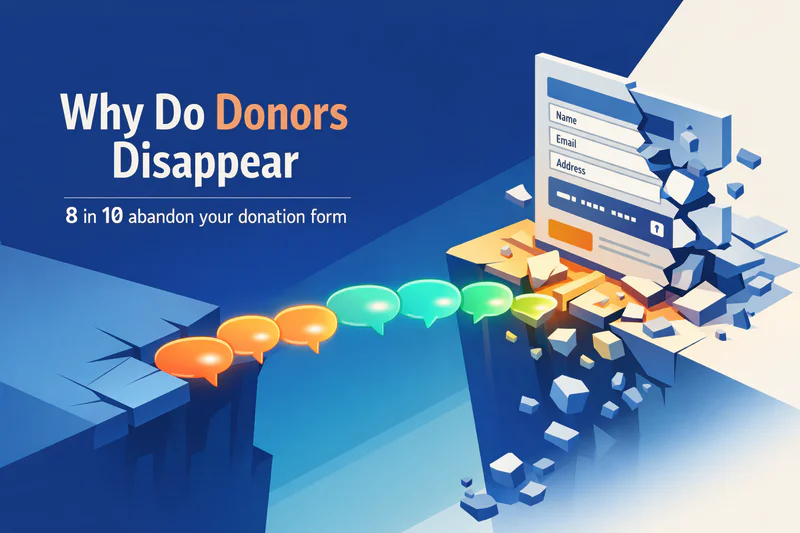
Let's start with a scenario you probably recognize.
A potential donor lands on your website. They're moved. They scroll your mission page, feel a twinge of purpose, and click "Donate Now." Then the form appears. Name. Email. Address. Donation amount. Card number. Security code. Billing address.
They close the tab.
You just lost them and you'll never know why.
This is the everyday tragedy of static web forms. And it's costing the non-profit sector billions.
The Form Is Broken. The Data Proves It!
Non-profits rank second-highest globally in online form abandonment at a staggering 77.9%, trailing only airlines, according to Finances Online form abandonment research. Nearly 8 in 10 people who start your donation form never finish it.
And it gets worse. Only 4% of non-profits currently use smart fundraising forms. Less than 1% use real-time fundraising intelligence, per the 2025 Non-profit Tech for good report.
The average donation page converts at just 12%, according to the 2024 M+R Benchmarks. For CFOs that's the core leak in your acquisition funnel. You're paying to drive traffic, then losing it to friction.
And the fix isn't a shorter form. The fix is no form at all.
It is. And conversational fundraising is the answer.
What Is a Conversation Graph And Why Does It Matter for Fundraising?
Most tools give you a better form. Zigment gives you a living memory of every donor interaction.
The Conversation Graph stores clicks, chats, mood, and intent in a single query-ready timeline capturing the 70% of B2C engagement that now happens outside the clickstream, invisible to legacy tools.
Think about what that means for a fundraiser.
When a visitor asks "Where does my donation go?" that's a trust signal.
When someone asks "Can I give monthly?" — that's a lifetime value signal.
When someone types "I saw your work in Uganda" — that's a passion signal.
A static form captures none of this. Zigment captures all of it, in real time, as structured, query able data.
Unlike a conventional CRM that records what happened, the Conversation Graph records what was said, how it was felt, and what was decided in response. Every node an ad click, a WhatsApp reply, a pledge update becomes part of a living narrative.
For RevOps managers, this is the intent layer you've been missing. You stop optimising for form completions and start optimising for conversation depth a far stronger predictor of donor lifetime value.
The Problem Zigment Was Built to Solve
Most organisations face three compounding problems: fragmented engagement across channels, manual workflows that can't scale, and disconnected data that leaves teams blind.
Every channel switch erases history, forcing donors to repeat themselves while staff scramble for context.
This isn't a minor inconvenience. It's a structural breakdown in the donor journey.
A prospective supporter discovers you on Instagram. They click a Facebook ad. They land on your website and browse your impact stories. They message you on WhatsApp. Then they call.
Five touchpoints. Five data silos. Zero shared memory.
McKinsey data shows that companies with fully instrumented customer journeys realise 5–10% revenue lift and up to 30% higher lifetime value yet fewer than 10% of organisations can track data seamlessly end-to-end.
That 10% gap? That's the competitive edge Zigment closes.
Donor Doesn't Want to Fill Out Your Form. They Want to Talk!
Here's a truth CFOs need to hear: you're not losing donors because your cause isn't compelling.
You're losing them because the experience between "I want to give" and "I gave" has too much friction and zero humanity.
Website visitors are 82% more likely to donate if they're engaged in live chat, according to Fund raise's non-profit chatbot research. Yet only 12% of NGOs worldwide currently have any chatbot on their site. That's an enormous gap and an enormous opportunity.
Think about how people actually make giving decisions. It's not rational. It's emotional. They're moved by a story, a statistic, or a friend's Facebook post. They feel a surge of generosity. That surge has a half-life. If your donation page fails them in those 60 seconds if it loads slowly, asks too many questions, or feels like a tax return the moment is gone.
A conversation extends that moment. It meets donors where they are emotionally. It answers their questions in real time. It guides them, reassures them, and critically it adapts.
The Proof Is Already There. Look at Who's Doing It.
This isn't theoretical. Early adopters are already seeing results.
HIAS (Hebrew Immigrant Aid Society) leveraged AI to analyze communication patterns and predict which donor appeals would drive the highest giving. The result? A 230% increase in contributions.
United Way of New York City deployed an AI chatbot during the COVID-19 pandemic to engage donors in real-time and raised over $50,000 quickly, efficiently, and without the staffing overhead of a human fundraising blitz.
The American Cancer Society ran an AI-optimized donor engagement campaign that generated donation revenue at 117% over benchmark, with a donor engagement rate of nearly 70%, per SAP's nonprofit AI analysis.
These aren't outliers. Organizations using AI for fundraising are seeing 20–30% increases in donations through personalized outreach and conversational engagement, according to Sigma Forces.
Bottom Line
If you're a RevOps manager, you need better data on donor intent not just form completions.
If you're in marketing, you need an engagement layer that works at 11pm when your staff doesn't.
If you're an NGO leader, you need to close the gap between the emotional spike a donor feels and the button they press.
If you're a CFO, you need higher conversion on your existing traffic without increasing acquisition costs.
If you're a CEO, you need a donor experience that reflects the quality of your mission.
Conversational fundraising delivers all of it.
Static web forms are a relic of a different internet one where the ask was "please fill this out" and donors had patience for friction. That internet is gone. Today's donors expect responsiveness, personalization, and a reason to trust you all in under 60 seconds.
Give them a conversation. Watch what happens to your conversion!