
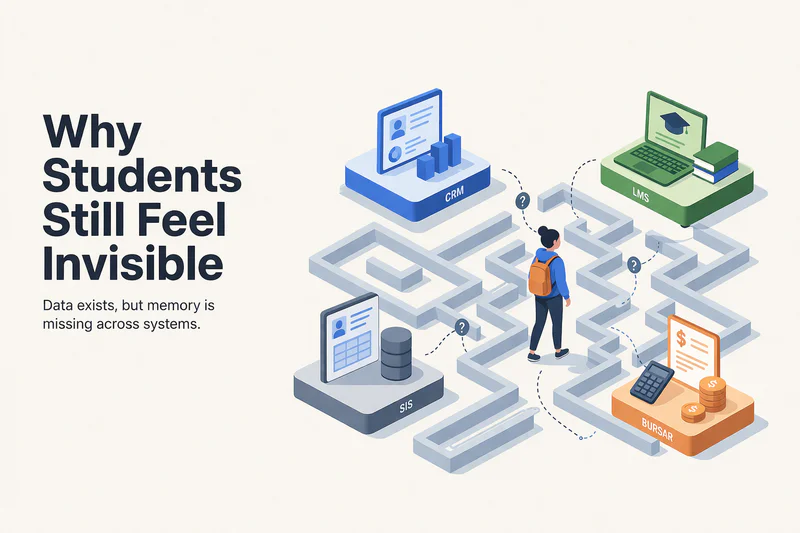
Let’s be brutally honest for a second. Navigating higher education in 2026 often feels like wandering through a giant, high-tech maze while wearing a blindfold.
Meet Maya. Maya is a high-achiever who applied to her dream university six months ago. At 11 PM on a random Tuesday, she chatted with an admissions bot, pouring her heart out about her dream of becoming a marine biologist. She even shared her anxiety about balancing a part-time job with lab hours.
Fast forward to today. Maya is enrolled, but she’s struggling with a complex tuition billing error. When she reaches out to the bursar’s office, the staff treats her like a total stranger. They have no record of her aspirations or her earlier financial concerns. To them, she is just "Student ID #45902."
This is the "Institutional Intelligence Gap." It’s the invisible wall that separates a student's lived experience from the data the institution actually sees. It’s why students feel like a number, and why staff feel like they are constantly playing catch-up.
The Reality of Information Silos in 2026
The core problem isn't a lack of software; it’s a lack of memory. Most institutions operate on static records grades, attendance, and billing. But a student's journey is dynamic, emotional, and happens 24/7.
According to the National Student Clearinghouse Research Center (2025/2026), while undergraduate enrollment rose slightly this year, the competition between institutions is at an all-time high.
Students now expect a "consumer-grade" experience. If they don't feel known, they leave.
Currently, student data is trapped in deep information silos:
The CRM Silo: Great for recruitment, but often goes dark the moment a student deposits.
The LMS Silo: Tracks grades, but misses the "why" behind a sudden drop in performance.
The SIS Silo: Holds the "truth" of the record but lacks the "truth" of the student’s daily struggle.
When these systems don’t talk, you lose context. This fragmentation leads to reactive interventions—the digital equivalent of closing the barn door after the horse has already bolted.
From Generative AI to Agentic Orchestration
We’ve moved past the era of simple "FAQ bots." In 2026, the trend has shifted toward Agentic AI. According to Gartner, worldwide AI spending is skyrocketing, with a heavy focus on Multiagent Systems that don't just talk—they do.
This is where a student success platform needs to evolve. Instead of just another dashboard, institutions need an orchestration layer. This layer creates what we call a Conversation Graph™.
Think of the Conversation Graph as the "connective tissue" of the university. It treats a student's words, mood, and career ambitions as data points just as valid as their GPA. It transforms a standard higher education crm into a living Marketing Memory Bank, ensuring that the "student-of-the-moment" is always recognized as the "alum-of-the-future."
1. Scaling Recruitment: The 24/7 Digital Concierge
In the recruitment phase, speed is the only currency that matters. Today’s applicants don’t want to wait 48 hours for an email. They expect student engagement solutions that feel human and instantaneous.
Real-Time Context: When a prospect asks about a degree at 2 AM, the AI doesn't just send a link. It checks prerequisites in real-time.
Smart Scheduling: It can autonomously verify a student's background and schedule a tour or an interview with a faculty member.
Identity Continuity: It begins the "narrative thread" for that student immediately. Everything Maya shared about marine biology is now part of her permanent, intelligent record.
2. The Advisor’s Co-pilot: Solving the Capacity Crisis
The math of modern advising is broken. Recent data from the American School Counselor Association shows that national student-to-counselor ratios are still hovering around 385:1.
When an advisor is responsible for nearly 400 lives, they can’t be proactive. They are stuck in a cycle of "Talent Dilution," spending 80% of their day on repetitive administrative tasks like course scheduling or syllabus hunting.
By integrating an Advisor's Co-pilot into your academic advising software, the script is flipped:
The AI handles the routine: "When is the drop/add deadline?" "How do I transfer these credits?"
The Advisor handles the complex: Because the AI has cleared their plate, the advisor can spend their time on deep mentorship and high-stakes crisis management.
Proactive Context: Before Maya walks into an advising session, the AI summarizes her recent interactions, highlighting that she’s been asking about "withdrawing" due to work-study stress.
3. Proactive Student Retention Strategies
Legacy university retention software often fails because it relies on "lagging indicators." If you wait until a student fails a midterm to intervene, you’re already too late.
Qualitative signal capture is the 2026 game-changer. By analyzing dialogue, an intelligent layer can spot "intent to drop" or "financial stress" long before it hits the official record.
"Retention isn't a single event; it's a thousand small conversations," says a 2025 Lumina Foundation report.
If Maya mentions she is struggling with transportation in a casual chat about a bursar payment, the system doesn't just process the payment. It triggers student retention strategies like instantly routing her to a student support grant or a local transit program.
4. From Alum to Donor: Keeping the Connection Alive
The most painful break in the student lifecycle usually happens at graduation. The student is "handed off" to alumni relations, and the relationship reset button is hit.
The alum who spent four years telling the university about their passion for social justice suddenly receives a generic "Please Donate to the Football Stadium" email. It’s jarring. It’s impersonal. It’s a wasted opportunity.
Identity continuity ensures that the alum is remembered as the applicant. By using the historical context stored in the Memory Bank, alumni relations can:
Tailor Outreach: Mention their specific capstone project or the professor they bonded with.
Smart Networking: Automatically suggest mentors based on career ambitions they stated three years prior.
Revenue-Focused Actions: Personalized engagement leads to a significant increase in alumni giving rates because the donor feels seen, not just solicited.
The Stateful Brain: Why Zigment.ai Matters
The goal of modern higher education shouldn't just be "graduation" it should be a lifelong partnership. But you can't have a partnership if you don't have a memory.
This is the core purpose of Zigment.ai. We act as the stateful, intelligent brain that sits above your existing tech stack. We don't replace your CRM or your advising tools; we make them smarter by bridging the "Institutional Intelligence Gap."
By using a unified Conversation Graph, Zigment ensures that every interaction from the first inquiry to the first alumni donation is part of one continuous, interconnected story.
We help you move from "automated task firing" to intelligent orchestration. Your staff is empowered, your data is unified, and students like Maya never feel like a number again.
Is your institution ready to stop losing context and start building connections? Let's orchestrate the full student lifecycle together.