
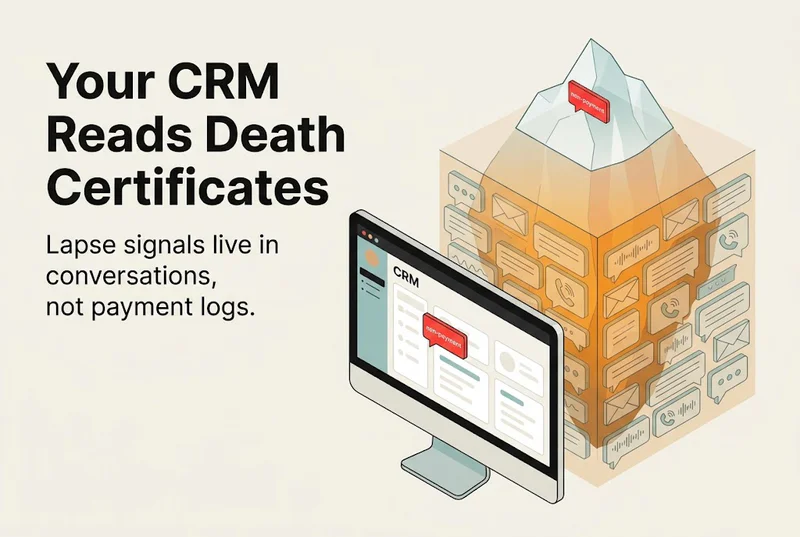
Sarah renewed her auto policy every March for seven years. In January she called about a fender-bender claim. In February she asked her agent about the rate increase on her renewal notice. In March her policy lapsed.
Her insurer's CRM registered one event: non-payment.
Here is what the CRM never captured: the fifteen-minute claims call where Sarah was transferred three times, the email thread about her premium jumping 22%, and the WhatsApp message to her agent that went unanswered for four days. Three signals. Three channels. Zero connection between them.
Insurance customer retention is the practice of keeping policyholders from lapsing, switching, or surrendering their coverage. Most insurers track renewal rates, payment history, and claims frequency. They are watching the actuarial rearview mirror. The signals that actually predict lapse live somewhere else entirely: inside the conversations policyholders have across calls, emails, chat, and agent interactions, weeks before non-payment confirms the decision.
Why Did 29% of Policyholders Switch Insurers Last Year?
The comfortable assumption in insurance goes like this: "We track renewal rates. We send reminders 60 days out. We offer loyalty discounts. Retention is handled."
The numbers say otherwise. 29% of insurance customers switched their insurer in 2025. The percentage of customers who shopped for auto insurance hit a record 57%, up from 49% the year before, according to JD Power research. US P&C personal lines retention sits at 84.2%. One in six policyholders walks away every year.
That is not "retention is handled." That is The Actuarial Blind Spot: the institutional habit of measuring lapse after the policyholder has already decided to leave.
The math compounds quickly. Life insurance lapse ratios jumped from 5.1% in 2023 to 7.0% in 2024. 30% of term life policies lapse before term completion. Policyholders aged 25 to 34 show lapse rates exceeding 18%. A mid-size carrier losing 8,000 policyholders annually at $2,400 average premium forfeits $19.2 million in recurring revenue. Every year. Before acquisition costs enter the equation.
The tools exist. Renewal reminders. Loyalty programs. Agent outreach scripts. The lapse rate climbs anyway.
The problem is not a lack of process. It is a lack of listening.
See how conversation signals detect churn risk early
What Does Traditional Insurance Customer Retention Get Wrong?
Name the signals a standard retention model tracks: payment history lapses. Claims frequency spikes. Coverage downgrades. Renewal dates approaching without confirmation.
Every one of those is a lagging indicator. By the time a policyholder's payment bounces, the decision to leave was made weeks or months earlier. You are reading the death certificate, not the vital signs.
70% of policy lapses stem from non-payment. But non-payment is the last symptom, not the first. Nobody stops paying a policy they still value. Something broke the perceived value long before the payment failed.
Call it The Channel Amnesia Problem. A policyholder calls the claims department about a denied repair in October. She emails her agent about a competitor's rate in November. She messages the chatbot about cancellation terms in December. Three interactions. Three systems. Zero connection between them.
Nobody noticed the trajectory. Not a person. Not a system. Not an algorithm.
Roughly 80% of the most revealing policyholder signals sit trapped in unstructured conversation data, scattered across call centers, agent emails, and chat systems. Traditional insurance customer retention models cannot see them. They were never built to look.
Explore how unified data layers eliminate information silos
How Do Conversation Signals Predict Policy Lapse Before Payment Data Does?
Here is the reframe: stop counting what policyholders do. Start listening to what they say.
Conversational analytics extracts structured intelligence from unstructured interactions. Every claims call, agent email, chat message, and support ticket carries signals that no actuarial model was designed to capture.
Three Signal Types That Surface Lapse Risk Early
Intent signals reveal where a policyholder's decision is heading. Is she comparing competitor quotes? Asking about cancellation penalties? Researching coverage alternatives? Intent tells you the destination before the renewal date confirms it.
Sentiment signals capture the emotional layer. Frustration with a denied claim. Confusion about premium adjustments. Resignation creeping into the tone of an email about coverage options. These patterns surface in word choice, message length, and response timing long before they appear in a lapse report.
Urgency signals flag the clock. A policyholder browsing coverage options six months before renewal carries different weight than one searching cancellation terms two weeks before. The questions might look similar in a keyword filter. The context surrounding them is completely different.
When these three signal types run continuously across every channel, you get something most carriers have never had: a live retention health map per policyholder. It updates with every interaction, not every renewal cycle. The gap between policyholder distress and carrier awareness shrinks from months to hours.
Conversational AI that contacts policyholders 45 to 60 days before renewal, confirms coverage needs, explains rate adjustments, and handles common questions improves retention rates by 12 to 18% while reducing CSR workload during peak periods. Predictive modeling improves early lapse risk identification accuracy by 20%. These are not projections. These are deployed results.
The best predictor of whether a policyholder renews is what she said last month. Not what her payment history said last quarter.
See why stateless bots fail to capture these signals
What Conversation Patterns Signal Lapse Before the Renewal Date?
Call it The Renewal Silence. Policyholders approaching lapse exhibit distinct conversational fingerprints, measurable and consistent across lines of business.
They drift from engagement language ("coverage review," "add a driver," "bundle options") to exit language ("cancellation fee," "transfer policy," "what happens if I don't renew"). Message lengths shorten. Response times to agent outreach stretch. Questions stop being exploratory and become transactional.
Then they stop responding entirely.
The silence is the loudest signal. A policyholder who engaged regularly for years and suddenly goes quiet after a rate increase notice is broadcasting risk. Most retention systems register nothing until the payment deadline passes.
Strong agent relationships reduce life insurance lapse by 40%. That statistic cuts both ways. When the relationship breaks, so does retention. And the relationship breaks in conversations. Not in spreadsheets.
Discover how lifecycle orchestration supports every customer stage
Where Does Insurance Customer Retention Break Across the Policy Lifecycle?
The value of conversation-driven retention compounds at every stage. The signals shift. The extraction mechanics stay the same.
Quoting and onboarding: Prospective policyholders ask dozens of questions across web chat, email, and phone before binding a policy. Insurance customer retention applied at onboarding identifies which prospects carry high commitment versus which ones are price-shopping with no loyalty intent. Your underwriting team stops distributing equal effort across every application.
How Signals Shift at Each Lifecycle Stage
Claims and mid-term engagement: The Claim Scar is real. One bad claims experience poisons the renewal decision months later. Sentiment shifts during claims conversations, changes in support ticket language, and declining interaction frequency build a composite risk profile over time. The carrier that detects frustration during a claims call in September can intervene before the renewal decision in March. Not after.
Renewal window: Policyholders approaching renewal who shift from active engagement to silence or terse one-word responses are broadcasting risk. Proactive outreach triggered by conversation signal changes recovers policyholders who would otherwise lapse without a word. Carriers using AI-driven renewal engagement report retention improvements between 12% and 18%.
Win-back: Former policyholders who left over a specific, identifiable grievance are recoverable. Conversation data tells you exactly why they left. Generic "we want you back" campaigns ignore that intelligence. Signal-informed win-back matches the outreach to the original pain point.
47% of insurance executives already use AI daily. The adoption gap is not technology. It is connecting AI to the conversation data where retention signals actually live.
See how conversational AI is changing banking customer journeys
Why Do Generic AI Deployments Fail in Insurance?
Production deployment of customer-facing AI outside claims and intake remains well below 50% across the insurance industry. Renewal outreach sits mostly in pilot phase. The reason matters for any carrier building an insurance customer retention strategy.
Call it The Reset Problem. A policyholder calls about a claim in January. She chats about her premium in February. The chatbot treats her as two separate strangers. Conversation resets. Context discarded. No pattern builds across touchpoints.
Every session starts from zero. The intelligence that would reveal lapse risk gets thrown away after every exchange.
How the Conversation Graph Prevents Resets
Effective insurance customer retention requires stateful systems: platforms that maintain a continuous timeline of every interaction, across every channel, for every policyholder. Where the claims call connects to the agent email, connects to the chat inquiry, connects to the renewal outreach. One thread per policyholder. No resets. No gaps.
80% of inbound volume at independent agencies is voice. That is an ocean of unstructured signal data that most retention systems discard after the call ends. Carriers achieving 92% retention in digital channels are not running better chatbots. They are running systems that remember.
The carriers getting this right are not buying more tools. They are connecting the ones they already have into a system that listens.
Read why automation without intelligence runs blind
Building the Intelligence Layer That Connects Every Signal
The missing piece in most retention stacks is not another dashboard. Not another chatbot. It is the connective layer that turns fragmented policyholder conversations into a unified intelligence stream.
Zigment's Conversation Graph provides exactly this: a single timeline per policyholder across every channel and system. Claims calls, agent emails, chat messages, and support interactions feed into one living record that captures intent, sentiment, context, and urgency over time. Underwriting teams, agents, and retention specialists work from the same picture instead of their own partial view.
When a conversation signal indicates lapse risk, the system triggers the appropriate response: a warm agent callback, a premium review offer, a coverage adjustment recommendation. The intervention matches the signal. The policyholder experiences continuity instead of the institutional silence that typically precedes lapse.
Carriers connecting their insurance customer retention strategy to conversation data are not predicting lapse after the fact. They are preventing it by acting on signals their current systems were never built to see.
What Actually Determines Whether a Policyholder Renews or Lapses?
Remember Sarah? She did not lapse because she stopped paying. She stopped paying because she was already gone. The claims call in January, the premium email in February, and the unanswered WhatsApp in March told that story clearly. Nothing in her carrier's stack was listening.
Most retention strategies work backward: analyze who lapsed, build a profile from the wreckage. Conversational analytics reverses the direction. It listens to what policyholders are saying right now and surfaces the patterns that predict what happens next.
The 57% shopping rate will not pause for your carrier to catch up. Your institution already has the conversation data. Every claims call. Every agent email. Every chat exchange.
The question worth sitting with: is anything in your current stack actually listening?