# Lifecycle Marketing Tools vs. Orchestration Platforms: Which One Do You Actually Need?
Author: Team Zigment
Author URL: https://zigment.ai/blog/author/team-zigment
Published: 2025-12-22
Category: Lifecycle marketing
Category URL: https://zigment.ai/blog/category/lifecycle-marketing
Tags: Lifecycle Marketing, modern data orchestration, Marketing Solution
Tag URLs: Lifecycle Marketing (https://zigment.ai/blog/tag/lifecycle-marketing), modern data orchestration (https://zigment.ai/blog/tag/modern-data-orchestration), Marketing Solution (https://zigment.ai/blog/tag/marketing-solution)
URL: https://zigment.ai/blog/lifecycle-marketing-tools-vs-orchestration-platforms
Imagine your marketing stack is a world-class orchestra. You’ve got the best violinists (HubSpot), a killer cellist (Klaviyo), and a powerhouse percussionist (Salesforce).
The problem? They’re all playing from different sheet music. In different rooms. At different tempos.
That’s what happens when you rely solely on lifecycle marketing tools.
You’ve got great lifecycle marketing software automating your emails and customer lifecycle software tracking your stages, but they aren't talking to each other. The result? Your prospect gets a "20% off" coupon for a product they just returned, while your sales team is simultaneously calling them to upsell.
Book a Journey Orchestration Walkthrough
> Customers say the experience is just as important as the product.. Yet most tools are built to manage _stages_, not _people!_
So, when do you stick with your current lifecycle marketing software, and when do you need a true marketing [orchestration](https://zigment.ai/blog/marketing-orchestration-tools) platform?
Let’s break down the technical divide and help you figure out if you're building a journey or just a series of disconnected steps.
## **What Lifecycle Marketing Tools Are Really Built to Do?**
Let's start with what these tools excel at. Because they do solve real problems!
Lifecycle marketing tools organize customers into stages and automate communication at each stage. They're designed to:
- Scale repeatable programs across acquisition, onboarding, engagement, and retention
- Reduce manual campaign execution
- Ensure consistency across marketing initiatives
- Trigger campaigns based on milestones or time-based rules
Here's what they handle brilliantly: welcome sequences. Cart abandonment emails. Renewal reminders. Anything with predictable triggers and linear paths.
### **But here's where expectations diverge from reality.**
Most teams invest in lifecycle marketing software expecting intelligent, context-aware personalization. What they get is structured [automation](https://zigment.ai/blog/journey-orchestration-vs-marketing-automation). The tool moves customers from Stage A to Stage B based on actions you programmed, but it doesn't adapt to shifting intent or cross-channel behavior without constant manual intervention.
Lifecycle marketing tools manage stages. Orchestration platforms manage journeys. That difference is everything.
Evaluate Your Lifecycle Stack
## **_Lifecycle Marketing Software vs. Orchestration Platforms: A Functional Comparison_**
_Understanding the technical divide is critical for making the right investment. While they may seem similar, their underlying architecture serves different purposes._
_Function_
_Lifecycle Marketing Software_
_Orchestration Platforms_
**_Data Processing_**
_Batch or trigger-based within its own system._
_Continuous, real-time ingestion from the entire stack._
**_Logic Structure_**
_Static "If/Then" workflows (Linear)._
_Dynamic "Next Best Action" (Non-linear)._
**_Customer View_**
_Tool-centric (sees only what it sends/tracks)._
_Holistic Single Customer View (SCV)._
**_Decision Speed_**
_Dependent on data sync intervals._
_Instantaneous based on live intent signals._
**_Coordination_**
_Operates in a silo._
_Acts as a conductor for all other tools._
**_Complexity Handling_**
_Becomes "brittle" with too many branches._
_Designed for multi-path, chaotic journeys._
**_Primary Goal_**
_Executing channel-specific tactics._
_Preserving context across the lifecycle._
**_Feedback Loops_**
_Manual optimization of workflows._
_Autonomous learning and journey adjustment._
## **When Lifecycle Marketing Software Is Enough (And When It's Not)!**
Let's be clear. Not every team needs [a marketing](https://zigment.ai/blog/what-is-marketing-orchestration) orchestration platform!
The decision shouldn't be based on trends or vendor hype. It should map to the actual complexity of journeys you need to execute.
### **Customer lifecycle software remains sufficient when:**
- Your journeys are relatively simple and linear
- Your channels are limited (mostly email + maybe one other)
- Your personalization needs are basic (segment-level targeting works)
- Your product is straightforward with clear use cases
- Your customer base is relatively homogeneous
### **You've outgrown this architecture when:**
- Journeys regularly span multiple systems that don't talk to each other
- Integrating marketing automation tools manually consumes significant operations time
- Timing and context significantly impact conversion
- Real-time decisions directly affect revenue
- Information silos prevent you from maintaining single customer view (SCV)
- Competition forces more sophisticated engagement
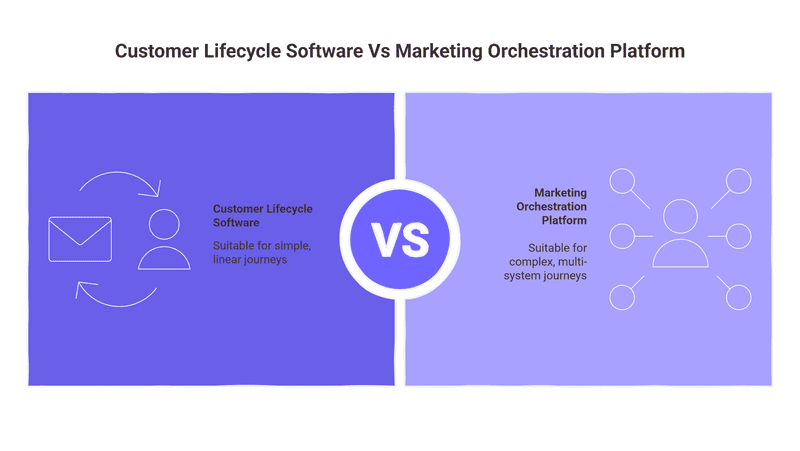
The signal isn't that your lifecycle marketing tools stop working. It's that achieving personalization goals requires exponentially more manual effort in integrating marketing automation tools and managing workflows.
You're constantly building workarounds. Custom integrations. Coordination processes. All to make disconnected systems behave as a unified experience.
Orchestration platforms aren't for everyone. But they become unavoidable when the gap between what customers expect and what your lifecycle marketing software can deliver starts costing revenue.
Request a Demo
## Lifecycle Marketing Software Struggles With Real-Time, Cross-Channel Personalization
Most customer lifecycle software operates in the category of marketing automation. It processes actions in scheduled intervals using predefined workflows.
The problem? Customer intent lives outside any single tool.
Intent is in your CRM when sales logs a call. It’s on your website when someone explores enterprise pricing. It’s in support tickets.
> When a lifecycle tool tries to personalize based only on what it sees, the result is "personalization lag."
>
> You get a scenario where a customer researching enterprise features gets nurtured as a small business prospect because your email software doesn't "know" what happened in the CRM five minutes ago.
## **Choosing the Right Tool: Lifecycle Marketing Software vs. Orchestration Platforms**
To help you identify where your tools are breaking down, refer to this comparison of how popular lifecycle marketing tools perform and where they reach their limits.
#### Lifecycle Marketing Tools vs Orchestration Need — Evaluation Chart
Tool
What It’s Good At (Why Teams Use It)
Where It Hits a Ceiling
Why an Orchestration Platform Is Needed
**HubSpot**
No-code workflows, lifecycle stages, email + CRM alignment
Automation limited to HubSpot-owned data; weak visibility into product usage, support, or sales actions
Unifies HubSpot with CRM, product, and support data into a Single Customer View (SCV) and coordinates journeys beyond email
**Marketo**
Advanced lead scoring, B2B nurturing, enterprise-scale programs
Static triggers tied to Marketo events; can’t adapt to real-time intent outside Marketo
Orchestration listens to live signals across web, CRM, and support to dynamically adjust journeys
**Klaviyo**
Ecommerce flows, revenue attribution, Shopify-native triggers
Email-centric execution; poor coordination with CRMs, sales, or support tools
Orchestration connects ecommerce behavior with post-purchase, retention, and service journeys
**ActiveCampaign**
Affordable SMB automation, email + SMS, site tracking
Limited omnichannel depth; journeys become brittle as channels grow
Orchestration manages cross-channel journeys involving apps, chat, sales, and customer success
**Braze**
Real-time mobile & in-app messaging, event-driven personalization
Mobile-first data silos; weak coordination with email, CRM, or support
Orchestration breaks channel silos and coordinates mobile intent across the full lifecycle
**Salesforce Marketing Cloud**
Enterprise scale, Salesforce-native data, Einstein insights
Preset journey paths; AI insights don’t execute autonomously across tools
Orchestration converts predictions into revenue-focused autonomous actions across the stack
**Iterable**
Cross-channel campaigns, experimentation, flexible segmentation
Campaign-centric logic; no persistent memory across tools and time
Orchestration creates a Marketing Memory Bank that preserves context across journeys
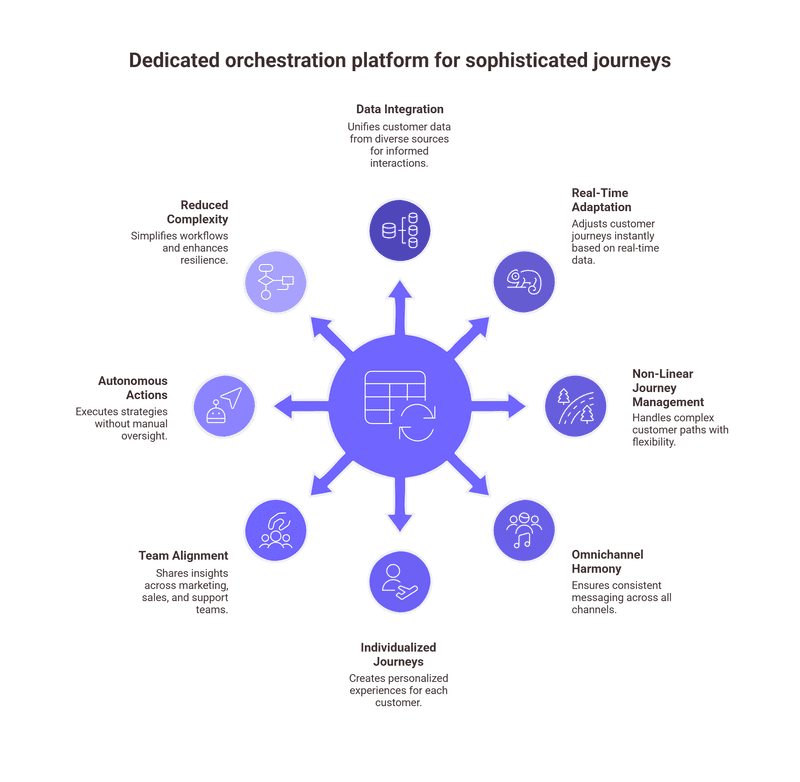
## Why you need a dedicated orchestration platform for sophisticated journeys?
### 1\. Breaking Cross-Channel Data Silos
Sophisticated personalization requires a unified view of the customer that spans your entire stack. Orchestration platforms pull data from disparate sources CRM, support tickets, web analytics, and product usage to ensure that every interaction is informed by the customer’s complete history, not just their latest email click.
### 2\. Real-Time Adaptation to Shifting Intent
Traditional lifecycle tools often rely on periodic data syncs, which can cause "personalization lag." An orchestration platform processes data in real-time, allowing you to pivot a customer’s journey instantly. If a user explores enterprise pricing on your site, the orchestrator can immediately suppress "basic plan" ads and trigger a high-touch sales outreach.
### 3\. Management of Non-Linear Journeys
[Modern](https://zigment.ai/blog/data-orchestration-tools-how-they-power-modern-business) customer paths are rarely a straight line from awareness to purchase. Customers frequently "loop" back to research or jump ahead to support. Orchestration platforms are built to handle this chaos, allowing customers to move between stages based on their actual behavior rather than a rigid, pre-defined flowchart.
### 4\. Contextual Omnichannel Harmony
Without orchestration, different tools might send conflicting messages—like a chatbot offering a discount while a sales rep pitches full price. A dedicated platform coordinates timing and content across all channels (Email, SMS, In-app, Social) to ensure the brand speaks with one voice and never "over-solicits" the user.
### 5\. Transition from Segments to 1:1 Individualization
While most automation tools rely on broad segments (e.g., "Inactive Users"), orchestration enables individualized journeys. It uses AI to determine the "Next Best Action" for each specific person, taking into account their unique preferences, past frustrations, and current engagement level.
### 6\. Alignment of Marketing, Sales, and Support
Sophisticated journeys don't stop at the marketing department. Orchestration platforms bridge the gap between teams by sharing insights across the organization. For example, if a customer has an open "high-priority" support ticket, the orchestrator can automatically pause all promotional marketing until the issue is resolved, preventing a brand-damaging experience.
### 7\. Execution of "Revenue-Focused" Autonomous Actions
Advanced orchestration layers can act as "agents" that execute strategy without manual oversight. By interpreting real-time signals, they can autonomously decide when to send a loyalty offer to prevent churn or when to escalate a trial user to a demo based on their product activity.
### 8\. Reduced Operational Complexity and "Brittle" Workflows
As you add more tools, simple automation becomes "brittle" one change in your CRM can break dozens of disconnected workflows. An orchestration platform centralizes your logic. This "hub-and-spoke" model makes your stack more resilient and allows your team to focus on high-level strategy rather than "fixing the plumbing."
## **Why the Future of Lifecycle Marketing Depends on Orchestration**
Stack complexity isn't decreasing. Personalization expectations aren't moderating. The limits of stage-based lifecycle marketing software aren't going away.
Here's what's actually happening:
Lifecycle marketing tools remain essential for channel-specific execution. You still need email platforms, CRM systems, advertising tools, and customer success software. These tools won't disappear. They'll continue improving at what they do.
What changes is the addition of an orchestration platform that solves the architectural problem these tools can't address individually.
That problem?
Unified intelligence that coordinates actions based on complete customer context while breaking down information silos and maintaining single customer view (SCV).
At Zigment, we believe the gap isn't just about "better syncs" it’s about intelligence. We don’t just add another silo; Zigment acts as the **Agentic AI Orchestration** layer. We’re the conductor that sits above your stack, making every tool you already own smarter by executing high-level strategy in real-time.
It's when you'll make that strategic shift before competitors do.
## FAQs
Q: What’s the difference between lifecycle marketing tools and orchestration platforms?
A: Lifecycle marketing tools (HubSpot, Klaviyo) automate stages with static triggers. Orchestration platforms (Zigment) conduct journeys across your stack like a real-time orchestra, creating a single customer view (SCV).
Q: When do I need a marketing orchestration platform vs lifecycle marketing software?
A: You need orchestration when lifecycle marketing software creates information silos, journeys span multiple tools, or real-time personalization drives revenue. For simple linear flows, customer lifecycle software is sufficient.
Q: Can HubSpot or Marketo replace a journey orchestration platform?
A: No. HubSpot handles no-code workflows; Marketo excels at lead scoring. Both are siloed and can’t access CRM or support data. Orchestration platforms unify these tools into a single customer view.
Q: What’s marketing automation vs journey automation?
A: Marketing automation = lifecycle marketing tools executing preset rules (e.g., email opens → nurture). Journey automation = orchestration platforms adapting to live signals across channels like a conductor.
Q: Do I need orchestration if I already use Salesforce Marketing Cloud?
A: Salesforce MC scales enterprise campaigns but follows preset paths. Orchestration platforms convert Einstein AI predictions into revenue-focused autonomous actions across the entire stack.
Q: What’s a single customer view (SCV) and why can’t lifecycle tools create it?
A: SCV = a 360° customer profile across HubSpot, CRM, and support. Lifecycle tools only see their own data (information silos). Orchestration platforms unify all sources for complete context.
Q: Can ActiveCampaign or MoEngage handle sophisticated omnichannel journeys?
A: ActiveCampaign is strong for SMB automation; MoEngage focuses on app engagement. Both lack cross-channel coordination. Orchestration platforms manage seamless email → app → sales → support journeys.
Q: What’s the ROI of marketing orchestration platforms vs lifecycle tools?
A: Orchestration platforms deliver 13% conversion uplift, 259% AOV increase, and 3x engagement via revenue-focused autonomous actions. Lifecycle tools provide only campaign-level metrics.
Q: Do orchestration platforms replace my existing lifecycle marketing stack?
A: No. An agentic AI layer for your marketing stack (Zigment) sits above HubSpot, Klaviyo, and Salesforce, making them smarter without replacing existing tools.
Q: How do I know I’ve outgrown my customer lifecycle software?
A: Red flags: tool sprawl, manual integrations, personalization lag, and sales/marketing misalignment. Orchestration platforms solve these by breaking information silos and enabling scalable journeys.
Q: What’s a journey automation tooling stack comparison?
A: Lifecycle tools: static, siloed, campaign-centric. Orchestration platforms: dynamic, SCV-based, integrated, and journey-centric. Your blog chart visualizes this evaluation clearly.
Q: Why can’t lifecycle marketing tools handle real-time personalization?
A: Lifecycle marketing software processes batch data with hourly or daily syncs. Orchestration platforms respond to live intent signals, allowing instant journey pivots based on customer behavior.
---
This blog is powered by Superblog. Visit https://superblog.ai to know more.
---