# MDM vs. CDP for Customer Master Data Management
Author: Team Zigment
Author URL: https://zigment.ai/blog/author/team-zigment
Published: 2025-12-11
Category: Data layer
Category URL: https://zigment.ai/blog/category/data-layer
Tags: customer data platforms, Master Data Management, Customer MDM
Tag URLs: customer data platforms (https://zigment.ai/blog/tag/customer-data-platforms), Master Data Management (https://zigment.ai/blog/tag/master-data-management), Customer MDM (https://zigment.ai/blog/tag/customer-mdm)
URL: https://zigment.ai/blog/mdm-vs-cdp-for-customer-master-data-management
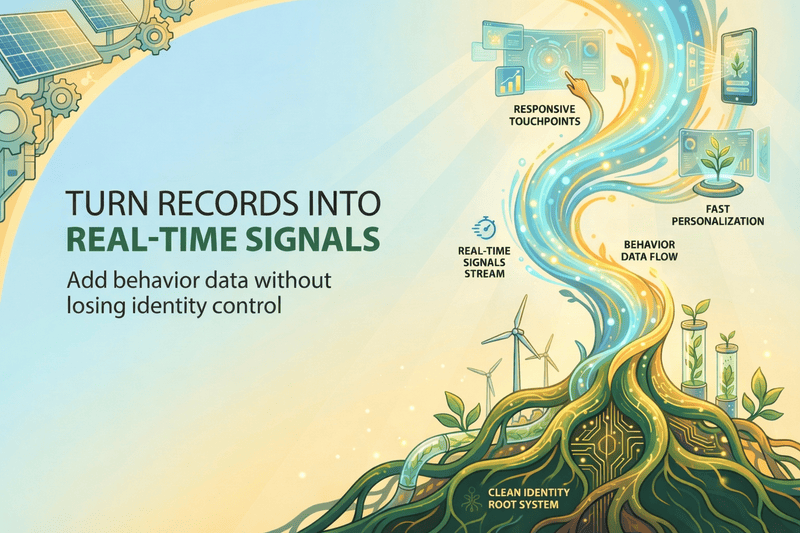
Every executive believes they have a customer data problem. Most are solving the wrong one.
Your CFO sees financial risk inconsistent records creating billing errors and compliance nightmares.
Your CMO sees lost revenue unable to personalize because data arrives too late. Your CIO sees chaos dozens of systems each claiming customer truth. They're all right, but they need fundamentally different solutions.
Customer MDM and CDP aren't competing products. They're purpose-built machines solving opposite problems with the same asset: your customer master database. Both promise to deliver [effective customer master data management](https://zigment.ai/blog/customer-data-management), but through radically different approaches.
MDM (Master Data Management) answers:
"Which customer record can we trust in court, on financial statements, and across enterprise systems?"
It's the backbone of regulatory compliance, governance, and transactional integrity. This is customer master data management built for control and accuracy.
CDP (Customer Data Platform) asks: "Can we act on what this customer just did right now?" It thrives on behavioral data, real-time activation, and marketing speed.
The million-dollar mistake?
Buying software based on vendor promises rather than understanding which problem is killing your business. One system prevents disasters. The other drives growth. Knowing which battle you're fighting determines everything.
Discover the Right Architecture for Your Business
## **Customer MDM: The Traditional Master Data Approach**
### **What is Customer MDM Designed For?**
Customer MDM emerged from enterprise IT departments with a focused mandate: establish authoritative control over master data entities.
It functions as the system of record for customer information, prioritising cataloguing, governance, and ensuring every record adheres to defined standards.
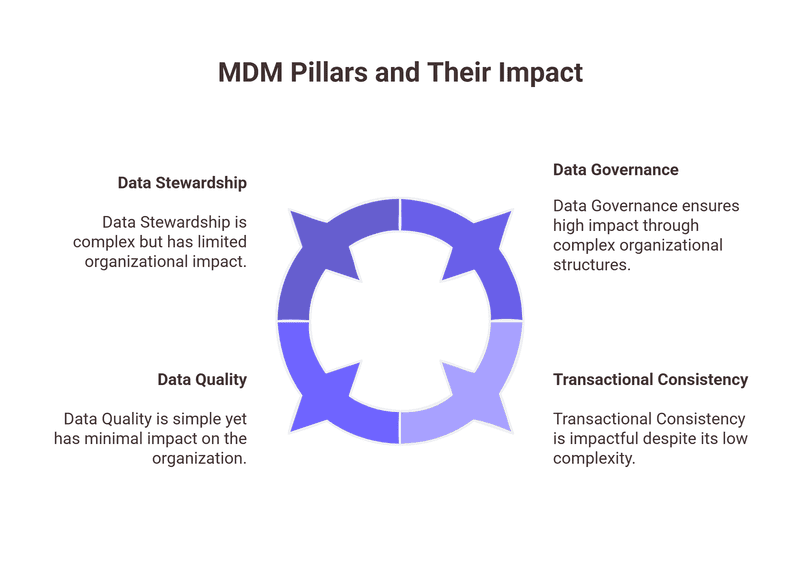
**Four Core Pillars of MDM:**
- **Data Governance** – Defines ownership rights, modification permissions, and approval workflows for customer data across the organisation.
- **Data Quality** – Ensures records meet established standards for completeness, accuracy, and consistency through systematic validation.
- **Data Stewardship** – Assigns designated personnel with accountability for maintaining data integrity within specific business domains.
- **Transactional Consistency** – Guarantees reliable propagation of customer information updates across all integrated enterprise systems.
### **The Golden Record Advantage**
MDM’s core strength is creating a single, authoritative golden record for every customer.
It resolves data conflicts across systems for example, ERP shows a 50,000 credit limit while CRM shows 75,000; MDM decides using predefined rules.
This makes MDM crucial for organisations where customer master data management influences financial reporting, compliance, and complex B2B structures.
### **The Limitations in the Age of Agility**
The same architecture that makes MDM stable also makes it slow.
Most MDMs rely on batch updates (nightly/hourly), which worked in traditional sales cycles but fail in today’s real-time digital experiences.
Customers expect instant personalization MDM simply can’t keep up.
### **Behavioural Data Integration Challenges**
Modern customers generate hundreds of behavioural events per session.
MDM was built for structured data (names, addresses, transactions), not high-volume behavioural signals.
This mismatch leads to data integration issues, delayed processing, and broken real-time use cases.
### **Organizational Agility Constraints**
Adding new data sources requires heavy IT lift: scoping, custom integrations, and change management.
Fast-moving marketing teams adopt new tools frequently MDM becomes a bottleneck.
Strong governance ensures quality but also slows innovation, creating friction between IT and business teams.
See How Real-Time Data Could Transform Your Revenue
## **Customer Data Platforms (CDP): The Marketing-Centric Solution**
### **What is a CDP Built to Do?**
Customer Data Platforms emerged from a distinct challenge—marketing technology teams requiring immediate access to actionable customer data. While MDM asks "Is this data perfect?", CDP asks "Can I use this data right now?"
### **Unified Customer Profiles with Behavioural Intelligence**
CDPs unify identity, transactions, and high-volume behavioural data (clicks, app interactions, email engagement, social activity).
Turns static records into dynamic intent-driven profiles.
### **Real-Time Marketing Activation**
The core purpose of a CDP: instant activation.
Cart abandoned → retargeting in seconds.
Pricing page viewed multiple times → sales alerted immediately.
Data → action without delay.
### **Continuous Identity Resolution**
CDPs stitch anonymous + known identifiers in real time.
Profiles update continuously across devices and channels no batch processing.
### **Its Relationship with Customer Master Data Management**
CDPs perform customer master data management, but with a fundamentally different operational philosophy. Where MDM prioritizes governance and absolute accuracy, CDP prioritizes completeness and velocity. A CDP delivers an 80% accurate profile available for marketing immediately rather than waiting for a 100% accurate profile after extensive validation.
This approach doesn't indicate negligence toward data quality. Modern CDP platforms incorporate identity resolution algorithms, deduplication logic, and data quality validation. However, these capabilities serve marketing activation objectives rather than enterprise governance mandates. The CDP's version of a golden record optimizes for personalization and segmentation effectiveness, not financial reporting accuracy or regulatory compliance requirements.
## **MDM vs. CDP on Criteria Comparison**
Feature
Customer MDM
Customer Data Platform (CDP)
**Primary Goal**
Data Governance, Compliance, Transactional Integrity
Marketing Activation, Personalization, Unified Customer View
**Data Focus**
Identity, Attributes, Structured Transactional Data
Behavioral, Identity, Unstructured, and Structured Data
**Data Speed**
Batch Processing, Near Real-Time
True Real-Time (Event-Driven)
**Key Users**
IT, Data Governance, Compliance
Marketing, RevOps, Customer Success
**Solving Data Integration Challenges**
Integrates core systems (ERP, CRM) via ETL/APIs; focus on cleanliness
Integrates all sources (Web, Mobile, MarTech) via APIs/Webhooks; focus on activation
**Achieving Customer Master Data Management**
The primary goal (governance perspective)
A necessary function performed to enable activation (marketing perspective)
**Implementation Timeline**
6-18 months typically
1-3 months for basic functionality
**Flexibility**
Rigid, requires IT involvement for changes
Self-service, marketers can add sources
**Cost Structure**
Large upfront investment, long-term contracts
SaaS model, scales with usage
The table reveals a fundamental truth: these systems optimize for different outcomes. Customer MDM treats data integration challenges as a governance problem requiring careful architecture and oversight. CDPs treat the same challenges as an activation problem requiring speed and flexibility.
Checkout the [Customer Data Management: Benefits, Types, and Key Challenges](https://zigment.ai/blog/what-is-customer-data-management-benefits-types-challenges)
## **When to Use Which: Aligning Architecture with Strategy**
Decision Criteria
Choose Customer MDM
Choose CDP
**Primary Strategic Driver**
Governance, compliance, and risk mitigation
Marketing agility and revenue growth
**Industry Context**
Highly regulated industries (financial services, healthcare, insurance)
Digital-first businesses (e-commerce, SaaS, media, D2C brands)
**Regulatory Requirements**
HIPAA, financial regulations, audit trails, regulatory compliance reporting mandatory
Marketing performance and customer experience optimization prioritized
**Organizational Complexity**
Large B2B enterprises with complex account hierarchies, multiple subsidiaries, multi-entity structures
B2C or simple B2B models with streamlined customer relationships
**Core System Integration**
Customer master database must serve ERP, billing, financial reporting, accounting systems
Integration with marketing technology stack (email, ads, analytics, personalization)
**Data Quality Priority**
100% accuracy required for financial reporting, legal obligations, transactional consistency
80% accuracy sufficient if available immediately for marketing activation
**Processing Architecture**
Batch processing (nightly/hourly) aligns with monthly invoicing, quarterly reporting
Real-time, event-driven architecture for millisecond-level responsiveness
**Primary Data Types**
Structured transactional data (demographics, addresses, purchase history, contracts)
Behavioral data (clickstream, email engagement, mobile interactions, social activity)
**User Base**
IT, finance, operations, compliance teams requiring centralized governance
Marketing, customer experience, sales teams needing self-service capabilities
**Change Velocity**
Stable data requirements; formal change management acceptable
Rapid tool adoption (quarterly); new platforms require immediate integration without IT bottlenecks
**Time-to-Value**
Months to quarters; extensive planning and governance setup required
Weeks; rapid deployment and immediate marketing impact
**Key Capabilities**
Golden record management, data governance frameworks, stewardship, audit trails
Unified customer profiles, segmentation, personalization, audience activation
**Data Integration Issues Solved**
Consistency across enterprise transactional systems (ERP, CRM, finance)
Marketing technology fragmentation; dozens of disconnected tools
**Success Metrics**
Data accuracy, compliance adherence, audit readiness, system consistency
Marketing performance, conversion rates, personalization effectiveness, campaign velocity
## **The Partnership Approach: Best of Both Worlds**
System
Role in Integrated Architecture
Key Responsibilities
**Customer MDM**
System of Record
Maintains authoritative golden record for customer identity
Handles governance, compliance, regulatory reporting
Integrates with core transactional systems (ERP, finance, billing, CRM)
Ensures data quality for legal and financial requirements
**CDP**
System of Engagement
Consumes authoritative identity data from MDM
Adds behavioural data layers and real-time interaction tracking
Enables marketing activation, personalization, audience orchestration
Provides self-service capabilities for marketing teams
**Combined Value**
Enterprise Excellence
Solves data integration challenges across all organizational levels
IT maintains governance through MDM; marketing drives agility through CDP
Eliminates governance-versus-speed tension
Customer master data management rigor + real-time marketing activation
See How Leading Brands Balance MDM and CDP
## **Making the Right Choice: Strategy Over Features**
The decision between Customer MDM and CDP isn't really about feature checklists or vendor capabilities. It's about your organization's strategic priorities and the customer experience you're building.
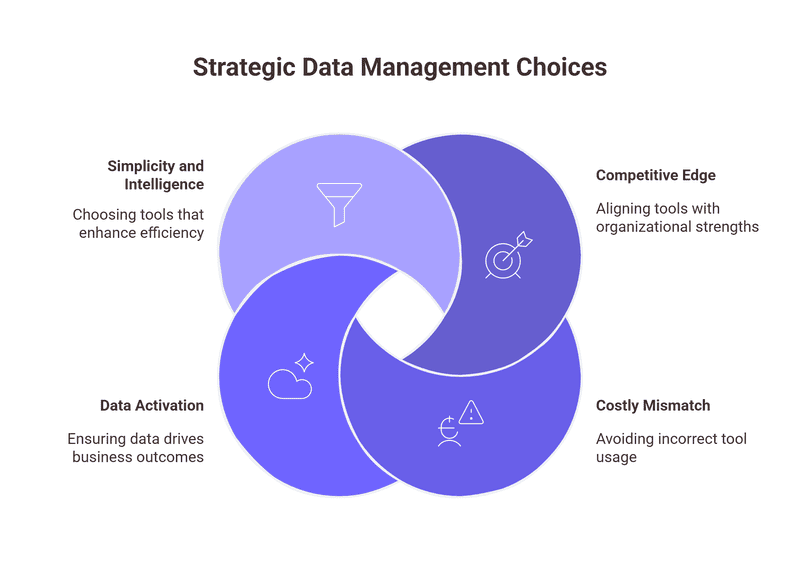
**1\. Know Your Competitive Edge**
- If your strength is operations, compliance, or complex customer hierarchies, MDM is your foundation.
- If you win through personalization, speed, and marketing agility, a CDP clears the data integration challenges blocking your growth.
### **2\. Avoid the Costly Mismatch**
The real mistake?
Using the wrong tool for the wrong job.
- A CDP is not a governance system.
- MDM is not a marketing activation engine
- Trying to force either into the wrong role guarantees years of frustration.
### **3\. Your Data Should Actually Work**
Your customer master database shouldn’t be a dusty compliance artifact—it should actively power better decisions, better experiences, and better revenue outcomes.
### **4\. Choose Simplicity, Build Intelligence**
Pick the tool that reduces complexity, not adds to it.
That’s how you create a real-time customer intelligence engine that helps your business thrive, not just survive.
## FAQs
Q: What are the key differences between Customer MDM’s batch processing for transactional consistency and CDP’s event-driven real-time activation for marketing personalization in regulated industries?
A: Customer MDM systems are designed for transactional consistency and regulatory correctness. They rely on batch-oriented ETL processes to reconcile customer data across ERP, CRM, billing, and finance systems, producing golden records that prioritize accuracy, auditability, and stability.
CDPs, by contrast, operate on event-driven architectures optimized for speed. They ingest real-time behavioral signals (web, email, product, ads) to enable immediate marketing activation. In regulated industries, this means CDPs often trade absolute accuracy for timely relevance, while MDMs trade speed for governed correctness.
Q: How does Customer MDM’s focus on data governance pillars like stewardship and quality rules differ from CDP’s emphasis on continuous identity resolution for omnichannel profiles?
A: MDM platforms enforce formal governance models: named data owners, stewardship workflows, validation rules, survivorship logic, and approval gates. This ensures compliance with regulations such as SOX, HIPAA, and GDPR, but introduces operational friction.
CDPs prioritize continuous identity resolution, stitching together known and anonymous signals in real time across channels. This process is probabilistic, automated, and marketer-driven, enabling fast omnichannel personalization without heavy IT involvement—but with looser governance controls.
Q: In what ways do MDM solutions resolve structured data conflicts like credit limit discrepancies across ERP and CRM versus CDP’s handling of high-volume behavioral events from web and mobile?
A: MDM resolves conflicts in structured, authoritative data by applying predefined rules (system precedence, survivorship logic, manual review). For example, it determines the correct credit limit or legal entity across ERP and CRM systems.
CDPs are built to process high-volume, high-velocity behavioral events such as clicks, sessions, and product usage. While they excel at real-time activation, they are not optimized to reconcile deeply structured conflicts or enforce strict data correctness.
Q: What challenges arise when integrating new MarTech sources into rigid MDM architectures compared to self-service APIs in CDPs for fast-moving RevOps teams?
A: MDM integrations typically require IT-led change management, schema modeling, governance approvals, and regression testing—often taking 6–18 months. This rigidity limits agility for marketing teams.
CDPs expose self-service APIs and connectors, allowing RevOps teams to onboard new MarTech tools in weeks. This flexibility accelerates experimentation but shifts responsibility for data hygiene and consistency closer to the business.
Q: When should highly regulated B2B enterprises with complex hierarchies choose MDM over CDP for financial reporting and HIPAA compliance rather than marketing agility?
A: Enterprises in finance, healthcare, manufacturing, and regulated services should prioritize MDM when:
Financial reporting accuracy must be 100%
Legal entity hierarchies are complex
Auditability and lineage are mandatory
CDPs are better suited to SaaS and digital-first B2B organizations where revenue growth, personalization, and speed matter more than absolute data precision.
Q: How do implementation timelines and costs differ for MDM’s large upfront investments versus CDP’s SaaS scaling for digital-first businesses facing data silos?
A: MDM implementations involve significant upfront investment, including data modeling, governance design, and systems integration—often spanning multiple quarters.
CDPs follow a SaaS deployment model, delivering weeks-to-value with lower initial costs and usage-based pricing. This makes them attractive for teams needing fast relief from data silos.
Q: How can enterprises combine MDM as the system of record with CDP as the system of engagement to eliminate IT-marketing friction in customer master data management?
A: In a hybrid architecture:
MDM serves as the system of record, ensuring clean identities, hierarchy management, and compliance
CDPs consume governed identities from MDM and layer real-time behavioral intelligence for activation
This separation allows IT to maintain control while marketing gains agility—reducing friction without sacrificing trust.
Q: What benefits emerge from MDM providing data lineage and quality for AI initiatives alongside CDP’s real-time insights for targeted B2B campaigns?
A: This hybrid model ensures:
MDM prevents AI hallucinations by supplying trusted, lineage-rich master data
CDPs enable agile segmentation and personalization using live behavioral signals
Together, they power AI systems that are both accurate and responsive, a critical requirement for enterprise-grade agentic AI.
Q: Why does traditional MDM’s batch updates fail modern real-time personalization needs compared to CDP’s strength in cart abandonment retargeting?
A: MDM’s batch-oriented updates are optimized for stability, not immediacy. They cannot react to events like cart abandonment or product interest in real time.
CDPs thrive on event streams, triggering instant responses such as retargeting, personalized messaging, or journey adjustments—capabilities essential for modern marketing.
---
This blog is powered by Superblog. Visit https://superblog.ai to know more.
---