
Two leads landed in the same queue on a Tuesday morning. On paper they were twins. Same plan, same tenure, a lead score of 74 apiece, both parked in the "engaged" stage. The rule did what rules do. It fired the identical email to both of them. "Three quick tips to get more from your account."
Priya had opened a chat forty minutes earlier and typed "this is the third time this has broken and nobody has called me back." She was furious. She was one click from cancelling. The tips email read like a shrug.
Daniel had messaged something else entirely. "We're opening two new offices next month, can you handle more seats." He was ready to spend. The very same email read like the company had not heard a single word he said.
Same score. Same stage. Same action. Two people living in completely different moments. That gap is the most expensive blind spot on a revenue team, and signal-driven next best action is built to close it.
What is signal-driven next best action?
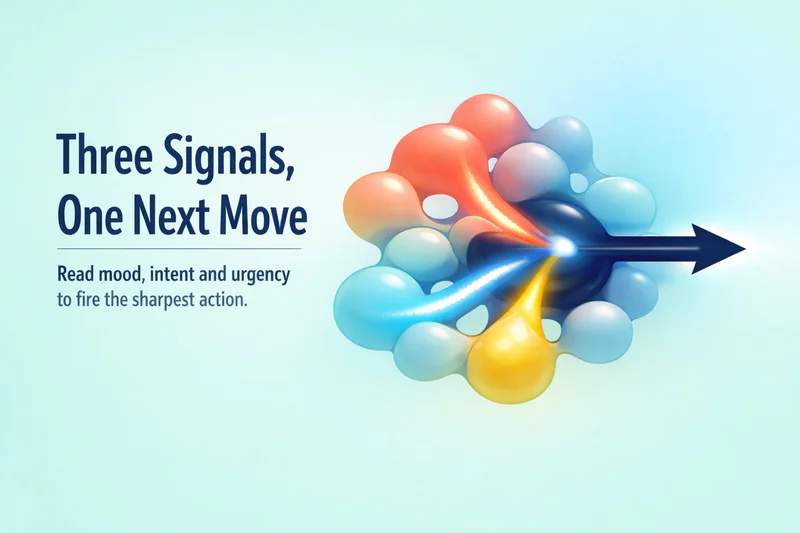
Signal-driven next best action is a way to choose a customer's next move from live conversational signals instead of fixed rules. It reads three things as they happen, mood, intent and urgency, then triggers the single sharpest action for that exact moment. Score tells you who someone is. Signals tell you where they are right now.
Rule-based systems decide from what a person was. A closed-won date, a plan tier, a score that updated overnight. Signal-driven systems decide from what a person is doing and feeling in the conversation happening this second. One reacts to a database. The other reacts to a human.
The shift sounds small. In practice it changes every message you send, because the same person deserves a different move at 9am when they are calm and at 9pm when they are frustrated. The record cannot tell those two moments apart. The conversation can.
Why rule-based next best action misreads people
Most "next best action" on the market is a decorated if-statement. If lead score is above 70, send nurture email B. If stage equals trial, send onboarding sequence C. It feels intelligent because it is automated. It is not intelligent. It is a light switch wired to a calendar.
Here is the flaw. A score is an average of the past. A stage is a label someone dragged across a board. Neither one knows that Priya is angry this minute, or that Daniel just described a buying trigger in plain language. Call it The Score Mirage. The number looks precise, so we trust it, and it quietly hides the living person underneath.
Picture the rep who trusts the number. She sees a 74 and a green "engaged" tag, so she sends the templated check-in. She never sees that the same lead spent the whole morning arguing with support. The score did not lie to her. It simply could not see what mattered. That is the quiet cost of deciding from history instead of from the conversation.
Rules also freeze. A person changes their mind halfway through a chat and the rule keeps marching toward the action it picked an hour ago. That is where teams finally feel the difference between orchestration and automation. Automation runs the step it was told to run. Orchestration reads the room and picks the step that fits the person in front of it.
Stop scoring the person. Start scoring the moment.
The three signals that actually decide the next move
A live conversation carries far more than words. It carries state. Three signals do most of the deciding, and each one changes the next move on its own.
Mood: how the person feels right now
Mood is the emotional temperature of the exchange. Frustration, delight, confusion, calm. You read it from word choice, punctuation, repetition, and the history of the thread. A customer who writes "still broken" for the third time is not in the same mood as one who opens with "quick question."
What mood changes is tone and channel. An angry customer gets a fast human, not a cheerful upsell. A delighted one is exactly the right person to ask for a referral. Same account, opposite moves, and the only thing that told them apart was mood.
Intent: what the person is actually trying to do
Intent is the goal behind the message. Cancel, expand, compare, complain, buy. It rarely arrives in a tidy form field. It shows up in phrasing like "we're expanding," or "how do you compare to," or "how do I turn this off." When you can read a lead's intent as it forms, you stop guessing and start answering the actual ask.
What intent changes is the content of the next action. Expansion intent routes to sales with a tailored offer. Cancellation intent routes to a save play. Comparison intent routes to proof, not fluff.
Urgency: how fast this has to happen
Urgency is the clock. It decides not what you do but how fast you do it, and whether a human jumps in now. "By Friday" is a different urgency than "sometime this quarter." A hot buyer who waits nine minutes for a reply cools into a maybe.
Urgency is the signal rule-based systems ignore most, because a batch job runs on its own schedule and never on the customer's. High urgency should break the queue and fire now. Low urgency can wait for the calm, considered follow-up that lands better anyway.
Act on urgency, not on the batch clock.
How the signals become an action in real time
Reading mood, intent and urgency is only half the job. The signals have to become a decision, and the decision has to fire across whatever channel the person is on, all before the moment passes. That loop needs a memory.
The memory is a Conversation Graph. Think of it as one living timeline per customer that holds every click, chat, form and call, plus the meaning layered on top, the intent, the urgency, the mood over time. When a new message arrives, the graph already knows the story so far. It does not start from zero.
From there the loop is simple to describe and hard to fake. Read the current state from the graph. Decide the next move from the freshest signals, never from last night's score. Act on the right channel, whether that is a WhatsApp reply, a routed call, a CRM update, or a clean human handoff. This is the engine behind autonomous next best action decisioning, and it is why some teams now treat the next best action as the brain behind a real-time customer journey rather than a nightly report.
The old way: a nightly job scores Priya, and tomorrow she receives nurture email B. The better way: the second she types "still broken," the system reads anger plus high urgency, drops the nurture, and routes her to a human inside a minute. See the shift? The action is computed at the speed of the conversation, not the speed of the database.
Speed is the whole game here. A signal has a shelf life. Anger cools, buying windows close, and a question left unanswered for an hour becomes a competitor's opening. Deciding the next action a day late is not deciding at all. It is documenting what you already missed.
A practical framework to put signals to work
You do not need to rip out your stack to do this. You need five moves, run as a loop, on top of the tools you already own.
Capture the signal. Pull mood, intent and urgency from every live channel, web chat, WhatsApp, email, calls. Do not flatten them into a single number. Keep them as three separate readings, because they change three different things.
Unify the context. Land every signal on one customer timeline, so a message on WhatsApp and a form on the website belong to the same person and the same story. Fragmented context produces confident, wrong actions.
Score the moment. Weigh the three signals together for this exact interaction. High urgency plus cancellation intent plus angry mood is a save play, right now, with a human, not a discount code next week.
Choose the action. Map the scored moment to one clear next move and the channel to deliver it on. One moment, one action, never a blast to a segment of thousands.
Close the loop. Watch how the person responds, feed that back into the timeline, and let the next decision start from the updated state. The loop learns, so the second action is smarter than the first.
Run those five in order and the next action stops being a guess. It becomes a read.
Rule-based vs signal-driven next best action
The two approaches can look identical in a demo. They diverge the second a real person does something the script did not expect. Here is where they split.
The table is not an attack on rules. Rules are perfectly good for the calm middle of a funnel where nothing surprising is happening. They fail at the edges, and the edges are exactly where revenue is won or lost.
Where an orchestration layer fits
Here is the honest part. Reading three signals in real time and acting on them across channels is not something a nurture rule or a stage-based workflow was ever built to do. It needs a coordination layer that sits above your CRM and messaging tools, a conversational orchestration layer that carries context between systems without dropping it.
That layer is what Zigment is. A Conversational Revenue Orchestration Platform for RevOps, Growth and Marketing teams running on HubSpot and Salesforce. It reads mood, intent and urgency, keeps the context intact as the conversation moves across systems, and triggers the next best action without asking you to replace the stack you already trust.
The results show up where revenue teams feel them. Zigment customers see around 40% higher conversions from inbound demand and up to 80% less manual effort on lead handling, because the follow-up fires on the signal instead of aging in a queue. Bajaj Auto runs context-preserving handoffs across more than 20 countries on it, so a conversation that starts in one place does not lose its memory when it moves to another.
None of this means every message needs a signal-driven brain behind it. A calm, predictable nurture flow runs fine on rules. The layer earns its keep at the hard moments, the furious customer, the sudden buyer, the lead who changes direction halfway through a sentence, where a wrong action is expensive and the right one has to fire in seconds.
The bottom line on the next best move
Go back to Priya and Daniel. Same score, same stage, same rule, two moments the rule could not see. One needed a fast apology and a human. One needed a sales conversation and a bigger plan. The record treated them as equals. The signals would have told them apart in seconds.
The sharpest next move a revenue team can make is almost never written in the score. It is spoken, live, in the conversation, in the mood, the intent and the urgency of a real person trying to do a real thing. Read those and you are doing Conversational Revenue Orchestration, turning what someone actually says into the exact action that earns their next yes.
Your customers are telling you what to do next. The only question left is whether your systems are still reading last night's report.