# Achieving Omni-Channel Continuity in Student Recruitment and Support
Author: Team Zigment
Author URL: https://zigment.ai/blog/author/team-zigment
Published: 2026-01-06
Category: EdTech
Category URL: https://zigment.ai/blog/category/edtech
Tags: omni channel engagement, Omni-Channel, Multi-Channel
Tag URLs: omni channel engagement (https://zigment.ai/blog/tag/omni-channel-engagement), Omni-Channel (https://zigment.ai/blog/tag/omni-channel), Multi-Channel (https://zigment.ai/blog/tag/multi-channel)
URL: https://zigment.ai/blog/omni-channel-continuity-in-student-recruitment-and-support
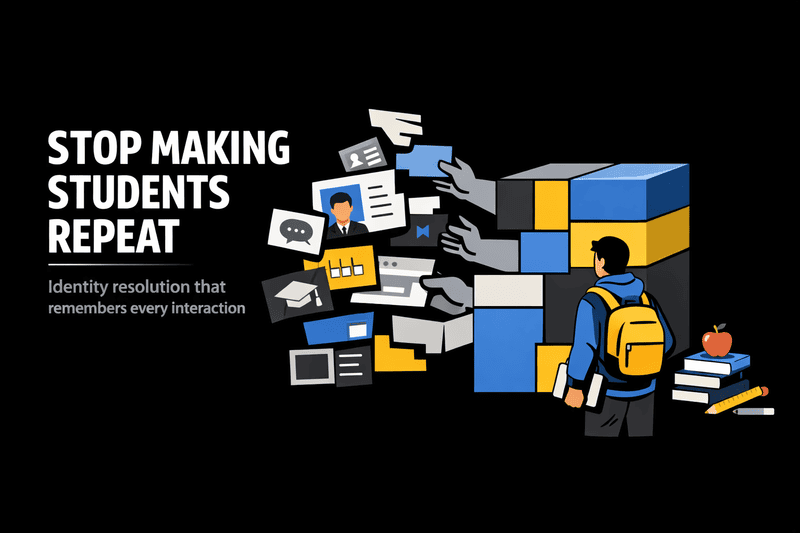
> Students don’t navigate your platforms,they navigate their own decisions. Channels are just the paths they take, and every interaction counts toward the outcome they’re seeking.
Most student drop-offs come from one problem: broken conversations.
A student shares intent on your website. That intent doesn’t carry into WhatsApp. Email treats them like a stranger again. Each reset chips away at confidence and momentum.
**Achieving Omni-Channel Continuity in Student Recruitment and Support** is how institutions prevent that breakdown. When context moves seamlessly across web, SMS, email, and social, students feel understood. Decisions happen faster. Support feels intentional.
Many teams rely on **multi-channel engagement** and assume coverage creates clarity. In reality, disconnected channels increase friction. Students repeat themselves. Advisors lack context. Journeys stall.
This article focuses on execution. You’ll see how strong **omni channel customer engagement** preserves intent across every interaction, where continuity fails most often, and what it takes to maintain one evolving conversation across the entire student lifecycle.
## **Why Achieving Omni-Channel Continuity Matters in the Student Journey**
Students don’t experience your funnel in stages.
They experience it as a single, ongoing decision.
One day they’re researching programs on your website. The next, they’re asking for clarity over WhatsApp. Later, they expect an email that already understands where they’re stuck. When those moments connect, momentum builds. When they don’t, hesitation creeps in.
This is where **achieving omni-channel continuity in student recruitment and support** changes outcomes.
Strong **omni channel customer engagement** keeps intent intact as students move across channels. Context follows them. Tone stays consistent. Support feels coordinated. Advisors step in with clarity instead of guesswork.
Compare that with typical **multi channel engagement**:
- Context lives in silos
- Students repeat questions
- Advisors respond without full history
Continuity solves this quietly and effectively.
It reduces friction, shortens decision cycles, and builds trust at every step of the student journey.
Talk to us about student journeys
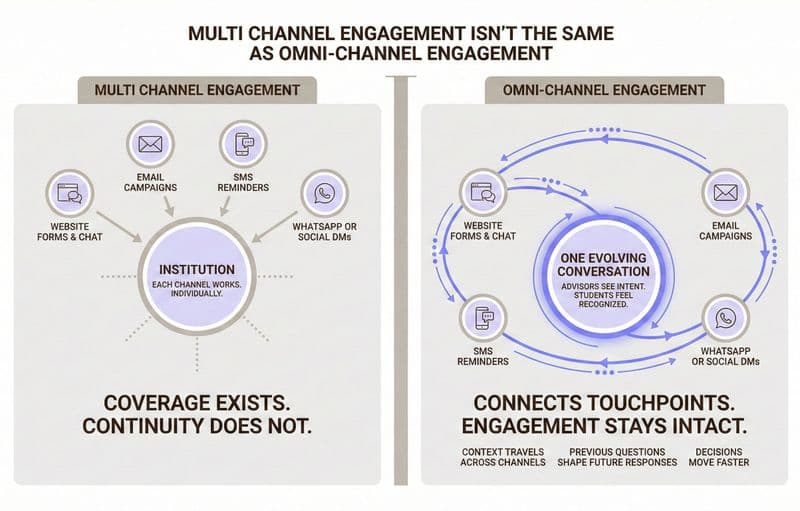
## **Multi Channel Engagement Isn’t the Same as Omni-Channel Engagement**
### **What Multi Channel Engagement Looks Like**
Most institutions operate across several channels:
- Website forms and chat
- Email campaigns
- SMS reminders
- WhatsApp or social DMs
Each channel works. Individually.
This is **multi channel engagement**. Coverage exists. Continuity does not.
### **Where Omni-Channel Engagement Changes the Experience**
**Omni channel engagement** connects these touchpoints into one evolving conversation.
- Context travels across channels
- Previous questions shape future responses
- Advisors see intent, not just interactions
Students feel recognized. Decisions move faster. Engagement stays intact.
### **Why the Difference Matters**
Multi channel engagement increases reach.
Omni channel customer engagement increases confidence.
That [difference](https://zigment.ai/blog/omni-channel-vs-multi-channel-customer-experience) determines whether a student keeps exploring or quietly drops off.
## **The Hidden Breakpoint: Context Loss Across Channels**
> Every time context is lost, students pause, repeat themselves, or disengage entirely. The small moments where understanding fails are often the moments that determine whether they move forward
### **Where Continuity Breaks**
Context loss usually shows up in small moments:
- A student re-explains their goals
- An advisor asks a question already answered
- An email ignores a recent WhatsApp conversation
Individually, these feel minor. Together, they erode trust.
### **Why Context Loss Hurts Engagement**
When context resets, students slow down.
They hesitate.
They disengage.
**Omni channel customer engagement** depends on preserving intent across every interaction. Without it, even well-timed messages feel irrelevant.
### **What Strong Continuity Prevents**
- Repetition across channels
- Conflicting guidance
- Disjointed tone and timing
Talk to us to fix gaps
## **Cross-Channel Identity Resolution for Student Engagement**
### **Why Identity Matters More Than Channels**
Students don’t show up with one identifier.
They use an email on your website, a phone number on WhatsApp, and a different device on social.
Without identity resolution, these appear as separate people.
### **What Cross-Channel Identity Resolution Solves**
Cross channel identity resolution for marketers brings those signals together into one profile:
- Website behavior
- Messaging history
- Intent signals and preferences
This creates a single, evolving view of the student.
### **How It Improves Omni-Channel Engagement**
With identity resolved:
- Messages align with previous conversations
- Advisors see full context instantly
- Timing and tone adapt naturally
This is where omni channel engagement becomes practical, not theoretical.
Talk to us about unified profiles
## **What Seamless Omni-Channel Student Engagement Actually Looks Like**
In a seamless omni-channel setup, students move freely across channels without losing momentum. A question asked on the website shapes the next WhatsApp response. An email follow-up reflects the student’s most recent concern. A counselor call begins with full context instead of discovery. The conversation evolves as students engage. It doesn’t restart.
Strong **omni channel customer engagement** responds to student signals in real time. High intent leads to faster, more direct support. Moments of uncertainty trigger reassurance and clarity. Silence prompts timely, relevant nudges rather than generic follow-ups. Channels adapt to intent, and timing adjusts naturally based on student behavior.
The result is simple and tangible. Students feel understood. They feel supported. And they feel confident enough to move forward.
> Seamless engagement is invisible to the student, but invaluable to the institution. Every response feels personal, timely, and relevant, guiding students forward without them having to repeat themselves
## **Static Journeys vs Adaptive, Context-Aware Orchestration**
Most student journeys today are designed once and reused endlessly. Fixed steps, predefined triggers, and limited flexibility assume students behave predictably. They don’t. Confidence fluctuates. Questions evolve. Timelines shift. Rigid journeys leave gaps, frustrate students, and slow decisions.
**Aspect**
**Static Journeys**
**Adaptive, Context-Aware Orchestration**
**Design**
Created once and reused
Evolves in real time based on student behavior
**Steps**
Fixed, linear
Flexible, dynamic pathways
**Triggers**
Predefined, rigid
Driven by recent interactions, engagement depth, and channel preference
**Response to Behavior**
Ignores changing needs
Adapts instantly to intent and context
**Advisor Role**
Follows campaign scripts
Steps in with full context at the right moment
**Outcome**
Repetition, friction, disengagement
Continuous, relevant conversations that guide students forward
Adaptive orchestration transforms static paths into living, responsive journeys. Every interaction respects student intent and preserves context, making **omni channel engagement** feel seamless and natural. Advisors no longer chase fragmented signals—they act with clarity at every touchpoint.
## **How Zigment Enables Omni-Channel Continuity at Scale**
### **Built for Continuity, Not Just Channels**
Zigment is designed around one core idea: conversations should carry forward.
Its orchestration layer connects every touchpoint, web chat, WhatsApp, SMS, email, into a single system that understands who the student is and where they are in their journey.
### **The Role of Agentic AI**
Zigment’s [Agentic AI layer](https://zigment.ai/blog/agentic-ai-what-it-really-means-and-how-it-works) doesn’t follow scripts. It responds to context.
- It interprets student intent in real time
- It adapts responses based on prior interactions
- It maintains tone and relevance across channels
### **Powered by the Conversation Graph**
At the center is the [Conversation Graph](https://zigment.ai/blog/the-conversation-graph), a unified profile that links identity, intent, and interaction history.
This enables true **omni channel customer engagement**, where every message builds on the last, regardless of channel.
In conclusion, achieving omni-channel continuity in student recruitment and support is ultimately about respect for the student’s time, intent, and attention. When conversations stay connected across web, SMS, email, and social channels, engagement feels natural instead of forced. Students move forward with confidence because they don’t have to repeat themselves or re-establish context.
## FAQs
Q: Can Agentic AI really maintain a consistent university brand voice across different channels
A: Yes. Unlike basic chatbots that use generic scripts, Agentic AI is trained on your institution’s specific marketing materials, viewbooks, and counselor interactions. It learns to mimic your institution's persona—whether that is prestigious and formal, or warm and community-focused. It then adapts this voice to the medium, ensuring the tone feels appropriate for a quick SMS text while remaining consistent with a detailed email follow-up.
Q: How does omni-channel orchestration integrate with existing Higher Ed CRMs like Slate or Salesforce?
A: Omni-channel orchestration does not replace your existing CRM; it acts as an intelligence layer on top of it. While CRMs record data, orchestration platforms (like Zigment) actively manage the flow of conversation. They pull historical data from the CRM to inform real-time interactions on WhatsApp or SMS and push new intent signals back into the CRM, ensuring your system of record is always up to date without manual data entry.
Q: Does cross-channel identity resolution violate student privacy or GDPR/FERPA regulations?
A: No, when implemented correctly, identity resolution enhances compliance by centralizing consent management. Instead of fragmented data where a student might unsubscribe on email but get spammed on SMS, a unified profile ensures that preferences and opt-outs are respected universally across all channels. It focuses on unifying data the student has voluntarily provided to create a coherent experience, rather than invasive surveillance.
Q: How does omni-channel continuity specifically reduce "Summer Melt"?
A: Summer melt often occurs when students feel disconnected or overwhelmed by administrative hurdles during the gap between deposit and enrollment. Omni-channel continuity prevents this by maintaining a "warm" connection. If a student stops engaging on email, the system can gently nudge them via SMS with context-aware support ("I saw you started the housing form but didn't finish..."). This prevents the silence that leads to doubt and drop-offs.
Q: What is the difference between "multichannel automation" and "adaptive orchestration"?
A: Multichannel automation is trigger-based and linear (e.g., "If student clicks link, send email"). It is rigid and often fails when a student behaves unpredictably. Adaptive orchestration is non-linear and context-aware. It assesses the student's current intent and sentiment in real-time to decide the next best action, channel, and tone, regardless of where they are in a pre-defined funnel.
Q: Does implementing omni-channel engagement require creating unique content for every platform?
A: No. The goal of omni-channel engagement is consistency, not volume. You don't need unique content for every channel; you need a unified voice that adapts to the channel's format. The core message (e.g., scholarship deadlines) remains the same, but the delivery shifts, short and punchy for SMS, conversational for WhatsApp, and detailed for email. The orchestration layer handles this adaptation automatically.
Q: What KPIs best measure the success of an omni-channel recruitment strategy?
A: Beyond standard open rates, you should track Engagement Continuity and Speed to Conversion.
Engagement Continuity: Measures how often a student switches channels without restarting the conversation.
Response Time Resolution: How quickly a student receives an accurate answer across any channel.
Advisor Efficiency: The reduction in time advisors spend digging for student history before a call.
Q: Can omni-channel continuity work for small institutions with limited recruitment teams?
A: Yes, it is actually more critical for small teams. Large universities might throw manpower at broken processes, but small teams cannot afford wasted time. By using AI-driven orchestration to handle identity resolution and context bridging, small teams can provide a "white-glove" concierge experience that scales, making them compete effectively with larger institutions without increasing headcount.
Q: How does omni-channel continuity specifically benefit international student recruitment?
A: International students often face the highest friction due to time zone differences and a preference for channels like WhatsApp over email. Omni-channel continuity bridges this gap by allowing an Agentic AI to maintain conversations 24/7. It ensures that a student in a different time zone receives instant, context-aware answers on their preferred messaging app, rather than waiting 24 hours for an email reply—a delay that often leads to them engaging with a competitor instead.
Q: How does shifting to omni-channel engagement lower the Cost Per Enrolment (CPE)?
A: It lowers CPE by plugging the "leaks" in your funnel. Most high acquisition costs come from spending money to attract leads that eventually drop off due to lack of engagement or broken processes. By preserving intent and context, omni-channel orchestration increases the conversion rate of existing leads. You spend less on acquiring new prospects because you are successfully enrolling a higher percentage of the students already in your pipeline.
---
This blog is powered by Superblog. Visit https://superblog.ai to know more.
---