# Recurring Donation Models in 2026: The Ultimate Guide to Predictable Nonprofit Revenue
Author: Team Zigment
Author URL: https://zigment.ai/blog/author/team-zigment
Published: 2026-02-17
Category: Non-Profit
Category URL: https://zigment.ai/blog/category/non-profit
Meta Title: Recurring Donation Models in 2026 for Predictable Revenue
Meta Description: Recurring donation models in 2026 turn one-time givers into monthly revenue you can forecast. Compare the 3 top models, cut churn, and scale retention.
Tags: Non Profits, AI in Nonprofits
Tag URLs: Non Profits (https://zigment.ai/blog/tag/non-profits), AI in Nonprofits (https://zigment.ai/blog/tag/ai-in-nonprofits)
URL: https://zigment.ai/blog/recurring-donation-models-2026-nonprofit-guide
# Recurring Donation Models in 2026: The Ultimate Guide to Predictable Nonprofit Revenue
[Team Zigment](https://zigment.ai/blog/author/team-zigment)
Feb 17, 2026
•
6 min read
•
[Non-Profit](https://zigment.ai/blog/category/non-profit)
- [Twitter / X](https://twitter.com/intent/tweet?url=https%3A%2F%2Fzigment%2Eai%2Fblog%2Frecurring%2Ddonation%2Dmodels%2D2026%2Dnonprofit%2Dguide&text=Recurring%20Donation%20Models%20in%202026%3A%20The%20Ultimate%20Guide%20to%20Predictable%20Nonprofit%20Revenue)
- [Facebook](https://www.facebook.com/sharer/sharer.php?u=https%3A%2F%2Fzigment%2Eai%2Fblog%2Frecurring%2Ddonation%2Dmodels%2D2026%2Dnonprofit%2Dguide)
- [LinkedIn](https://www.linkedin.com/shareArticle?mini=true&url=https%3A%2F%2Fzigment%2Eai%2Fblog%2Frecurring%2Ddonation%2Dmodels%2D2026%2Dnonprofit%2Dguide&title=Recurring%20Donation%20Models%20in%202026%3A%20The%20Ultimate%20Guide%20to%20Predictable%20Nonprofit%20Revenue)
- [WhatsApp](https://api.whatsapp.com/send?text=Recurring%20Donation%20Models%20in%202026%3A%20The%20Ultimate%20Guide%20to%20Predictable%20Nonprofit%20Revenue%20https%3A%2F%2Fzigment%2Eai%2Fblog%2Frecurring%2Ddonation%2Dmodels%2D2026%2Dnonprofit%2Dguide)
- [Ask ChatGPT](https://chatgpt.com/?hints=search&q=Summarize%20this%20article:%20https%3A%2F%2Fzigment%2Eai%2Fblog%2Frecurring%2Ddonation%2Dmodels%2D2026%2Dnonprofit%2Dguide)
- [Ask Claude](https://claude.ai/new?q=Summarize%20this%20article:%20https%3A%2F%2Fzigment%2Eai%2Fblog%2Frecurring%2Ddonation%2Dmodels%2D2026%2Dnonprofit%2Dguide)
- [Ask Grok](https://grok.com/?q=Summarize%20this%20article:%20https%3A%2F%2Fzigment%2Eai%2Fblog%2Frecurring%2Ddonation%2Dmodels%2D2026%2Dnonprofit%2Dguide)
- Copy link
Contents
[Contents](#post)
- [Recurring Donation Models in 2026, Why the Subscription Shift Matters](#recurring-donation-models-in-2026-why-the-subscription-shift-matters)
- [The Economics of Recurring Revenue, A RevOps Perspective](#the-economics-of-recurring-revenue-a-revops-perspective)
- [Moving Donors from One-Time to Monthly Through Conversational Negotiation](#moving-donors-from-one-time-to-monthly-through-conversational-negotiation) - [1\. Dynamic Upgrade Prompting](#1-dynamic-upgrade-prompting)
- [2\. Behavioral Timing](#2-behavioral-timing)
- [3\. Micro-Commitment Escalation](#3-micro-commitment-escalation)
- [Three High-Performing Recurring Donation Models in 2026](#three-high-performing-recurring-donation-models-in-2026) - [1\. The Impact Club (Access-Based Model)](#1-the-impact-club-access-based-model)
- [2\. The Direct Sponsorship Model](#2-the-direct-sponsorship-model)
- [3\. The Micro-Giving / Round-Up Model](#3-the-micro-giving-round-up-model)
- [Reducing Donor Churn in 2026: The Silent Revenue Killer](#reducing-donor-churn-in-2026-the-silent-revenue-killer) - [Involuntary Churn](#involuntary-churn)
- [Emotional Churn](#emotional-churn)
- [AI-Driven Donor Retention Strategies That Scale](#ai-driven-donor-retention-strategies-that-scale)
- [AI-Driven Retention and Revenue Orchestration: Turning Stability Into Strategy](#ai-driven-retention-and-revenue-orchestration-turning-stability-into-strategy)
- [Frequently Asked Questions](#post-faqs)
A one-time donor is worth a thank-you email. A recurring donor is worth a forecast.
Recurring donation models in 2026 turn that forecast into real money. Monthly donors give roughly 4–5x more over 36 months than one-time givers, and they retain far better. That gap is why predictable revenue now sits on the board agenda, alongside acquisition cost and cash flow.
Across mid-to-large nonprofits, acquisition costs keep climbing and response rates keep flattening. Finance teams are asking harder questions about what next quarter actually looks like. A reliable base of monthly donors answers most of them.
Here’s the uncomfortable truth. Most organizations still try to convert donors to monthly giving with static forms and checkbox upgrades. It’s passive. It leaves money on the table. And it ignores how modern donors actually behave.
People are conditioned by subscription experiences. They expect personalization. They expect relevance. They expect conversation.
If you’re leading development, marketing, or revenue operations, your mandate is clear:
- Stabilize cash flow
- Increase donor lifetime value (LTV)
- Reduce churn without expanding headcount
In this guide, we’ll break down:
- The economics behind recurring revenue
- How to move donors from one-time to monthly through conversational negotiation
- The highest-performing recurring models in 2026
- Practical AI-driven retention systems that increase CLV
Let’s build revenue you can actually predict.
## **Recurring Donation Models in 2026, Why the Subscription Shift Matters**
The subscription economy trained donors long before nonprofits did.
Streaming platforms, SaaS tools, grocery deliveries people are comfortable committing monthly when value is clear and friction is low. That conditioning changes fundraising strategy.
Here’s what we’re seeing across high-performing nonprofits:
- **Campaign spikes are flattening.**
- **Retention is outperforming acquisition.**
- **Monthly donors drive planning confidence.**
When we examine recurring donation models in 2026, the biggest shift is psychological. Donors don’t want to be “asked again.” They want to be enrolled in impact.
To align with this shift:
- Position recurring giving as participation, not obligation.
- Show cumulative impact (“Your $50 monthly funds 600 meals annually.”).
- Provide consistent touchpoints that reinforce value.
Recurring revenue gives you something priceless: stability. And stability allows smarter investments in growth.
## **The Economics of Recurring Revenue, A RevOps Perspective**
Let’s talk numbers.
From a revenue operations standpoint, the difference between one-time and recurring donors is dramatic.
**Why recurring donors matter financially:**
- Lower re-acquisition cost
- Higher lifetime value (4–5x over 36 months is common)
- Improved revenue forecasting accuracy
- Reduced campaign dependency
Consider a simple scenario:
- Average one-time gift: $100
- Average recurring gift: $35/month
- 24-month retention
That’s $840 from a single recurring donor versus $100 once. Even after accounting for payment fees and stewardship costs, the margin gap is substantial.
For RevOps leaders, the key metrics to track include:
- Donor Lifetime Value (LTV)
- Monthly Recurring Revenue (MRR)
- Churn rate (voluntary + involuntary)
- Upgrade conversion rate
When marketing, CRM, and finance data flow together, recurring revenue becomes orchestrated, not accidental.
[Discuss your revenue strategy](https://zigment.ai/contact-us?utm_source=organic&utm_campaign=blogs)
## **Moving Donors from One-Time to Monthly Through Conversational Negotiation**
Forms don’t negotiate. Conversations do.
A static donation page that says “Make this monthly?” captures a fraction of potential upgrades. Conversational systems convert significantly more because they adapt in real time.
Here’s how conversational negotiation works:
### **1\. Dynamic Upgrade Prompting**
Instead of a checkbox, trigger a tailored suggestion:
- Donor gives $100 once.
- AI responds: “Would you like to provide this support every month? That would fund 1,200 meals this year.”
Impact reframing increases commitment.
### **2\. Behavioral Timing**
Follow up when intent is warm:
- Immediately post-donation via SMS
- After a high-engagement email click
- Following an event registration
Timing matters more than volume.
### **3\. Micro-Commitment Escalation**
Start smaller if needed:
- Offer $20/month instead of repeating $100
- Show flexible pause options
- Reduce perceived risk
The key takeaway: Recurring conversion improves when the ask feels responsive and human. Automation enables that responsiveness at scale.
[Connect with us to strategize upgrades](https://zigment.ai/contact-us?utm_source=organic&utm_campaign=blogs)
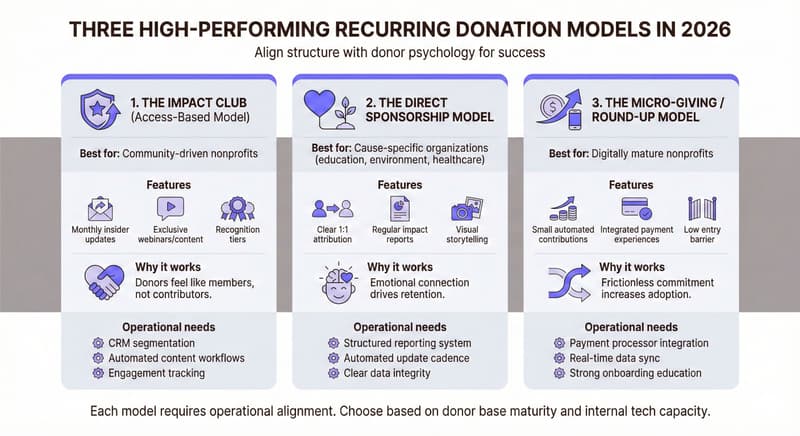
## **Three High-Performing Recurring Donation Models in 2026**
Not all recurring models are equal. The most successful organizations align structure with donor psychology.
### **1\. The Impact Club (Access-Based Model)**
Best for: Community-driven nonprofits.
**Features:**
- Monthly insider updates
- Exclusive webinars or behind-the-scenes content
- Recognition tiers
**Why it works:**
Donors feel like members, not contributors.
**Operational needs:**
- CRM segmentation
- Automated content workflows
- Engagement tracking
### **2\. The Direct Sponsorship Model**
Best for: Cause-specific organizations (education, environment, healthcare).
**Features:**
- Clear 1:1 attribution
- Regular impact reports
- Visual storytelling
**Why it works:**
Emotional connection drives retention.
**Operational needs:**
- Structured reporting system
- Automated update cadence
- Clear data integrity
### **3\. The Micro-Giving / Round-Up Model**
Best for: Digitally mature nonprofits.
**Features:**
- Small automated contributions
- Integrated payment experiences
- Low entry barrier
**Why it works:**
Frictionless commitment increases adoption.
**Operational needs:**
- Payment processor integration
- Real-time data sync
- Strong onboarding education
Each model requires operational alignment. Choose based on donor base maturity and internal tech capacity.
## **Reducing Donor Churn in 2026: The Silent Revenue Killer**
Churn quietly erodes growth.
There are two primary types:
### **Involuntary Churn**
- Expired cards
- Failed payments
- Banking issues
**Solution:** Automated dunning workflows with timely reminders.
### **Emotional Churn**
- Reduced engagement
- Message fatigue
- Perceived lack of impact
**Solution:**
- Engagement scoring
- Personalized updates
- Proactive check-ins before cancellation
Even a 5% reduction in churn significantly increases LTV. Retention is a revenue multiplier.
[Discuss reducing donor churn](https://zigment.ai/contact-us?utm_source=organic&utm_campaign=blogs)
## **AI-Driven Donor Retention Strategies That Scale**
You cannot personally steward 5,000 monthly donors. You can build systems that feel personal.
AI-driven donor retention strategies now include:
- [**Sentiment analysis**](https://zigment.ai/blog/customer-signals-intent-and-sentiment-extraction-in-ai) in email replies
- **Engagement decline alerts**
- **Predictive churn scoring**
- **Automated thank-you personalization**
- **Smart upgrade suggestions**
For example:
- A donor stops opening emails for 60 days.
- The system triggers a friendly SMS update.
- Engagement resumes.
That’s operational intelligence in action.
Automation supports your team. It doesn’t replace human connection. It ensures no signal goes unnoticed.
## **AI-Driven Retention and Revenue Orchestration: Turning Stability Into Strategy**
You cannot manually manage 5,000 recurring donors.
But you can build systems that make each one feel seen.
AI-driven donor retention strategies in 2026 focus on early detection and proactive engagement. Instead of waiting for cancellations, high-performing nonprofits monitor signals continuously.
Here’s what modern retention infrastructure looks like:
- **Sentiment analysis** in donor replies and support tickets
- **Engagement decline alerts** when open rates or clicks drop
- **Predictive churn scoring** based on behavioral patterns
- **Automated thank-you personalization** that reinforces impact
- **Smart upgrade nudges** when engagement peaks
Imagine this scenario:
A donor stops opening emails for 45 days.
The system flags declining engagement.
A friendly, conversational SMS is triggered:
“Hi Sarah, we wanted to share a quick update on the wells you’re helping fund this month…”
Engagement resumes. Churn prevented.
That’s the difference between reactive fundraising and [orchestrated retention.](https://zigment.ai/blog/revenue-orchestrations-link-marketing-sales-retention-goal)
This is where Zigment fits into the equation.
Rather than functioning as another tool in your stack, Zigment operates as a revenue orchestration layer that connects acquisition, retention, and RevOps forecasting.
It supports recurring growth across three critical pillars:
- **Acquisition:** AI agents engage website visitors in real-time conversations, converting one-time interest into recurring commitments immediately.
- **Retention:** Invisible monitoring of donor behavior triggers proactive outreach before disengagement turns into cancellation.
- **Revenue Alignment:** CRM data syncs seamlessly so finance and marketing share the same forecasting view.
The result?
- Higher donor lifetime value
- Lower churn
- More predictable monthly revenue
- Reduced manual workload for your team
Recurring Donation Models in 2026 reward nonprofits that think like subscription businesses. Stability comes from predictability. Predictability comes from retention. And retention requires orchestration.
When conversational engagement, automation, and revenue intelligence work together, you don’t just increase monthly gifts, you build long-term partnerships.
Predictable revenue builds confident teams.
Confident teams scale impact.
That’s the future of recurring giving
## FAQs
Q: What is considered a "healthy" churn rate for nonprofit recurring giving programs?
A: While benchmarks vary by sector, a healthy monthly churn rate for recurring nonprofit programs typically falls between 1.5% and 3%. In 2026, organizations utilizing AI-driven retention strategies and predictive dunning (managing failed payments) are seeing rates closer to 1%. If your annual churn exceeds 15-20%, it suggests a need to audit your donor stewardship and involuntary churn mechanisms immediately.
Q: How can AI agents specifically convert one-time donors to monthly subscribers?
A: AI agents move beyond static donation forms by engaging donors in real-time conversational negotiation. Instead of a generic "Make this monthly" checkbox, an AI agent analyzes the donor’s behavior and context to present a personalized value proposition (e.g., "Turning this $50 into a monthly gift feeds a family for the whole winter"). This approach mimics a major gift officer's strategy but scales it to every digital visitor, significantly increasing upgrade conversion rates.
Q: Which recurring donation model works best for small-to-mid-sized nonprofits?
A: For smaller organizations with limited content production resources, the Direct Sponsorship Model or Micro-Giving/Round-Up Model often yields the highest ROI. Unlike "Access-Based" models that require constant exclusive content creation, direct sponsorship relies on reporting impact you are already creating. This reduces operational friction while still providing the emotional connection required for high Donor Lifetime Value (LTV).
Q: How do we prevent "involuntary churn" caused by expired credit cards?
A: Involuntary churn accounts for up to 30% of lost recurring revenue. To combat this, modern nonprofits use automated account updater services provided by payment processors, combined with AI-triggered communication flows. Instead of a generic error email, a conversational AI can send a timely text or WhatsApp message prompting the donor to update their details securely, positioning the update as necessary to prevent a break in impact.
Q: What is the difference between a membership model and a recurring donation model?
A: The distinction lies in the value exchange. A membership model usually implies a transactional benefit (access to events, merchandise, or voting rights), whereas a recurring donation model is driven purely by philanthropic impact. However, in 2026, successful nonprofits are blending these by offering "Impact Memberships" where the "perk" is exclusive access to behind-the-scenes reporting and leadership, satisfying the donor's desire for involvement without creating a taxable goods-exchange.
Q: Can we implement recurring donation strategies if we have a legacy CRM?
A: Yes. You do not need to replace your entire tech stack to modernize. Solutions like Zigment act as a "revenue orchestration layer" that sits on top of legacy CRMs. They handle the conversational engagement and front-end data collection, then sync the clean data back to your existing finance and record-keeping systems. This allows for modern subscription experiences without a painful database migration.
Q: How does shifting to recurring revenue impact a nonprofit's cash flow forecasting?
A: Moving to a recurring model transforms fundraising from "episodic" to predictable revenue. Finance teams can forecast cash flow with 80-90% accuracy based on Monthly Recurring Revenue (MRR) and historical retention data. This stability allows organizations to commit to long-term programs and operational hiring, reducing the boom-and-bust cycle associated with reliance on year-end appeals.
Q: What is the optimal time to ask a new donor to upgrade to a monthly gift?
A: Data suggests the "Golden Window" is while the donor's emotional connection is highest specifically, the thank-you page immediately following a one-time donation, or within 48 hours via a personalized follow-up. Using dynamic upgrade prompting, you can acknowledge the initial gift and immediately show how a small monthly commitment amplifies that specific impact, capitalizing on the "warm glow" effect.
Q: How do we communicate value to recurring donors without causing "donor fatigue"?
A: The key is to separate "fundraising asks" from "impact reporting." Recurring donors should receive a higher ratio of evidence-of-impact content vs. solicitation emails. In 2026, successful retention strategies involve hyper-short, personalized updates (e.g., a 15-second video or a single photo via SMS) that validate their investment without asking for more money, effectively resetting the engagement scoring clock.
Q: Why is "conversational fundraising" replacing static donation forms?
A: Static forms are passive; they rely on the donor's pre-existing motivation. Conversational fundraising is active; it uses two-way dialogue to overcome objections, answer questions, and build trust in real-time. In an era where donors are conditioned by conversational commerce and instant support, static forms feel impersonal. Conversations increase trust, and higher trust directly correlates to higher average gift sizes and longer retention.
---
This blog is powered by Superblog. Visit https://superblog.ai to know more.
---