# The Rise of Micro-Moments: How Gen Z Makes Decisions in Real Time
Author: Team Zigment
Author URL: https://zigment.ai/blog/author/team-zigment
Published: 2025-12-15
Category: Agentic AI
Category URL: https://zigment.ai/blog/category/agentic-ai
Tags: Agentic AI, conversational AI, Marketing for gen z
Tag URLs: Agentic AI (https://zigment.ai/blog/tag/agentic-ai), conversational AI (https://zigment.ai/blog/tag/conversational-ai), Marketing for gen z (https://zigment.ai/blog/tag/marketing-for-gen-z)
URL: https://zigment.ai/blog/rise-of-micro-moments-how-gen-z-makes-decisions-in-real-time
A swipe. A pause. A second glance. That’s often all it takes. In fact, most Gen Z decisions happen in fleeting moments of attention, when something feels relevant _right now_ or it doesn’t.
That’s the reality behind The Rise of Micro-Moments: How Gen Z Makes Decisions in Real Time, and it’s quietly rewriting how brands earn trust, clicks, and conversions.
We’re no longer competing for loyalty over months. We’re competing for relevance in seconds.
If your experience can’t recognize intent instantly, respond naturally, and adapt mid-interaction, Gen Z moves on, no frustration, no feedback, no second chance. Just silence.
In this article, we’ll break down how Gen Z micro-moments actually work, why traditional journeys collapse under real-time behavior, and what teams must build if they want to show up _at the exact moment decisions are made_.
## What Are Micro-Moments?
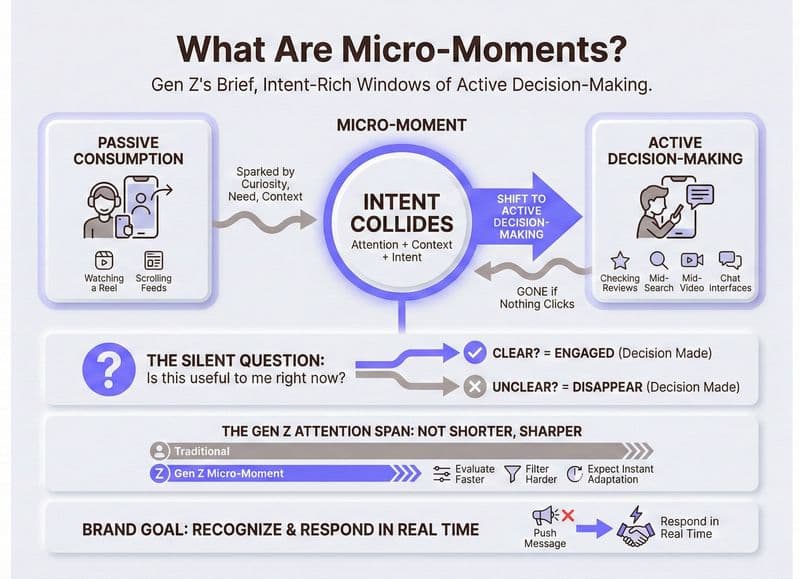
Micro-moments are brief, intent-rich windows when Gen Z shifts from passive consumption to active decision-making. They’re not planned, linear, or predictable. They happen in real time, sparked by curiosity, need, or context and they disappear just as quickly if nothing clicks.
One moment they’re watching a reel. Next, they’re checking reviews. Then they’re gone, until something pulls them back. These are **Gen Z micro-moments**: brief windows where attention, context, and intent collide.
What makes these moments powerful isn’t their length. It’s their timing.
In a micro-moment, Gen Z asks one silent question: _Is this useful to me right now?_ If the answer is unclear, the decision is already made.
These moments show up everywhere:
- While scrolling social feeds between tasks
- Inside chat interfaces while multitasking
- Mid-search, mid-video, mid-conversation
This behavior explains the so-called **Gen Z attention span**. It’s not shorter, it’s sharper. They evaluate faster, filter harder, and expect experiences to adapt instantly.
For brands, this changes the goal. It’s no longer about pushing a message. It’s about recognizing the moment and responding in real time.
Start noticing where your own experiences lose attention.
## **From Funnels to Flashes: Why Traditional Customer Journeys Break Down**
Traditional journeys are designed around sequence, step one, step two, step three. But Gen Z behavior is non-linear by default. They enter, exit, return, and change their minds without warning. The “path” looks less like a funnel and more like a flicker.
Here’s where most journeys fail:
- They wait for users to complete steps
- They react too late to behavioral signals
- They treat channels as silos instead of one continuous experience
Gen Z expects **omni-channel engagement** that feels connected, not coordinated. If they switch from Instagram to chat to a website, they assume context follows. When it doesn’t, trust erodes fast.
This is why **Journey Orchestration** matters. Not as a buzzword, but as a practical shift, from mapping journeys to responding to moments. Orchestration listens for what’s happening _now_ and adapts instantly.
The takeaway is simple:
If your system waits for the next stage, Gen Z has already moved on.
Consider where your journey design still assumes patience.
## **Real-Time Pipelines: The Infrastructure Powering Instant Decisions**
Micro-moments only work if your systems move at the same speed as your users.
Most don’t.
Many teams still rely on delayed data, events processed in batches, insights reviewed hours later, actions taken the next day. For Gen Z, that gap is fatal. The moment is already gone.
**Real-Time Pipelines** change this dynamic. They allow behavioral data to flow instantly from interaction to decision to response.
What that enables in practice:
- A pause or scroll triggers an immediate adjustment
- An abandoned action reshapes the next message
- Context updates across channels in seconds, not sessions
This is the foundation of **real-time [marketing AI](https://zigment.ai/blog/the-secret-sauce-of-top-ai-marketing-agencies-its-agentic-ai)**. Not dashboards. Not reports. Live responsiveness.
Without real-time pipelines, even the smartest AI reacts too late. With them, systems can adapt while the user is still present, still deciding.
The takeaway is straightforward:
You can’t design for Gen Z micro-moments if your data arrives after the moment has passed.
Map how long it takes your data to become actionable.
## **Intent detection: Understanding What Gen Z Means Without Asking**
> Gen Z doesn’t enjoy explaining themselves.
>
> They expect systems to keep up.
Every micro-moment leaves a trail, what they skipped, where they paused, how quickly they bounced back. These behaviors matter more than direct questions because they happen _before_ a decision is fully formed.
Strong **[intent detection](https://zigment.ai/blog/customer-signals-intent-and-sentiment-extraction-in-ai)** focuses on behavior in motion, not static inputs.
What actually signals intent:
- A product page opened twice within minutes
- Scrolling past features but stopping at pricing
- Switching from search to chat mid-task
- Dropping off at the same step repeatedly
When these signals are connected in real time, experiences adjust quietly. The copy shortens. The recommendation shifts. Help appears only when it’s useful.
This is where **AI-triggered micro-moment engagement** earns trust. Not by asking, _“How can I help? "but_ by responding as if it already knows.
For Gen Z, the best experiences don’t ask for clarity.
They provide it.
Look beyond clicks to the signals you’re ignoring.
## **Conversational AI as the Frontline of Micro-Moment Engagement**
> When Gen Z wants help, they don’t want a form.
>
> They want a response.
Chat, voice, and in-app conversations feel natural because they match how decisions actually happen in fragments, not flows. **Conversational AI** fits directly into Gen Z micro-moments by meeting users where they already are, without forcing a context switch.
What works in these moments:
- Short, direct responses over long explanations
- Follow-ups that react to behavior, not scripts
- Tone that adapts based on urgency and intent
The best conversational experiences don’t feel like support. They feel like momentum. A question answered quickly. A doubt removed. A decision nudged forward without pressure.
When conversational AI is connected to **Journey Orchestration**, context carries across channels. A chat remembers what a user browsed. A recommendation reflects what they skipped. The conversation continues, even if the platform changes.
## **Agentic AI: Acting on Moments, Not Just Predicting Them**
Most AI systems stop at prediction, _this user might churn_, _this product could convert_. **Agentic AI** goes a step further. It doesn’t wait for a human or a rule to intervene. It decides and acts within the moment.
For Gen Z, this difference is obvious.
### Agentic AI can:
- Adjust content mid-session based on live behavior
- Trigger assistance when friction appears, not after
- Route users to the fastest resolution path automatically
- Personalize responses without restarting the experience
This matters because Gen Z impulse behavior leaves no buffer. If help arrives late, relevance is already lost.
When Agentic AI is paired with real-time pipelines and journey orchestration, systems stop reacting and start participating. They move with the user instead of chasing them.
The result?
Experiences that feel responsive, not reactive, and moments that turn into decisions instead of drop-offs.
## **Micro-Moment Marketing Examples in the Wild**
Micro-moments aren’t theoretical. They’re already shaping how Gen Z interacts with brands, often without noticing.
Here’s what effective **micro-moment marketing examples** look like in practice:
- **E-commerce**
A Gen Z shopper lingers on a product but skips reviews. A short, conversational prompt surfaces key feedback instantly, no pop-ups, no pressure.
- **Fintech**
A user starts setting up an account, pauses at verification, then returns later. The experience resumes exactly where they left off, with simplified steps and contextual reassurance.
- **Media & Content Platforms**
A viewer abandons a video halfway through. The next recommendation is shorter, more relevant, and aligned with what held their attention longest.
In each case, **AI-triggered micro-moment engagement** adapts based on behavior, not assumptions. No surveys. No hard sells.
The pattern is consistent:
Respond quickly. Reduce effort. Respect attention.
That’s what turns fleeting interest into action.
## **What This Means for Brands Competing for Gen Z Attention**
> Gen Z isn’t ignoring brands.
>
> They’re filtering them.
Winning attention today isn’t about louder campaigns or more channels. It’s about building systems that respond when intent appears and disappear when it doesn’t.
### What brands need to do differently:
- **Design for moments, not milestones**
Stop optimizing journeys around stages. Optimize around real-time decisions.
- **Invest in orchestration, not isolated tools**
**Journey Orchestration** ensures every interaction builds on the last, across channels.
- **Act on qualitative signals**
Scrolls, pauses, exits, and returns are as valuable as clicks and conversions.
- **Let AI act, not just analyze**
Agentic systems must respond while the user is still present.
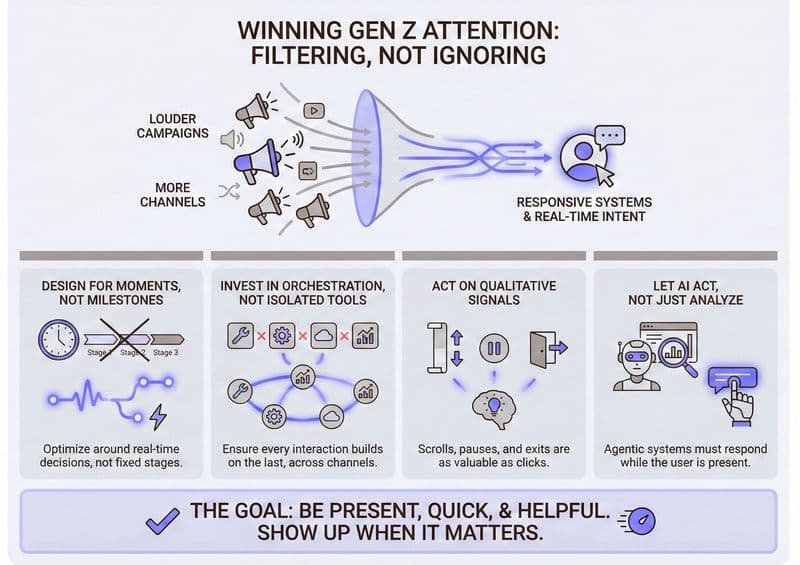
The brands that win Gen Z aren’t perfect. They’re present.
They show up quickly, clearly, and with just enough help to keep things moving.
Revisit how your systems show up under pressure.
## **The Future Belongs to Brands That Act in the Moment**
Micro-moments are where decisions actually happen, quietly, quickly, and often without warning. Brands that rely on delayed data, rigid journeys, or disconnected tools will keep missing these moments, no matter how strong their message is.
This is exactly where **Zigment** fits.
Zigment is built for real-time decisioning, connecting **journey orchestration**, **conversational AI**, and **agentic AI** into a single system that listens, understands intent, and acts while the moment is still alive. It turns behavioral signals into immediate, meaningful responses across channels, without forcing users through predefined flows.
For Gen Z, this isn’t a “better experience.”
It’s the only one that feels natural.
The takeaway is simple: if you want to influence decisions, stop designing journeys for later. Start showing up _now_, in the moment Gen Z is ready to move.
## FAQs
Q: How does Agentic AI differ from traditional chatbots in customer service?
A: Traditional chatbots rely on pre-scripted decision trees and often fail when a user deviates from the expected flow. Agentic AI, however, possesses the autonomy to make decisions and take actions in real-time without human intervention. It can resolve complex issues, process transactions, and adapt its tone based on user sentiment, offering a fluid experience that mirrors human capability rather than a static script.
Q: What are the key metrics for measuring the success of micro-moment marketing?
A: Unlike traditional funnels that measure conversion rates over weeks, micro-moment marketing requires analyzing real-time engagement metrics. Key performance indicators (KPIs) include time-to-resolution, intent recognition accuracy, and drop-off reduction rates at high-friction points. Successful strategies prioritize how quickly a brand can move a user from curiosity to satisfaction, rather than just tracking final clicks.
Q: How can brands balance real-time personalization with Gen Z privacy concerns?
A: Gen Z values personalization but demands transparency. To balance this, brands should rely on first-party data and behavioral signals (like session pauses or clicks) rather than invasive third-party tracking. The key is value exchange: Gen Z is willing to share data if it results in an immediate, tangible improvement to their experience, such as faster checkout or hyper-relevant recommendations.
Q: Is Journey Orchestration just for enterprise brands, or can SMBs implement it?
A: While Journey Orchestration sounds complex, the underlying logic is accessible to businesses of all sizes. SMBs can start by integrating their CRM, email, and chat platforms to share data instantly. Tools like Zigment and other AI-driven platforms are increasingly democratizing this tech, allowing smaller teams to automate real-time responses and context sharing without needing massive enterprise infrastructure.
Q: Can micro-moment strategies be applied to B2B marketing?
A: Absolutely. B2B decision-makers are also consumers who experience micro-moments. They search for solutions on mobile between meetings or seek instant answers via chat. B2B brands can leverage intent detection to identify when a prospect is researching technical specs or pricing and trigger an immediate, helpful intervention—such as an automated calendar booking or a specific case study—shortening typically long sales cycles.
Q: Why do traditional customer journey maps fail for Gen Z consumers?
A: Traditional maps assume a linear progression: awareness, consideration, decision. Gen Z behavior is non-linear and fragmented. They may jump from a social media ad to a review site, abandon the cart, and return days later via a direct search. Static maps cannot account for these rapid shifts; brands need dynamic orchestration that adapts to the user's current context, regardless of where they entered the funnel.
Q: What role do "Real-Time Pipelines" play in reducing cart abandonment?
A: Real-time pipelines process data instantly rather than in batches. If a user abandons a cart, a real-time system can detect the exit intent immediately and trigger a retention mechanism—like a discount via chat or a reminder notification—within seconds. This immediacy captures the user's attention while the purchase intent is still fresh, significantly recovering revenue that would be lost with delayed follow-ups.
Q: How does "Intent Detection" actually work without asking user questions?
A: Intent detection utilizes machine learning to analyze behavioral patterns. It looks at "digital body language," such as how fast a user scrolls, which images they zoom in on, or how often they toggle between tabs. By correlating these actions with historical data, AI can predict if a user is confused, price-shopping, or ready to buy, allowing the system to serve the right content automatically.
Q: What is the "Gen Z Attention Span" myth?
A: It is a misconception that Gen Z has a short attention span; in reality, they have a highly selective filter. They can focus deeply on content that feels relevant but will instantly discard anything that feels generic or slow. For marketers, this means the challenge isn't creating shorter content, but creating sharper, value-driven experiences that instantly answer the subconscious question: "Is this useful to me right now?"
---
This blog is powered by Superblog. Visit https://superblog.ai to know more.
---