# “Frustrated Prospect” Play: How to Use Sentiment to Pause Nurture Workflows
Author: Team Zigment
Author URL: https://zigment.ai/blog/author/team-zigment
Published: 2026-01-22
Category: Hubspot
Category URL: https://zigment.ai/blog/category/hubspot
Tags: hubspot workflows, Sentiment Analysis
Tag URLs: hubspot workflows (https://zigment.ai/blog/tag/hubspot-workflows), Sentiment Analysis (https://zigment.ai/blog/tag/sentiment-analysis)
URL: https://zigment.ai/blog/sentiment-based-pause-for-nurture-workflows
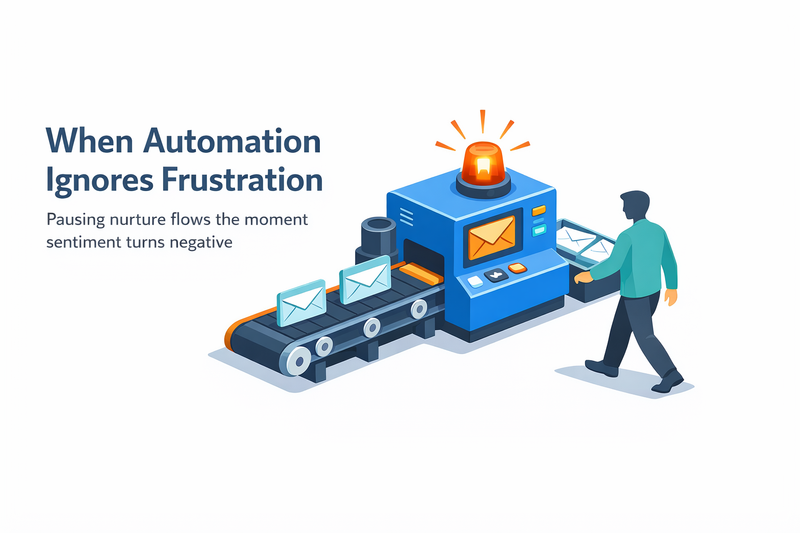
> If your funnel can’t pause when a prospect pushes back, it’s not optimized. It’s just persistent.
A prospect replies to your email with a single line: _“Please stop. This is getting frustrating.”_
And five minutes later, your nurture workflow sends them another follow-up.
That moment is the quiet leak in your funnel.
You didn’t lose this deal because of pricing, timing, or product fit. You lost it because your system couldn’t read the room. HubSpot sequences kept running. HubSpot email marketing kept firing. The prospect felt processed, not understood.
This happens more often than most teams want to admit. One industry analysis found that over most B2B buyers disengage after receiving irrelevant or poorly timed follow-ups, not because they lack interest, but because the experience creates friction. When sentiment turns negative and automation doesn’t react, trust erodes fast.
The core issue is simple. Most HubSpot programs are designed to execute instructions, not interpret intent.
In this article, we’ll break down how frustration shows up in real buyer signals, why traditional nurture logic misses it, and how you can pause workflows at the exact moment they start doing damage. We’ll focus on practical steps you can apply on top of HubSpot today, protecting pipeline momentum, improving response quality, and giving prospects space when they’re asking for it.
## **The Problem: When HubSpot Sequences Miss Human Signals**
### **What HubSpot Sequences Do Well**
Let’s be fair. **HubSpot sequences** are great at consistency.
They:
- Send follow-ups on time
- Reduce rep forgetfulness
- Scale outbound and inbound response
- Power **HubSpot email sequences** for busy sales teams
For linear outreach, they work exactly as designed.
### **Where Things Start to Break**
The trouble begins when sentiment enters the picture.
A prospect replies with:
- “I already spoke to someone.”
- “This isn’t relevant right now.”
- “Why am I still getting these emails?”
> Negative sentiment isn’t the end of the journey. It’s a request for adjustment.
From a human perspective, that’s a clear signal.
From the system’s perspective, it’s just another logged email.
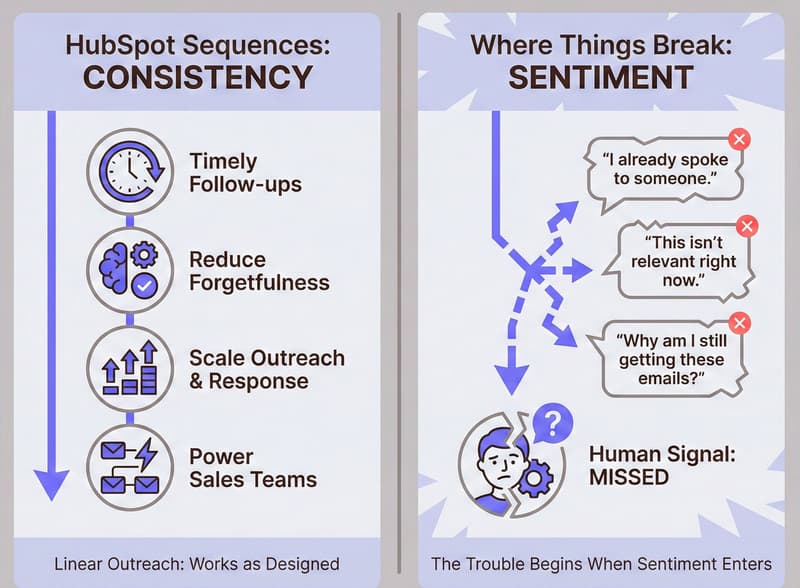
In **hubspot sequences vs workflows**, neither is truly equipped to _understand_ tone. Sequences keep sending unless a rep manually unenrolls. Workflows rely on explicit triggers, not emotional context. Frustration, confusion, and hesitation fall through the cracks.
### **The Hidden Cost**
When **HubSpot email sequences** ignore sentiment:
- Prospects feel unheard
- Reps scramble to recover trust
- Marketing and sales lose alignment
Talk to us about leakage
## **Why It Matters: Revenue Leakage Inside the Sales Hub**
### **Friction Shows Up Before the Deal Is Lost**
Most deals don’t die loudly. They slow down. Replies get shorter. Meetings get postponed. Then they disappear.
When **HubSpot sales sequences** keep running after frustration appears, you create drag inside the funnel. Prospects stop responding. Sellers chase ghosts. Pipeline reviews turn into guesswork.
This problem compounds quickly in **Sales Hub HubSpot** environments where:
- Multiple reps touch the same account
- Marketing and sales sequences overlap
- Context lives in scattered notes and inboxes
### **Enterprise Scale Makes It Worse**
In **sales hub enterprise demo HubSpot** motions, one misfired follow-up can undo weeks of relationship-building. Prospects evaluating complex solutions expect coordination, not noise. When outreach feels disconnected, confidence drops.
Talk to us about complexity
### **What the Numbers Reflect**
Revenue teams see this as:
- Longer sales cycles
- Lower demo-to-opportunity conversion
- Higher unsubscribe and reply-based friction
## **What Teams Usually Try (And Why It Falls Short)**
### **The Most Common Workarounds**
When frustration surfaces, teams react fast—but not always effectively. The usual fixes look like this:
- Adding more branches to workflows
- Training reps to manually unenroll prospects
- Creating internal alerts during **sales hub onboarding HubSpot**
- Relying on rep judgment in **Sales Hub Professional HubSpot** setups
On paper, these feel responsible. In practice, they don’t scale.
### **Why These Approaches Break Down**
Manual intervention depends on timing. Reps miss signals. Alerts get ignored. Context lives in Slack, not in the system. By the time someone acts, the damage is done.
Even mature teams running **SalesHub HubSpot** hit the same wall. Logic grows complex. Governance weakens. No one can explain why a prospect received a message or why it wasn’t stopped.
## **A Better Way: Let Sentiment Drive Decisions, Not Just Triggers**
### **Reframing the Automation Model**
Most teams try to improve outcomes by refining rules. That’s the wrong lever.
A stronger approach starts by changing how decisions are made:
- From scheduled sends to situational responses
- From channel-specific logic to shared context
- From static enrollment to continuous evaluation
This shift fits naturally into modern **HubSpot marketing** programs that already span acquisition, sales, and retention.
### **Why Sentiment Changes Everything**
Sentiment adds meaning to behavior. A reply that sounds irritated, confused, or hesitant should influence what happens next. Not tomorrow. Immediately.
When sentiment becomes an input:
- **HubSpot email marketing** pauses instead of pushing
- Sales outreach adapts instead of repeating itself
- Buyers feel heard, not handled
This approach doesn’t add more workflow branches. It reduces them. It also fills a gap not covered in most **sales hub certification HubSpot** playbooks.
Connect with us to rethink
## **The “Frustrated Prospect” Playbook**
> The best next action is the one that acknowledges what just happened
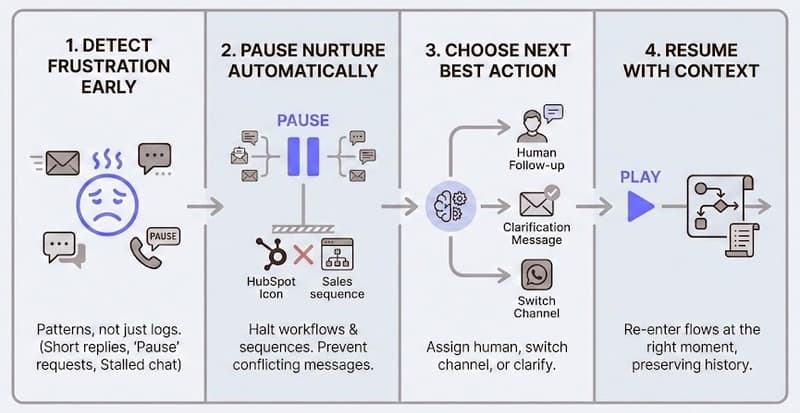
## **Step 1: Detect Frustration Early**
Frustration rarely announces itself clearly. It shows up in patterns:
- Short, blunt email replies
- Repeated questions already answered
- WhatsApp or SMS messages asking to “pause” or “stop”
- Chat conversations that stall mid-flow
These signals live across channels, not just inside **HubSpot email marketing** logs.
### **Step 2: Pause Nurture Automatically**
Once frustration is detected:
- Pause **lead nurturing HubSpot** workflows
- Halt active sales sequences without rep considering it
- Prevent parallel messages from marketing and sales
This is where **HubSpot marketing automation** needs help. Native tools don’t evaluate tone. They wait for explicit actions.
### **Step 3: Choose the Next Best Action**
Pausing is only half the job. The [system should decide what happens next](https://zigment.ai/blog/next-best-action-the-brain-behind-real-time-customer-journey):
- Assign a human follow-up
- Switch to a lower-friction channel
- Send a single clarification message
### **Step 4: Resume With Context**
When the moment is right:
- Re-enter the prospect into flows at the correct state
- Preserve history across **HubSpot lead generation** and sales touchpoints
## **Measure, Iterate, and Govern with RevOps Discipline**
### **Metrics That Actually Matter**
If frustration handling isn’t measurable, it won’t last. RevOps teams should track:
- Time-to-pause after negative sentiment
- First response time once a human steps in
- Demo-booked rate after a pause event
- Drop-off rate inside paused vs. unpaused nurtures
These metrics fit naturally into **revenue operations HubSpot** dashboards.
### **Why Governance Matters**
As orchestration becomes smarter, control becomes critical. **HubSpot RevOps** leaders need visibility into:
- Why a sequence was paused
- Who or what made the decision
- When and how outreach resumed
This is where **HubSpot revenue operations** maturity shows up, not in more activity, but in cleaner accountability.
Connect with us on governance
## **Where Zigment Fits in This Model**
This is where Zigment fits, quietly, deliberately, and on top of what you already run.
Zigment adds a **stateful,** [**agentic layer**](https://zigment.ai/blog/agentic-ai-what-it-really-means-and-how-it-works) **on top of HubSpot**. It brings persistent memory through a [**Conversation Graph**](https://zigment.ai/blog/the-conversation-graph), goal-driven planning with **Next Best Action**, and true omnichannel continuity across web, app, email, SMS, and WhatsApp. All with enterprise-grade governance and human-in-the-loop controls.
For mid-market to enterprise B2B teams running HubSpot across Marketing, Sales, and Service, with 10+ sellers or CSMs and a RevOps leader accountable for pipeline speed, this fills a critical gap.
The outcomes are practical and measurable: higher qualified-lead and demo-booked rates, faster first response when sentiment shifts, and stronger retention over time.
## FAQs
Q: Does HubSpot natively pause sequences based on email sentiment?
A: Currently, HubSpot does not offer native sentiment analysis that automatically pauses sequences or workflows based on the tone of a reply. Standard HubSpot functionality relies on binary triggers, such as a reply being logged, a link clicked, or a specific property value changing. To effectively pause automation based on frustration (e.g., "Not interested right now" or "Stop emailing me"), you need to integrate an AI-driven layer or third-party tool that can interpret the intent behind the text and update workflow enrollment triggers accordingly.
Q: What is the difference between keyword filtering and AI sentiment analysis in sales automation?
A: Keyword filtering is a rigid method that looks for specific strings of text (e.g., "unsubscribe" or "remove me"). It often fails because prospects rarely use exact keywords; they might say, "I'm swamped, let's talk next quarter." AI sentiment analysis, utilizing Large Language Models (LLMs), understands the context and intent of the message. It can distinguish between a hard "no," a timing objection, or a frustrated plea to stop, allowing for nuanced automation decisions that keyword filters miss.
Q: How can RevOps teams reduce high unsubscribe rates in aggressive nurture campaigns?
A: High unsubscribe rates are often a symptom of "deaf" automation, continuing to message a prospect who has already signaled disinterest via a soft channel (like a short reply or SMS). RevOps teams can reduce this friction by implementing a "Listen-First" architecture. This involves using an agentic layer to monitor all incoming signals (email, chat, WhatsApp) and automatically moving prospects into a "Cooling Off" static list if negative sentiment is detected, preventing the hard unsubscribe that damages domain reputation.
Q: When should I re-enroll a prospect into a nurture workflow after a negative reply?
A: Re-enrollment should never be automatic immediately after a frustration signal. Best practices suggest a "Cooling Off" period of 30 to 90 days, depending on the severity of the sentiment. Alternatively, the best approach is to switch the channel or the sender—for example, moving the prospect from a marketing automated newsletter to a personalized, low-frequency check-in from a founder or senior account executive to rebuild trust before resuming standard nurturing.
Q: Why do manual unenrollments fail in Sales Hub Enterprise environments?
A: Manual unenrollment relies on human vigilance, which is not scalable. In Enterprise environments, a sales representative might manage hundreds of leads. If a prospect replies negatively to a marketing email, the sales rep may not see that reply in time to stop their concurrent Sales Hub sequence. This "gap" between Marketing Hub and Sales Hub allows conflicting messages to fire, making the brand appear disorganized and disrespectful of the buyer's time.
Q: Can we automate a "break-up" email when a prospect shows frustration?
A: Yes, but it requires caution. Instead of a standard "break-up" email (which can seem passive-aggressive), use sentiment detection to trigger a "Step-Back" email. If the system detects frustration, it can automatically pause the sales pitch and send a humble, text-only message: "I sensed I might be overstepping. I’ll pause communications for now and check back in a few months." This acknowledges the friction and often saves the relationship better than simply going silent.
Q: How does a "Stateful" automation layer differ from standard HubSpot workflows?
A: Standard HubSpot workflows are generally linear and stateless, they execute If/Then branches based on current data but don't "remember" the nuance of previous conversational context. A stateful layer (like Zigment) maintains a continuous memory of the conversation graph. It remembers that a prospect asked for a pause three weeks ago and prevents a new, unrelated workflow from accidentally restarting the conversation too early, ensuring continuity across different touchpoints.
Q: What metrics indicate that my nurture strategy is causing revenue leakage?
A: Beyond standard open and click rates, look for "Reply-to-Unsubscribe" ratios and "Ghosting" rates post-engagement. If you see a high volume of short, negative text replies (e.g., "Stop," "Who is this?") or if prospects engage early but go silent immediately after a specific follow-up email, it indicates your automation is creating friction. Revenue leakage is most visible when leads stalled in the "middle of the funnel" have a high velocity of negative sentiment replies that are not being addressed.
Q: Is it possible to pause marketing emails while keeping personal sales emails active?
A: Yes, this is a common strategy known as "Air Cover Control." By using exclusion lists in HubSpot, you can set a rule where if a contact has an active Deal or is enrolled in a high-priority Sales Sequence, they are automatically added to an exclusion list for general Marketing newsletters. However, the reverse—pausing sales emails based on marketing replies—usually requires a deeper integration to bridge the gap between marketing assets and sales inboxes.
Q: How does checking prospect sentiment help with GDPR and compliance?
A: While GDPR focuses on consent, sending unwanted emails after a prospect has informally asked you to stop can be seen as a violation of the "Right to Object" or legitimate interest principles. Automating sentiment detection ensures that informal opt-outs (e.g., "Please take me off your list") are processed just as rigorously as clicking an "Unsubscribe" link, keeping your database compliant and cleaner.
---
This blog is powered by Superblog. Visit https://superblog.ai to know more.
---