
Why the pilots haven't moved the math in smaller banks — and what does
A perspective for CMOs, CIOs, and AI transformation heads at India's Small Finance Banks and Urban Co-operative Banks
Most Small Finance Banks and Urban Co-operative Banks in India have, by now, run some version of an AI pilot. A chatbot on the website. A lead-scoring model inside the CRM. An automated welcome and follow-up sequence. A re-skinned IVR with a synthesized voice. In a few cases, a voice-bot for outbound collections.
If you are reading this as the person who funded one of those projects, or championed it internally, or sat through the demos and approved the procurement, you already know the rest of the sentence. Eighteen months later, the conversion math has not meaningfully changed. The RM productivity numbers look about the same. The customer-experience scores, where they are measured, have not moved in either direction. The pilot is rarely declared a failure — it is usually quietly absorbed into the operating budget and stops being mentioned in board reviews.
This is not unique to your bank. It is the dominant pattern across the segment. And it is worth understanding clearly, because the gap between what was promised and what was delivered is not — as is sometimes assumed — a problem with the AI models themselves. The models are capable. The vendors were not lying. What was wrong was the shape of the deployment. And until that shape changes, the next AI pilot will land in the same place as the last one.
What the existing pilots actually delivered
It is worth being specific about what each of the common AI deployments in this segment actually does, because the gap between the marketing description and the operational reality is where the disappointment lives.
The FAQ chatbot on the website answers a list of questions it was trained on. It does this competently within its own boundary. It has no idea that the customer it is talking to messaged the bank on WhatsApp yesterday, walked into the branch last week, or has a pending KYC document sitting in someone's inbox. When the conversation gets even slightly outside its training set, it either guesses confidently or hands off to an email queue that is processed the next business day.
The lead-scoring model inside the CRM ranks leads on a schedule, daily or weekly, against features it was trained on. It is, in most implementations, a rules engine dressed up as machine learning. It does not adapt to real-time signals. It does not know that the lead it is ranking as low-priority just opened the loan terms document for the third time this evening. By the time its ranking refreshes, the moment has passed.
The automated welcome and follow-up sequence sends scheduled messages at fixed intervals. It treats every lead the same way regardless of what they have said, asked, or done. It will send the same Day-3 reminder to a customer who has already spoken to an RM and to a customer who has gone silent. Both experience it, in different ways, as proof the bank is not paying attention.
The re-skinned IVR handles inbound calls with a slightly more pleasant interface than the old menu. It does not remember the previous call. It does not know that the customer it just routed to a human agent had the same complaint resolved last month. It is, in operational terms, a cosmetic upgrade on a system that was already underperforming.
Each of these tools, in isolation, does its narrow job. None of them are wrong as features. The problem is that they were installed as features — bolted onto an existing operational stack with the expectation that AI capability inside a single silo would improve outcomes that depend on context across all the silos. That expectation was, in retrospect, the mistake.
What the data actually shows
The architectural reason none of this moved the math
The shortest way to describe what went wrong is this: every one of these AI deployments was placed inside a silo that the customer's actual journey runs across.
A customer's path to a loan, an account, an FD, a renewal, or a complaint resolution touches the website, WhatsApp, voice, the branch, an RM, the call center, the CRM, the core banking system, and the marketing automation tool — usually in a sequence no one inside the bank could predict in advance. The intelligence the bank needs is intelligence that follows the customer across all of those systems and holds the thread of who they are, what they have asked, what they have been promised, and what they are trying to do.
What the pilots delivered, instead, was intelligence trapped inside a single layer. A smart chatbot that was structurally incapable of knowing what happened on the call yesterday. A smart lead score that could not see the WhatsApp exchange that morning. A smart welcome sequence that could not register that the customer had already had the conversation it was about to initiate. Each tool became, in effect, a slightly more sophisticated version of the silo it was installed into — and the customer, who experiences the bank as one institution, continued to feel the gaps.
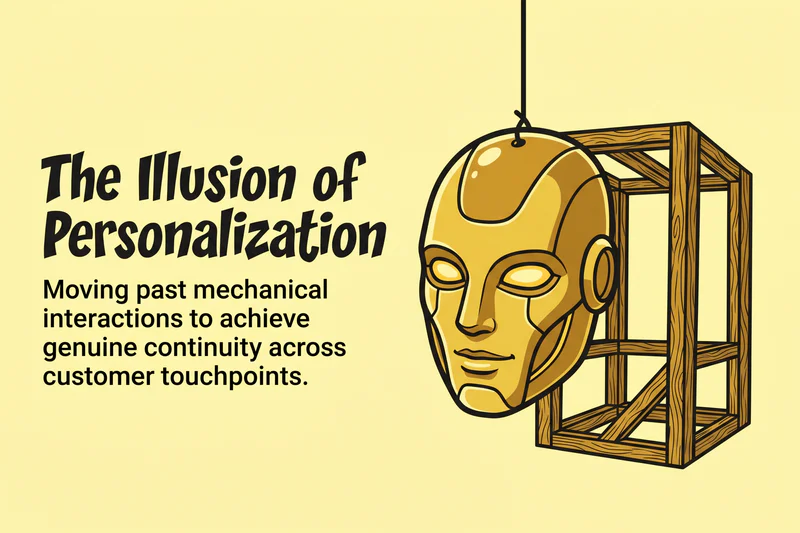
This is the pattern that the industry has started calling mechanical personalization — surface-level adjustments applied without underlying continuity. The technology looks like personalization. The customer experiences it as the same impersonal treatment, just with a more polished voice. And the bank's conversion numbers, which depend on whether the system can actually act on context, do not move — because there is no context to act on.
Why this also keeps stalling at security review
There is a second, quieter reason that the agentic-AI conversation in Indian banking has been more theatre than practice — and it is one that CIOs and CISOs at smaller banks see clearly even when the business teams do not.
Most of the platforms that genuinely could solve the cross-silo problem are not deployable inside the supervisory environment Indian banks operate in. They are SaaS-only, with data leaving the bank's perimeter for processing in jurisdictions the board has not approved. They handle conversation data in formats that do not meet RBI's expectations on capture, retention, or audit. They do not have an on-premise deployment path for banks where the board, the auditor, or the regulator requires one. They have not been built with DPDPA-aligned data handling, right-to-erasure workflows, or conversation-level data lineage as architectural starting points — these have been added as features, where they have been added at all.
The result is that the platforms that could plausibly fix the problem are the ones that cannot get past the bank's security review. And the platforms that do get past the security review tend to be the narrow, single-silo point tools that — as established above — cannot fix the problem.
This is the structural bind smaller banks have been in for the last three years. The right architectural answer existed but was not deployable in this segment. The deployable options were architecturally inadequate. The pilots that resulted were, predictably, the deployable-but-inadequate ones.
What actually works, and what it requires
A genuine fix requires something different from the pilots that have come before — and it is worth being clear about what different means here, because the segment has heard a lot of marketing promises that did not survive contact with operations.
The first requirement is that the intelligence layer sits across the silos rather than inside any one of them. Every customer conversation — on WhatsApp, voice, web, branch, SMS, email — needs to land in a single structured record that follows the customer across channels and across time. An AI agent engaging with the customer at any point needs to read from and write to that record. The agent's value is not its language model; it is the continuity of context it operates from. Without that continuity, every agent is just another chatbot in a silo.
The second requirement is that this layer integrates with — rather than replaces — the systems the bank already runs. Core banking stays the system of record for transactions. The CRM stays the system of record for contacts. The compliance archive stays where it is. The conversation layer fills the space between them that has, until now, been empty. This matters operationally, because a fix that requires replacing the core banking system is not a fix; it is a five-year project the bank will never start.
The third requirement is that the entire architecture is designed for the regulatory environment Indian smaller banks live in — not retrofitted to it. On-premise deployment available where the board requires it, including air-gapped configurations. Conversation capture in regulator-acceptable formats. RBI Cyber Security Framework alignment, DPDPA-aligned data handling, role-based access, complete audit logs, and conversation-level data lineage built in from the start. Not as compliance documentation produced after the fact, but as the architectural shape of the platform itself.
When these three requirements are met, the AI deployment stops behaving like a feature inside a silo and starts behaving like infrastructure across the bank. The chatbot conversation continues at the branch. The branch conversation continues on WhatsApp. The WhatsApp conversation is visible to the RM, to the compliance team, to the auditor, and to the analytics dashboards — without anyone having to stitch it together manually. The math finally moves because the system, for the first time, has enough context to act on.
The decision in front of the segment
The honest framing for CMOs, CIOs, and AI transformation heads at smaller banks today is not whether to invest in AI. That decision has effectively been made, and most institutions are already a pilot or two into it. The framing is whether the next round of investment will repeat the pattern of the last one — another tool inside another silo — or whether it will fund the architectural layer that finally lets the AI investments already made, and the ones still to come, actually deliver the outcomes they were sold on.
That is not a glamorous decision. It does not produce a demo as visually impressive as a chatbot. It requires the bank to think in terms of conversation infrastructure rather than conversation features. It requires the security review and the business case to be aligned from the start, rather than discovered to be in conflict at month four of a pilot. It requires acknowledging that the last eighteen months of investment did not fail because the technology was wrong — it failed because the deployment shape was wrong, and the deployment shape was wrong because the right shape was not, until recently, available in a form this segment could actually buy.
That form is now arriving. The banks that recognize it for what it is will spend the next two years building a conversational layer their competitors do not have. The banks that treat it as another vendor pitch will spend the next two years adding another silo to the stack, and reading another version of this article in 2028.
Zigment is a Conversation Orchestration platform built for India's smaller and modernizing banks. The platform captures every customer conversation across WhatsApp, voice, web, branch, and other channels into a single structured record, powers AI agents that engage with full context, and integrates with the core banking, CRM, and compliance systems banks already run. Zigment is SOC 2 Type II compliant, ISO 27001 certified, DPDPA-aligned, and aligned to the RBI Cyber Security Framework, with both SaaS and on-premise deployment available. Learn more at zigment.ai.