
TL;DR
- A single customer view for enterprise is one governed, real-time record of everything a person has done with your company, available to whoever is talking to them right now.
- Most large organisations already built one. Gartner found only 14% had actually achieved it, while three times as many had already bought the platform meant to deliver it.
- The enterprise failure is rarely storage. It is activation, the last mile between a warehouse that knows everything and a conversation that knows nothing.
- Four things break it: business units that each own a version of the customer, identity resolution that stops at a boundary, overnight batch latency, and governance that fences data away from the front line.
- The fix is a layer that carries the view to the point of contact. It is not another migration.
Marcus runs customer experience at a multinational insurer with eleven million policyholders. On his wall is a dashboard his team spent two years and a great deal of money building. It is genuinely impressive. It shows Elena Roth, a fourteen-year customer, as low risk, high value, and perfectly healthy.
Elena cancelled her policy that afternoon. In the previous seventy-two hours she had opened a complaint on WhatsApp about a delayed claim, spent nine minutes in a web chat asking how to leave, and hung up on an IVR twice. All of it was captured. None of it was on Marcus's wall, because the dashboard refreshes from the warehouse overnight and the warehouse does not ingest conversation.
The retention agent who called Elena that morning saw the healthy version. He opened with an upsell.
This is the enterprise version of the problem, and it looks nothing like the startup version. Marcus is not missing data. He is drowning in it. What he is missing is the shortest distance between what the company already knows and the person currently on the phone.
What is a single customer view at enterprise scale?
A single customer view is one unified, governed, real-time record of every interaction a person has had with your company, across chat, email, voice, forms, claims, payments, and support, with the intent and history intact. At enterprise scale it carries one extra requirement that changes everything. It has to resolve to the same person across business units, regions, brands, and acquired systems, and it has to be readable at the moment of contact rather than the morning after.
That last clause is where most programmes quietly fail. A single customer view for enterprise is usually scoped as a data project and judged on whether the record exists. The record almost always ends up existing. Whether anyone can act on it while the customer is still listening is a different question, and it is rarely the one on the project charter.
Gartner's survey of 402 marketing, IT, and enterprise leaders responsible for customer data initiatives found that only 14% had achieved a 360-degree view of their customer, while 82% still wanted one. The detail worth sitting with is the next one. Three times as many respondents had adopted a customer data platform as had actually achieved the view it was bought to produce.
Buying the platform and achieving the view turn out to be two different projects, and most enterprises have only finished the first.
Why does the enterprise single customer view keep failing?
Ask a Series A founder why they lack a unified customer record and the answer is simple. They never built one.
Ask a bank, an insurer, or a global retailer the same question and you get something stranger. They built one, sometimes twice. There is a steering committee, a golden record, a data dictionary, and a slide showing all of it connected.
And the agent on the phone still opens with an upsell to a customer who is mid-complaint.
Call it the Activation Gap. Everything upstream works, because data is collected, cleansed, deduplicated, modelled, and governed. Then it stops, one step short of the only place it was ever going to earn its money, which is inside a live conversation.
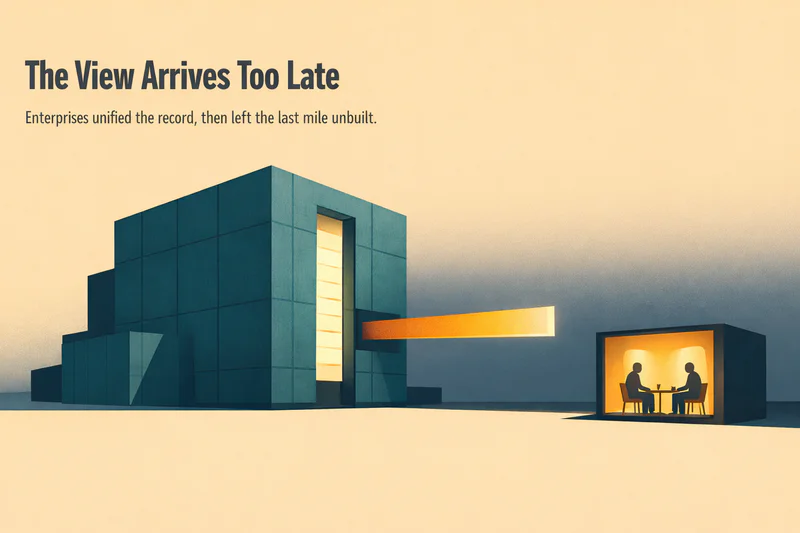
The enterprise has solved storage and left the last mile unbuilt.
The gap is structural rather than technical. Gartner also found that 78% of organisations centralise customer data management inside IT, and that 59% of marketing leaders felt IT policy constrained their use of newer technology. The record is owned by the function furthest from the conversation. Every request to use it becomes a ticket, and tickets do not resolve at the speed of a customer deciding to leave.
The view was never missing. It was just never in the room.
What actually breaks a unified customer record in a large organisation
The Activation Gap has four common causes. Most enterprises have at least three of them running at once, which is why the problem survives repeated attempts to fix it with better tooling.
Business units that each own a version of the customer
Retail banking knows Elena as an account, the insurance arm knows her as a policy, and the acquired regional brand still holds her in a system nobody has fully mapped since the integration. Each unit has a P and L, a roadmap, and a reasonable argument for why its definition is the correct one.
Consolidation projects tend to lose to that argument, because no unit wants to inherit another's data quality.
Identity resolution that stops at the boundary
Matching works beautifully inside a domain and falls apart across them. The same person is a customer ID here, a policy number there, a household in the marketing model, and an anonymous device on the website. Enterprises usually solve this for the two systems with the loudest owners and declare the pattern reusable. It rarely is, and the unmatched remainder is where the highest-value customers hide, because long tenure means more systems.
A record that is accurate at midnight and wrong by lunchtime
Warehouse and lakehouse architectures were designed for analysis, where yesterday's truth is entirely adequate. Conversations do not work that way. A complaint filed at nine in the morning has to be visible to the retention agent at eleven, not in tomorrow's load. Batch latency is invisible in a quarterly report and decisive in a phone call.
Governance that fences the data away from the people who need it
Residency rules, consent scope, and access control are not obstacles to route around. They are the job. The trouble is that most enterprise stacks enforce them by restricting access to the store, which means the safest possible outcome is also the least useful one. The frontline gets a redacted, delayed, partial view, and then gets measured on customer experience.
Every one of these failures happens after the data is already unified, which is why buying more storage never resolves them.
Warehouse, enterprise CDP, or orchestration layer
Three architectures claim to deliver the unified view. At enterprise scale they are not competitors so much as different parts of the same sentence, and confusing them is how organisations end up buying the third thing to fix what the first two were never designed to do. Pricing below is shown as third-party estimates as of 2026.
| What matters at enterprise scale | Warehouse or lakehouse | Enterprise CDP | Conversational orchestration layer |
|---|---|---|---|
| Primary job | Store and analyse history | Unify profiles and build segments | Deliver the view into a live interaction |
| Freshness at moment of contact | Batch, usually overnight | Near real time for segments, slower for full profiles | Real time, updates as the conversation happens |
| Captures conversation intent | No, event and transaction rows | Partly, mostly clicks and campaign response | Yes, what was said and how urgent it sounded |
| Time to first business outcome | Quarters | Quarters, longer with legacy sources | Weeks |
| Works across business units and regions | Yes, once modelled | Yes, with per-region instances and cost | Yes, it reads the systems each unit already runs |
| What it asks of your team | A data engineering function | A dedicated platform team plus migration | Connection to the stack you already own |
Read down the freshness row and the pattern is obvious. The first two columns are excellent at knowing things and structurally poor at knowing them in time. That is not a defect. Neither was built to sit inside a conversation, and asking a warehouse to do it is a category error that costs enterprises years.
How do you close the activation gap without another migration?
The instinct after a failed unification programme is to run a better one. New platform, cleaner model, tighter governance, eighteen months. That instinct is expensive and it repeats the original mistake, which was treating a conversation problem as a storage problem.
The better question is narrower. What already touches every system you own, updates in real time, and carries intent as well as fact?
For most enterprises the answer is the conversation itself. Every fragment of Elena lived inside one, whether the complaint, the chat, the abandoned call, or the renewal notice. Conversations are the one thread that already runs through the CRM, the claims system, the contact centre, and the messaging channels.
Build the unifying layer there and the sequence looks like this.
- Connect rather than migrate. The layer reads the systems each business unit already runs, so no team is asked to surrender its platform or its roadmap as a precondition.
- Resolve identity at the point of contact. Stitch the person together when they show up, using the live conversation as the joining signal, instead of waiting for a nightly match job to agree.
- Carry intent, not only events. Record what the customer asked and how urgent they sounded alongside what they clicked, because the first pair predicts churn and the second does not.
- Push the view to the edge. Deliver it into the agent's screen and the automated flow at the moment of the interaction, under the same consent and residency rules the store enforces.
Zigment calls the resulting timeline the Conversation Graph. It is one continuous record per person holding what they clicked, what they asked, how urgent they sounded, and what happened next, kept intact as they move across channels and business units. The logic behind how conversation builds the customer view holds at eleven million policyholders as well as at three hundred.
None of this replaces the warehouse. The warehouse remains the system of record and the place analysis happens. The layer is what finally makes that record legible at the speed of a customer deciding whether to stay, and teams generally describe it as adding an intelligent layer to the stack rather than replacing anything.
Where an orchestration layer fits (and where Zigment sits)
Zigment is an orchestration layer that sits on top of the tools you already run, including Salesforce, HubSpot, your contact centre, and your messaging channels, and coordinates the agents, workflows, and handoffs across them. The single customer view is what it produces as it works, not a separate deliverable you wait two years to receive.
Because every conversation lands in one timeline, the payoff shows up where an enterprise actually feels it. The retention agent calling Elena sees this morning's complaint, not last night's snapshot. A handoff between the claims team and the renewals team carries the full history. Zigment's customers see around forty percent higher conversions from inbound demand and up to eighty percent less manual effort on lead handling.
Scale is the part enterprises test hardest, and reasonably so. Bajaj Auto uses Zigment to preserve conversation context across handoffs in more than twenty countries, which is the same mechanism Marcus needs across business units rather than borders. The debate about whether the right master data foundation is an MDM or a CDP stays live and stays useful. It simply answers a different question than the one Elena's cancellation asked.
The design principles behind a single customer view built for the AI era point the same way, toward a model that unifies meaning rather than a store that only unifies rows. The broader case for a single customer view is well documented and it holds. The enterprise correction is about where the view has to arrive, not whether it is worth having.
The bottom line
Marcus's problem was never a missing record. He had one, governed and complete and two years in the making. His problem was that it lived somewhere Elena's cancellation could not reach it in time.
That is the enterprise single customer view failure in one line. Not an absence of data, but a distance between the data and the conversation. Another platform shortens the wrong distance. A layer that carries the record into the moment of contact shortens the one that costs you customers.
You have likely already paid for the view. What remains is delivering it to the person on the phone before the call ends, which is what Conversational Revenue Orchestration does on top of the stack you already own. If that gap is costing you renewals, see it working on your own stack.
So find your own Elena. The fourteen-year customer your systems describe as healthy, right up to the afternoon she leaves. How many of those did your dashboard call low risk this quarter?