# Stop Automating, Start Orchestrating: The 2026 Playbook for HubSpot Users
Author: Team Zigment
Author URL: https://zigment.ai/blog/author/team-zigment
Published: 2026-01-24
Category: Hubspot
Category URL: https://zigment.ai/blog/category/hubspot
Tags: hubspot limitations, hubspot workflows, Orchestration
Tag URLs: hubspot limitations (https://zigment.ai/blog/tag/hubspot-limitations), hubspot workflows (https://zigment.ai/blog/tag/hubspot-workflows), Orchestration (https://zigment.ai/blog/tag/orchestration)
URL: https://zigment.ai/blog/stop-automating-start-orchestrating-2026-playbook-hubspot
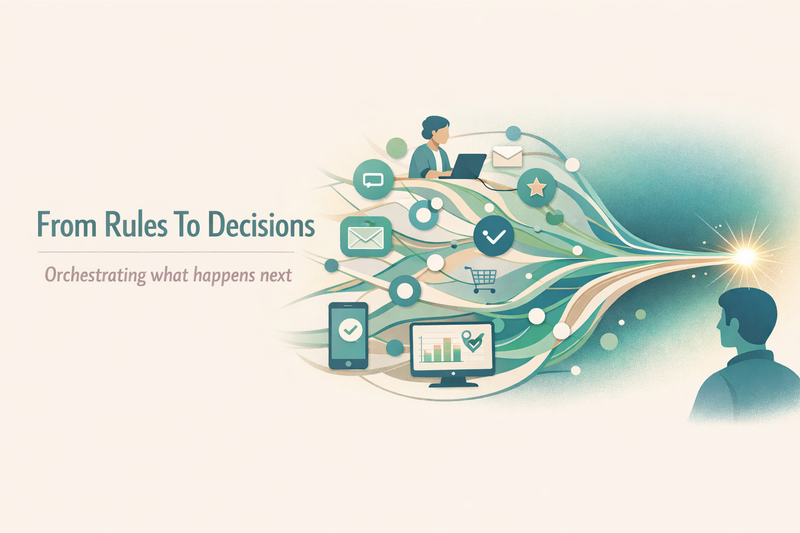
Your HubSpot dashboards look busy.
Workflows are firing.
Emails are going out.
And yet, deals slow down.
Leads respond on WhatsApp after clicking an email. Sales follows up without seeing the conversation. Marketing keeps nurturing someone who already spoke to an SDR yesterday. Nothing is _technically_ broken, but momentum is.
That’s the quiet failure of modern HubSpot workflows. They execute rules perfectly, while context leaks everywhere else.
We’ve worked with teams running 50, sometimes 100+ workflows, all designed with good intent. The result is complexity without coordination. Speed without direction. Activity without progress.
In 2026, winning teams stop asking, “Which workflow should fire?”
They ask, “What should happen next, for this buyer, right now?”
This playbook shows how to make that shift, on top of HubSpot, not instead of it.
## **The Problem: Why HubSpot Workflows Break in the Real World**
Let’s be clear about where things start going wrong, not in strategy decks, but in day-to-day execution.
> Stateless systems can’t manage emotional journeys.
Most teams rely heavily on HubSpot workflows and HubSpot automation workflows to manage growth. At first, it works. A lead fills a form. An email goes out. A task gets created. Clean. Predictable.
Then reality shows up.
### **Where the cracks appear**
- **Workflows are stateless**
Each workflow runs in isolation. It doesn’t remember what happened five minutes ago on another channel, or what Sales just said on a call.
- **Channels don’t talk to each other**
Email logic lives in Marketing. WhatsApp or SMS lives elsewhere. Sales actions sit outside automation entirely.
- **Sequences vs workflows create confusion**
Teams debate _HubSpot sequences vs workflows_ internally, while the buyer experiences duplicated follow-ups, awkward timing, or silence.
- **Edge cases become the norm**
Every “what if” adds another branch. Another exception. Another fragile dependency.
### **The familiar failure pattern**
- Leads get touched, but not moved
- Sellers lose context mid-conversation
- RevOps spends more time fixing logic than improving pipeline speed
The painful truth?
Your workflows aren’t broken. They’re just solving the wrong problem.
Automation handles steps. Journeys need decisions.
That gap is where revenue quietly leaks.
Talk to us about workflow gaps
## **Why This Matters: Revenue Leaks Hide Between the Steps**
On paper, many HubSpot workflows examples look solid. Clear triggers. Logical branches. Well-timed emails. But [revenue doesn’t move on paper](https://zigment.ai/blog/revenue-orchestrations-link-marketing-sales-retention-goal), it moves through real buyer behavior, and that’s where cracks turn costly.
### **The real impact teams underestimate**
- **Slower first response times**
When context is split across tools, replies lag. Minutes turn into hours. Hours turn into lost intent.
- **Misaligned follow-ups**
Marketing automation HubSpot programs keep nurturing while Sales is already engaged, creating mixed signals.
- **False confidence in activity metrics**
Opens, clicks, and workflow completion look healthy, yet demos don’t get booked.
Teams invest heavily in marketing automation with HubSpot **,** expecting scale to unlock growth. Instead, scale amplifies friction.
RevOps leaders feel this most. Pipeline velocity slows. Forecasts stretch. Everyone is “busy,” but fewer deals move forward with momentum.
The takeaway is simple and uncomfortable:
Automation optimizes execution. It doesn’t protect outcomes.
And outcomes, qualified conversations, faster decisions, retained customers are what growth actually depends on.
Connect with us on revenue leaks
## **What Teams Commonly Try and Why It Keeps Failing**
When results stall, most teams don’t rethink the model. They add more logic.
### **The usual fixes**
- **More lead nurturing in HubSpot**
Additional email tracks, tighter segmentation, longer drip sequences.
- **Channel-specific optimization**
Polishing HubSpot email marketing while WhatsApp, SMS, or chat run separately.
- **Heavier lifecycle gating**
More rules to decide who goes where, and when.
On the surface, this feels responsible. Activity increases. Coverage improves. Nothing slips through the cracks at least in theory.
### **Why this approach breaks down**
- Lead nurturing happens **per channel**, not per buyer
- Context resets when someone replies outside email
- Sales and Service actions remain invisible to Marketing logic
So teams double down again. More workflows. More branches. More exceptions.
At that point,HubSpot marketing becomes a web of automation no one wants to touch. Every change risks breaking something else.
The result isn’t scale.
It’s noise.
Buyers don’t feel guided. Teams don’t feel confident. And RevOps spends its time managing complexity instead of accelerating revenue.
## **A Better Way: From HubSpot Automation to Orchestration**
This is where high-performing teams change the question.
They stop asking how to improve HubSpot marketing automation and start asking how to coordinate decisions across the entire journey.
### **What orchestration actually means**
[Orchestration](https://zigment.ai/blog/what-is-marketing-orchestration) is not more workflows.
It’s a different operating model.
- **From rules to decisions**
Instead of “if this, then that,” the system decides the [_next best action_](https://zigment.ai/blog/next-best-action-the-brain-behind-real-time-customer-journey) based on live context.
- **From stateless to stateful**
Every interaction updates a shared memory of the buyer across email, chat, WhatsApp, SMS, sales calls.
- **From single-channel to omnichannel**
One intent. One plan. Many channels.
This shift directly impacts HubSpot lead generation and pipeline speed. Leads don’t just get touched they get guided.
### **Where HubSpot fits**
HubSpot remains critical:
- System of record
- CRM, workflows, reporting
- Execution engine for actions
What it doesn’t do natively is reason across channels in real time. That’s not a flaw, it’s a design boundary.
For **revenue operations HubSpot** teams, orchestration fills that gap without ripping anything out.
The takeaway is straightforward:
Automation executes. Orchestration decides.
And decisions are what move revenue forward.
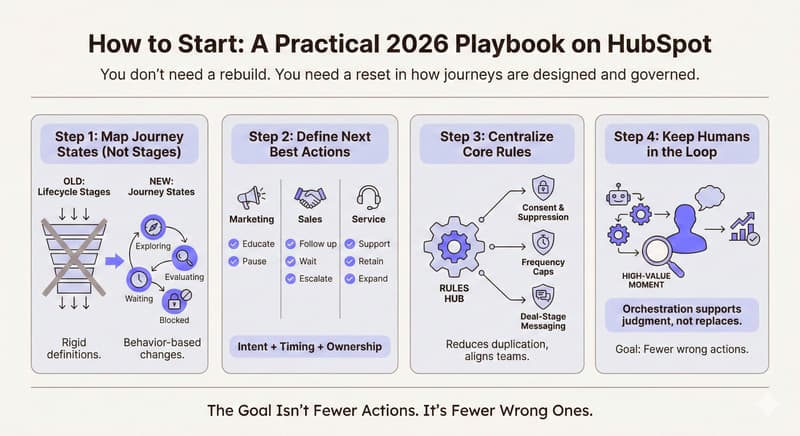
## **How to Start: A Practical 2026 Playbook on HubSpot**
You don’t need a rebuild. You need a reset in how journeys are designed and governed.
Here’s a clean way **HubSpot revenue operations** teams are starting the shift.
### **Step 1: Map journey states, not lifecycle stages**
- Replace rigid stages with states like _exploring_, _evaluating_, _waiting_, _blocked_
- States change based on behavior, not internal definitions
### **Step 2: Define Next Best Actions by role**
- Marketing: educate or pause
- Sales: follow up, wait, or escalate
- Service: support, retain, or expand
Each action should have intent, timing, and ownership.
### **Step 3: Centralize rules that matter**
- Consent and suppression
- Frequency caps
- Deal-stage-sensitive messaging
This reduces duplication across **HubSpot revops** workflows and keeps teams aligned.
### **Step 4: Keep humans in the loop**
High-value moments deserve review. Orchestration supports judgment, it doesn’t replace it.
The goal isn’t fewer actions.
It’s fewer wrong ones.
## **Measure and Iterate: Metrics That Reflect Real Progress**
> Journey metrics reveal truth faster than dashboards.
If you measure workflows, you’ll optimize workflows.
If you measure journeys, you’ll improve revenue.
That distinction matters more than ever for HubSpot revenue operations teams.
### **Metrics worth tracking**
- **First response time across channels**
Not just email. Include WhatsApp, SMS, and chat.
- **Next-action latency**
How long it takes to move from one meaningful step to the next.
- **Qualified lead to demo rate**
A clearer signal than opens or clicks.
- **Journey drop-offs between tools**
Where context disappears, momentum usually follows.
- **Retention and re-engagement signals**
Early indicators of long-term growth.
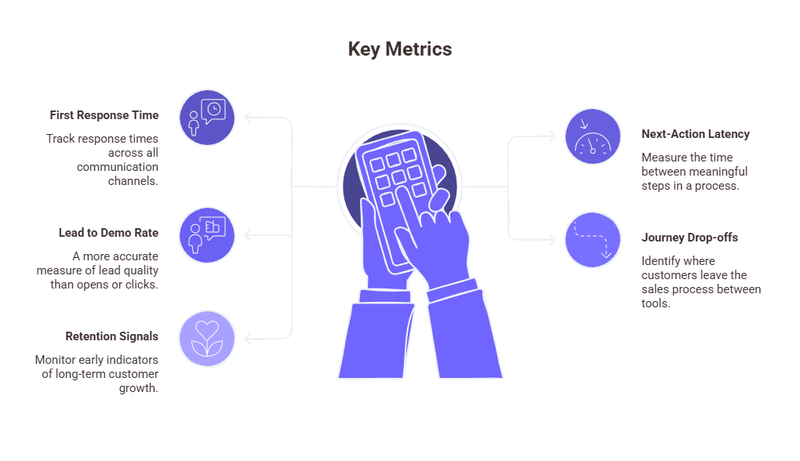
These metrics reveal how well your system coordinates, not just how busy it is.
The strongest teams review them weekly, not quarterly. Small adjustments compound quickly when decisions stay connected.
Execution creates activity.
Coordination creates momentum.
Talk to us about metrics
## **Where Zigment Fits In**
Once teams accept that automation alone can’t carry modern journeys, the next question is obvious: _how do we orchestrate without rebuilding everything we’ve already invested in?_
This is where Zigment comes in.
Zigment adds astateful, agentic layer on top of HubSpot **,** designed specifically for teams that have outgrown rule-based automation but don’t want to abandon it.
Here’s what that looks like in practice:
- **Persistent memory through a** [**Conversation Graph**](https://zigment.ai/blog/the-conversation-graph) Every interaction, email replies, WhatsApp messages, chat, sales activity, updates a shared understanding of the buyer.
- **Goal-driven planning with Next Best Action**
Instead of firing rules, Zigment evaluates intent and decides what should happen next, and who should own it.
- **True** [**omnichannel**](https://zigment.ai/blog/omni-channel-customer-engagement-reason-customers-disappear) **continuity**
Journeys stay intact across web, app, email, SMS, and WhatsApp, without duplicating logic per channel.
- **Enterprise-grade governance**
Policy enforcement, auditability, and human-in-the-loop controls are built in, not bolted on.
For mid-market to enterprise B2B teams running HubSpot, especially those with 10+ sellers or CSMs, this changes outcomes fast. Faster first responses. Higher qualified-lead and demo-booked rates. Better retention through consistent, contextual engagement.
HubSpot remains your system of record and execution engine.
Zigment becomes the brain that keeps every move connected.
In 2026, growth doesn’t come from more workflows.
It comes from knowing what to do next and doing it together, across every channel.
## FAQs
Q: What is the actual difference between HubSpot Workflows and Sequences, and why does it matter?
A: HubSpot Workflows are designed for "one-to-many" marketing automation—great for processing lists, managing data properties, and sending broad nurture emails. HubSpot Sequences are for "one-to-one" sales engagement, allowing reps to automate personal follow-ups.
Q: What does it mean that HubSpot workflows are "stateless"?
A: "Stateless" means the automation has no memory of what happened just before or in parallel on another channel.
Example: A workflow sends a "Book a Demo" email because a user visited a pricing page.
The Flaw: It doesn't know that the same user just complained on WhatsApp about a bug or told a sales rep "not right now" on a call five minutes ago. Stateless systems execute rules based on triggers, not context. Orchestration adds a "stateful" memory layer so every message respects the buyer’s entire recent history.
Q: If I implement orchestration, do I need to replace HubSpot?
A: Absolutely not. HubSpot is your system of record and execution engine—it is excellent at sending the email, logging the call, and storing the data. Orchestration sits on top of HubSpot. Think of HubSpot as the muscles executing the movement, while orchestration (like Zigment) acts as the brain deciding which muscle to move and when, ensuring your existing HubSpot investment works smarter, not harder.
Q: How does "revenue leakage" happen in automated workflows?
A: Revenue leakage in automation occurs in the "white space" between tools and teams. Common examples include:
Speed Lag: A lead replies to an SMS, but the alert sits in a shared inbox for hours while the lead goes cold.
Context Loss: Sales follows up with a generic script because they didn't see the specific question the lead asked a chatbot.
False Negatives: A lead is marked "closed-lost" because they didn't open an email, even though they were engaging heavily on social or WhatsApp. Orchestration plugs these leaks by unifying signals into a single "Next Best Action."
Q: What is "Next Best Action" marketing, and how is it different from a drip campaign?
A: A drip campaign is linear and rigid: Send Email 1 > Wait 3 Days > Send Email 2. It assumes the path forward. Next Best Action is dynamic and fluid. It evaluates live data to decide the immediate best step.
Scenario: A lead clicks a pricing link.
Drip: Queues "Pricing FAQ" email for tomorrow.
Next Best Action: Notices the lead is a high-value target currently online and triggers a "Connect now" prompt for a live agent via WhatsApp immediately.
Q: Can’t I just build "orchestration" using HubSpot’s custom code and branching logic?
A: Technically, you can try, but it creates "technical debt." To orchestrate a true omnichannel journey using only native workflows, you would need complex if/then branches for every possible permutation of channel, timing, and behavior. This results in "Spaghetti Automation"—a web of logic so fragile that one change breaks the whole system. An orchestration layer manages this complexity dynamically, without you needing to hard-code every single exception.
Q: How does Zigment specifically help with HubSpot orchestration?
A: Zigment acts as a stateful, agentic layer that integrates directly with HubSpot. It connects your fragmented channels (Email, WhatsApp, SMS) into a single conversation graph. Instead of you writing rules for every scenario, Zigment’s AI agents analyze the buyer's intent in real-time and autonomously execute the correct next step—whether that's drafting a reply, scheduling a meeting, or alerting a human—while updating HubSpot instantly.
Q: What metrics should I track to measure "Orchestration" success vs. "Automation" success?
A: Stop looking at Activity Metrics (workflow completions, emails sent) and start tracking Journey Metrics:
Next-Action Latency: Time between a user signal and your system's meaningful response.
Journey Continuity: The % of leads who move seamlessly from marketing (nurture) to sales (conversation) without drop-off.
Conversation Velocity: How fast a lead moves from "Inquiry" to "Qualified" when channels are coordinated vs. siloed.
Q: Is this approach only for Enterprise-level teams?
A: No, but it is most critical for teams where volume exceeds human capacity. If your sales team can manually check every lead’s history before sending an email, you might not need this yet. But if you have 10+ reps or manage thousands of leads where "context" is getting lost in the noise, shifting from stateless workflows to orchestration is the highest-ROI move you can make in 2026.
Q: What is the first step to moving from workflows to orchestration?
A: Don't rebuild everything. Start by mapping "States" instead of "Stages."
Old Way: Lifecycle Stage = MQL (Static definition).
New Way: State = "Active Evaluation" (Dynamic status based on behavior). Identify one high-friction journey—like your "Demo Request to Meeting Booked" flow—and map out where the hand-offs fail. Apply orchestration logic there first to prove the value.
---
This blog is powered by Superblog. Visit https://superblog.ai to know more.
---