# The 5 Best Customer Journey Orchestration Platforms in 2026
Author: Team Zigment
Author URL: https://zigment.ai/blog/author/team-zigment
Published: 2025-11-17
Category: Customer journey orchestration
Category URL: https://zigment.ai/blog/category/customer-journey-orchestration
Meta Title: Best Customer Journey Orchestration Platforms in 2026
Meta Description: Compare the best customer journey orchestration platforms for 2026 on features, integrations, channels, and fit from SMB to enterprise.
Tags: Customer Experience, Customer Journey orchestration, Journey orchestration Platform
Tag URLs: Customer Experience (https://zigment.ai/blog/tag/customer-experience), Customer Journey orchestration (https://zigment.ai/blog/tag/customer-journey-orchestration), Journey orchestration Platform (https://zigment.ai/blog/tag/journey-orchestration-platform)
URL: https://zigment.ai/blog/top-journey-orchestration-platforms-in-2026
## TL;DR
- A journey orchestration platform reads live customer data, detects intent, and fires the next best action across email, SMS, WhatsApp, push, and web. Older journey-mapping tools only visualize the path. They do not execute it.
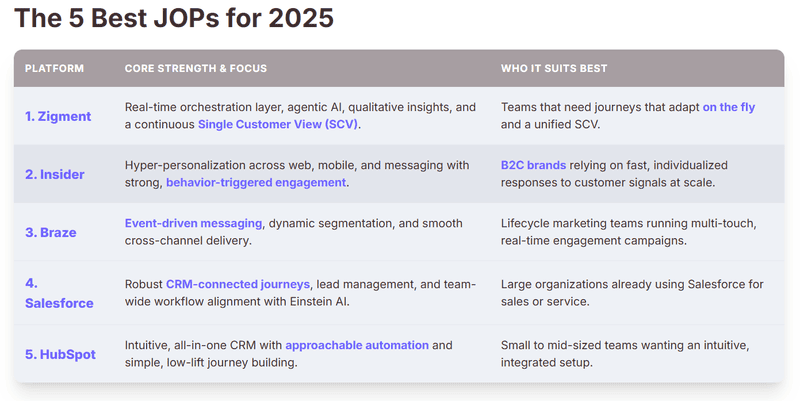
- The ten platforms covered here are Zigment, Insider, Braze, Salesforce Marketing Cloud, HubSpot, Adobe Journey Optimizer, Microsoft Dynamics 365 Customer Insights, Iterable, Klaviyo, and Genesys Cloud CX. They were judged on how well each fits how a team actually works, covering customer understanding, fit with the existing stack, control over journeys, daily usability, and room to scale.
- Integration is the real dividing line. Zigment is API-first and sits on top of your CRM, helpdesk, and analytics rather than replacing them. Salesforce and HubSpot lean on their own ecosystems, while Insider and Braze need a strong upstream data pipeline to reach full orchestration.
- The platforms that win read context and act in the moment without feeling mechanical. Customers do not want more messages. They want timing that makes sense.
> Customer journeys aren’t linear anymore, they’re living systems that react to every click, pause, and question. Journey orchestration is what keeps those moving parts connected.
Customer expectations have skyrocketed, and businesses can no longer rely on disconnected tools or static customer journey maps. The demand for top customer journey orchestration platforms has grown because brands need real-time, AI-driven systems that unify data, automate actions, and personalize interactions across every touchpoint.
This guide breaks down ten customer journey orchestration platforms worth evaluating in 2026, what each one is actually built for, and where each strains. It also covers the three places customer journeys break in practice, because that is what the platform choice has to solve.
## **What Is a Journey Orchestration Platform?**
A **journey orchestration platform (JOP)** is a real-time system that connects customer data, identifies intent, and automates the [next-best action](https://zigment.ai/blog/mood-intent-urgency-next-best-action) across every channel. Our primer on [what customer journey orchestration is](https://zigment.ai/blog/what-is-customer-journey-orchestration) covers the definition in full. Unlike traditional journey mapping tools, which visualize but don’t execute, JOPs operate dynamically. They pull data from multiple sources, analyze behavior as it happens, and trigger personalized messages, offers, or workflows at the exact moment a customer needs them.
Modern platforms go beyond basic [marketing automation](https://zigment.ai/blog/journey-orchestration-vs-marketing-automation "Journey Orchestration vs Marketing Automation") by integrating AI, predictive analytics, and omnichannel execution. This allows teams to remove data silos, respond instantly to customer behavior, and deliver consistent experiences across marketing, sales, product, and support. The architectural bar for doing that live is covered in what [real-time journey orchestration actually requires](https://zigment.ai/blog/what-real-time-journey-orchestration-requires).
See how real-time orchestration can reshape your customer flow.
## **Why Does Journey Orchestration Matter Today?**
> The brands winning today aren’t the ones sending more messages, they’re the ones sensing intent in real time and responding with relevance.
Customers move quickly, and most brands struggle to keep up. People hop between channels, expect quick answers, and lose interest just as fast. Journey orchestration helps teams respond in the moment instead of scrambling after the fact.
The stakes are measurable. [Salesforce](https://www.salesforce.com/blog/customer-engagement-research/ "Salesforce State of the Connected Customer") found that 79% of customers expect consistent interactions across departments, yet most stacks deliver the opposite. And [McKinsey](https://www.mckinsey.com/capabilities/growth-marketing-and-sales/our-insights/the-value-of-getting-personalization-right-or-wrong-is-multiplying "McKinsey, The value of getting personalization right") found that faster-growing companies drive 40% more of their revenue from personalization than slower rivals. Orchestration is how teams close that gap.
You can think of it like a map that redraws itself as someone browses, clicks, or asks a question. The system picks up those signals and guides them forward in a way that feels natural. It also helps every teamwork from the same source of truth, which cuts down on mixed messages.
At its core, journey orchestration reduces guesswork. It pulls scattered data together and helps brands show up at the right time without overdoing it. In a world where attention slips fast, that bit of timing goes a long way.
Explore how adaptive journeys can keep your brand in sync with customer behavior.
## **How Did We Choose the Top Customer Journey Orchestration Platforms in 2026?**
Deciding on a [journey orchestration](https://zigment.ai/blog/agentic-ai-in-journey-orchestration) platform can feel a bit overwhelming, mostly because everything sounds promising at first glance. What matters more is how well the tool fits the way your team actually works.
### **What Brands Should Keep in Mind**
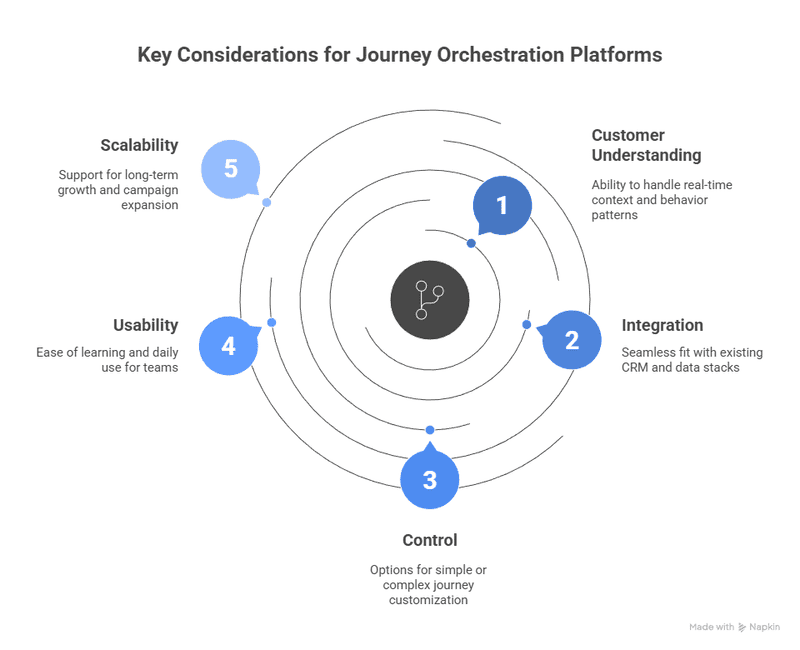
**How the platform understands your customers**
Look at whether it handles real-time context, behavior patterns, and signals that change quickly throughout the day. This is the difference between a fixed sequence and [adaptive journey orchestration](https://zigment.ai/blog/adaptive-journey-orchestration).
**How it fits into your existing setup**
Some tools slide neatly into your CRM or data stack. Others need extra configuration before they feel natural. We break this down further in our look at [journey orchestration integration capabilities](https://zigment.ai/blog/journey-orchestration-integration-capabilities).
**How much control you want over your journeys**
Simple drag and drop paths might be enough for some teams, while others need branching logic, decision points, and more expressive personalization.
**How comfortable your teams will be using it daily**
A tool that’s easy to learn and doesn’t slow people down usually wins in the long run, even if it’s not the flashiest option.
**How well it supports your long term goals**
Think about whether it can grow with your campaigns instead of forcing you to jump platforms again later.
A platform might be powerful, but if it takes a small army to run it, most teams won’t get far. The ones that made this list strike a good balance between capability and usability, which is a rare mix in this space.
## **Where Do Customer Journeys Actually Break?**
Every platform on this list can draw a journey. The difference shows up at the seams, in the handful of places where a real customer quietly stops moving. Three of them account for most of the loss.
### The gap between intent and response
Someone raises their hand at 11:40 on a Tuesday night. In most stacks that becomes a row in a CRM, and the row waits until someone works the queue on Thursday morning. The intent has expired by then, and no amount of personalization downstream recovers it. A multi-city residential real estate group closed that specific gap by starting the conversation at the point of the ad click rather than after it, and saw **40 percent higher conversion than its offline process alongside 65 percent less tele-calling**.
### The gap between volume and qualification
More reach is easy. More reach without filtering just moves the bottleneck onto your sales team. A fertility care network running across 88 clinics answers inbound in **under thirty seconds** and **filters roughly 90 percent of it** before a salesperson ever sees it, which cut cost from advertising to booked consultations by **40 percent**. Orchestration earned its place there by removing work, not by adding messages.
### The gap at the handoff
This is the one buyers discover last. A qualified person reaches a human, and the human opens a record holding a name, a source, and a timestamp. The budget hesitation, the competitor they mentioned, the language they were comfortable in, all of it is gone. A global vehicle manufacturer running across **more than twenty countries and twenty languages** preserves that context into the handoff and cut cost per qualified lead **45 percent** while doubling qualified volume.
The pattern behind all three is the same. What survives the gap is context, and a platform either carries it or restarts the customer at its own front door. For the full stage-by-stage walk through an enterprise lifecycle, our guide to the [best journey orchestration platforms for enterprise](https://zigment.ai/blog/best-journey-orchestration-platforms-for-enterprise) follows one customer across five stages and five industries.
## **Key Features to Evaluate in Customer Journey Orchestration Tools**
When comparing **customer journey management** or **journey orchestration software**, a few capabilities matter more than anything else.
**Unified Data Interface**
Your platform should pull customer signals from every system into one place, a clean, real-time view instead of scattered data.
**AI-Driven Automation**
Look for predictive audiences, dynamic triggers, and automated decisioning that adapts journeys based on live behavior.
**Omnichannel Execution**
The tool should coordinate journeys across email, SMS, push, WhatsApp, and web without losing context.
**Single Customer View (SCV)**
Strong identity resolution ensures every interaction maps to the right individual, improving personalization and journey analytics.
**Real-Time Journey Analytics**
Beyond dashboards, you need insights that reveal drop-offs, intent shifts, conversion paths, and friction points.
**User-Friendly, No-Code Journey Builder**
A drag-and-drop interface helps teams design, test, and launch journeys workflows quickly without depending on developers or complex workflows.
## **1\. Zigment**
Zigment works from the belief that every customer interaction leaves a thread worth paying attention to. Most platforms only grab the clean, structured bits, but Zigment pulls in everything and stitches it into a [single customer view](https://zigment.ai/blog/single-customer-view-business-needs-key-benefits-real-impact) that feels current, not frozen. Its conversation graph maps how people actually move through touchpoints, and because it listens to qualitative signals like tone, intent, and hesitation, the agentic AI can spot the next best action without teams wrestling with endless rules or complicated flows.
The orchestration layer is what ties it all together. Instead of asking you to rebuild your stack, Zigment sits neatly on top of what you already use. It cleans scattered data, feeds that unified SCV into every channel, and smooths out the rough edges so journeys don’t feel patched together. The end result is a system that guides customers with context and timing, rather than forcing them through a rigid sequence.
The payoff shows up in deployments. Across live rollouts, Zigment has driven roughly 40% higher conversions on inbound demand, up to 80% less manual lead-handling effort, and 3x ROI, usually going live in under four weeks. One real-estate rollout lifted conversion 40 percent against the client's own offline baseline.
See how Zigment’s conversation-led orchestration simplifies complex journeys.
## **2\. Insider**
Insider is a cross-channel customer engagement platform built for hyper-personalization, offering AI-powered segmentation, predictive audiences, and coordinated journeys across web, mobile, email, and messaging apps. Its strength comes from combining deep behavioral insights with on-site and in-app experience tools, making it a strong choice for brands that want to craft individualized lifecycle journeys at scale. Teams may find that fully unlocking its advanced capabilities works best when they have the bandwidth for thoughtful setup and experimentation.
## **3\. Braze**
Braze excels in real-time customer engagement, using behavioral triggers, dynamic segmentation, and mobile-first messaging across push, in-app, email, and SMS. It’s particularly strong at helping teams deliver timely messages that match user intent, supported by powerful APIs and experimentation options. Many brands pair Braze with strong upstream data systems to get the most from its real-time orchestration and personalization strengths.
## **4\. Salesforce**
Salesforce serves as a robust CRM and customer operations platform, unifying sales, marketing, and service workflows with extensive customization, powerful automation, and AI-driven insights through Einstein. It’s designed for scalability, making it a fit for organizations that need flexible data models and end-to-end operational alignment. Larger teams often dedicate resources to ongoing optimization so they can fully utilize Salesforce’s depth and ecosystem.
## **5\. HubSpot**
HubSpot offers an intuitive, all-in-one CRM with strong marketing, sales, and service capabilities, popular for its ease of adoption, clean interface, and native automation tools. It supports teams looking for a unified system that streamlines content, email, pipeline, and customer engagement tasks without heavy configuration. As businesses scale into more complex use cases, some choose to extend HubSpot with additional integrations or custom workflows to maintain that simplicity with greater sophistication.
## **6\. Adobe Journey Optimizer**
Built for large enterprises running real-time journeys at volume, and genuinely powerful once the Adobe Experience Platform data layer is in place. Decisioning, offer management, and channel coverage are all mature. The catch is that the value is tied to the Adobe stack. Teams outside it pay a steep learning curve and a steep bill for capability they will only partly use. Best fit for organizations already committed to Adobe.
## **7\. Microsoft Dynamics 365 Customer Insights**
The strongest identity and governance story on this list, and the obvious pick for any organization already standardized on Microsoft. Entra ID handles single sign-on and conditional access natively, and the data layer connects to the Dataverse estate most Microsoft-first teams already run. The trade-off mirrors Adobe. It compounds inside the Microsoft data estate and thins outside it.
## **8\. Iterable**
A capable lifecycle and cross-channel platform with a fast path from contract to first live journey, which matters more than most buyers admit when a quarter is on the line. Enterprise security and identity controls clear the bar. Where it strains is depth against CRM objects for B2B revenue motions, where orchestration has to read and write against accounts and opportunities rather than contact records.
## **9\. Klaviyo**
The strongest option on this list for ecommerce and direct-to-consumer lifecycle work, with excellent commerce data models and segmentation out of the box. Worth naming clearly for what it is. Klaviyo is built around the ecommerce customer, so teams orchestrating across sales, support, and a CRM system of record will find it narrower than the category leaders here.
## **10\. Genesys Cloud CX**
The reference point for contact-center and service-side journey orchestration, with mature compliance and a robust uptime story. If the journey problem you are solving centers on service and support rather than acquisition, Genesys is built for exactly that. For marketing-led acquisition journeys it is heavier than the job needs.
## **Comparison of the Top Customer Journey Orchestration Platforms**
On integration capabilities specifically, the customer journey orchestration platforms that stand out are **Zigment** (API-first, sitting on top of your CRM, helpdesk, and analytics instead of replacing them), **Salesforce** (deep native ecosystem and APIs), and **HubSpot** (a large integration marketplace with simple syncs). Insider and Braze integrate well too, though both usually need a strong upstream data pipeline to unlock their full orchestration. The table below breaks down integration nature alongside channels, AI, ease of use, and scalability.
Platform
Suitable company size
Trial / Demo availability
Key features
AI / Automation
Channels supported
Ease of use
Integration nature
Scalability
**Zigment**
SMB → Mid-market → Enterprise
Demo available
Real-time orchestration, conversation graph, event-based triggers, SCV, agentic actions
Context-aware automation, predictive actions (stated on website)
Email, SMS, WhatsApp, push, webhooks, CRM connectors
Marketer-friendly UI with no-code builder + advanced logic
API-first, integrates with CRMs, helpdesks, analytics tools
Designed for multi-system orchestration
**Insider**
Mid-market → Enterprise
Demo / trial available
Predictive segmentation, on-site personalization, journey automation, audience and segmentation layer
Predictive segmentation, propensity models
Web, mobile, email, push, messaging apps
Generally easy for marketers, deeper features require setup
Many native integrations, data-platform and CRM sync requires mapping
Strong digital scalability
**Braze**
Mid-market → Enterprise
Demo, POC often available
Canvas journey builder, event-driven messaging, experiments, segmentation
ML personalization features, real-time triggers
Mobile push, in-app, email, SMS, webhooks
Canvas is intuitive, data setup requires technical involvement
Requires strong data pipelines, API-heavy
Extremely high (used by large-scale mobile apps)
**Salesforce Marketing Cloud**
Mid-market → Enterprise
Demos and pilot evaluations
Journey Builder, CRM integration, audience management, enterprise workflows
Einstein AI for scoring, segmentation, predictions
Email, SMS (via Mobile Studio), push, advertising, service channels
Powerful but steep learning curve
Deep integrations via Salesforce ecosystem &, APIs
Enterprise-grade scalability
**HubSpot**
SMB → Mid-market
Free tier + trials on paid hubs
CRM + marketing automation, workflow builder, email tools, forms, segmentation
Basic predictive scoring &, automation
Email, web, chat, limited SMS (via partners)
Very easy, designed for general marketing teams
Large integration marketplace, simple syncs
Good for SMB/mid-market volumes
Adobe Journey Optimizer
Enterprise
Demo via Adobe sales
Real-time journeys, offer decisioning
Strong, Adobe Sensei-backed
Email, SMS, push, in-app, web
Steep learning curve
Deep within Adobe Experience Platform
Enterprise-grade
Microsoft Dynamics 365 Customer Insights
Mid-market to Enterprise
Trial and demo available
Unified profiles, journey orchestration
Copilot-backed decisioning
Email, SMS, push, web
Familiar to Microsoft-first teams
Native to Dataverse and Entra ID
Enterprise-grade
Iterable
Mid-market to Enterprise
Demo available
Cross-channel lifecycle journeys
Predictive sends and AI optimization
Email, SMS, push, in-app, web
Marketer-friendly
Good connector coverage, lighter CRM depth
Strong at consumer volume
Klaviyo
SMB to Mid-market
Free tier and trials
Ecommerce segmentation and flows
Predictive analytics for commerce
Email, SMS, push
Very easy for commerce teams
Deep ecommerce platform integrations
Good for commerce volume
Genesys Cloud CX
Mid-market to Enterprise
Demo and pilot
Service journey orchestration, routing
AI routing and agent assist
Voice, chat, email, messaging
Built for contact-center operators
Deep CX and telephony ecosystem
Enterprise-grade
**Final Thoughts on the Future of Journey Orchestration**
> As channels multiply and data scatters, the real advantage lies in customer journey orchestration platforms that can turn every interaction into a connected thread.
Journey orchestration, alongside [revenue orchestration](https://zigment.ai/blog/top-revenue-orchestration-platforms-for-2026 "Top Revenue Orchestration Platforms"), is slowly shifting from a nice-to-have to something teams can’t really ignore anymore. Customers move around fast, and they expect brands to keep up without losing the plot. The whole industry seems to be drifting toward that idea of one connected customer thread instead of scattered touchpoints that never quite talk to each other.
Looking ahead, the customer journey orchestration platforms that win will be the ones that pay attention. They handle context well and make decisions in the moment without feeling mechanical.
People don’t want more messages. They want moments that make sense. And that’s where orchestration is quietly heading.
## FAQs
Q: Why do companies need journey orchestration today?
A: Customers bounce between channels constantly, and brands need a way to keep up without losing the story or sending mixed signals.
Q: What is a journey orchestration platform?
A: It’s a system that connects data, channels, and decisions so brands can guide customers through experiences that feel continuous instead of disconnected.
Q: How is journey orchestration different from basic marketing automation?
A: Automation sends messages based on triggers. Orchestration listens to context, adapts in real time, and keeps every touchpoint tied to one customer thread.
Q: Can journey orchestration work without a unified customer view?
A: It can, but it won’t reach its full potential. A single customer view gives the platform the context it needs to make smarter decisions.
Q: What types of teams benefit the most from these platforms?
A: Marketing, sales, and customer experience teams that rely on consistent, timely communication and want their tools to work together instead of in silos.
Q: How do I know which platform is right for my brand?
A: Choose the one that fits your data setup, aligns with your daily workflows, and adapts quickly to how your customers behave.
Q: Do these platforms replace CRMs or CDPs?
A: No, they usually sit on top of them. The CRM handles records, the CDP manages data, and the orchestration layer brings everything to life across touchpoints.
Q: Which journey orchestration platforms stand out for integration capabilities?
A: On integration, Zigment, Salesforce, and HubSpot stand out. Zigment is API-first and sits on top of your existing CRM, helpdesk, and analytics tools rather than replacing them. Salesforce offers deep native integrations across its own ecosystem, and HubSpot has a large integration marketplace with simple syncs. Insider and Braze integrate well too, but both usually need a strong upstream data pipeline to reach their full potential.
Q: What is the best customer journey orchestration platform for SMBs?
A: For SMBs and mid-market teams, HubSpot and Zigment are the easiest to adopt. HubSpot is strong for general marketing automation with a clean, low-config interface. Zigment adds real-time, conversation-led orchestration on top of your existing stack without a heavy rebuild, and it scales from SMB up to enterprise. Larger or more complex teams more often weigh Salesforce, Braze, and Insider.
---
This blog is powered by Superblog. Visit https://superblog.ai to know more.
---