
TL;DR
Most voice of customer programs stall because dashboards read reviews and NPS scores to nobody in particular. The signal never reaches the person who could act on it. This piece is a program blueprint: what to capture, how to code it at scale, how to feed it back to product, sales, and support without a dashboard war, and how to keep it honest. Zigment built one on a coded corpus of roughly 756 sales calls, 48,300 turns, 621 profile-coded, using a 62-agent parallel workflow. The method is reproducible, and it moves the reader from "we listen" to "we changed the pitch on Tuesday."
The dashboard your Head of Product has never opened
Picture Priya, a CX Lead six months into a shiny voice of customer program. She has a five-figure Qualtrics contract, a live sentiment dashboard, an NPS score that ticks along at 42. Her Head of Product has never opened the dashboard. Her sales team quotes the wrong price twice a week. Her support team keeps re-answering the same three questions in a loop.
Priya is not doing a bad job. She is running a listening program, not a voice of customer program. That is the "comforting lie" the industry sells. If a signal never lands in a workflow that someone owns, the listening is theatre. This is the pattern we call Dashboard Drift: signals get captured, aggregated, and displayed, then die in a viewer nobody visits.
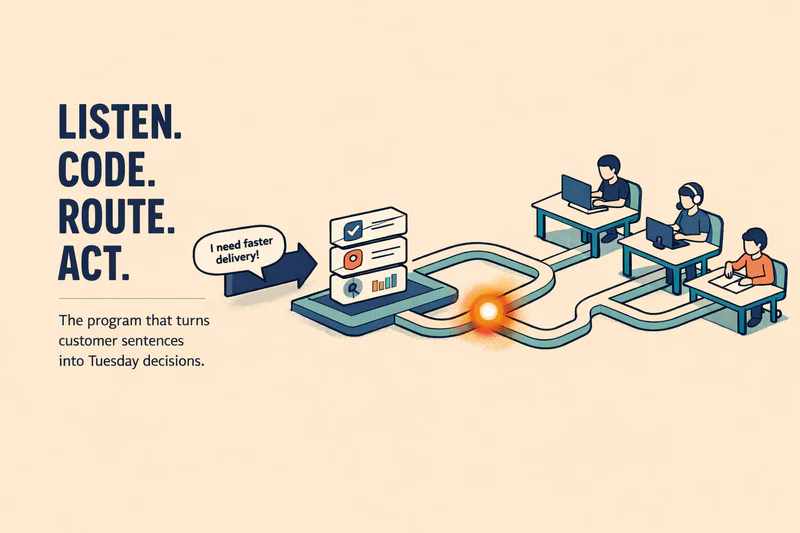
The fix is not more listening. The fix is a program with an owner, a coded substrate, and a route from a customer sentence to a Tuesday standup.
What is a voice of customer program, and why do most stall?
A voice of customer program is a governed operation that captures how customers actually describe their needs, codes it into structured signal, routes that signal to the teams who can change execution, and audits whether execution actually changed. It has an owner, service-level agreements, and a substrate. It is not a survey tool, and it is not a dashboard.
Most stall for one reason. A Forrester Consulting study commissioned by Alchemer found that only 24% of CX leaders say feedback is effectively addressed inside the business, and only 19% say voice of customer work is well embedded in operations. That is a governance failure, not a data-capture failure. The industry keeps selling capture instruments to companies that need routing plumbing.
The three scales nobody counts
There is scale as your vendor sells it: number of surveys sent, number of reviews scraped, number of dashboards spun up. Call that collection scale. Every mature voice of customer vendor optimizes for it because it is what sells.
There is scale as your analyst experiences it: number of unstructured artifacts a coder can meaningfully categorize per week. Call that analysis scale. Gartner's widely cited estimate puts unstructured data at 80 to 90% of what an enterprise holds, growing roughly three times faster than structured. A single coder reading transcripts by hand cannot keep up. Neither can a topic-modeling dashboard that returns "pricing", "support", "onboarding" as buckets, which everyone already knew.
Then there is the scale nobody names, the one that decides whether the program earns its budget: decision-to-execution scale. How many customer sentences reached a person who could act, in the week the customer said them, in a form that person could use? For most voice of customer programs the answer is under ten a quarter. That is why executives quietly cut the line item.
Why the survey-first voice of customer program breaks quietly
The survey-first program breaks in three places, and none of the breaks show up in the dashboard.
The first is sample bias. Qualtrics's own platform data shows average survey response rates fell roughly 27% between 2020 and 2024. The customers who still respond are the loudest tails. The middle disappears. You end up with a program that hears the ecstatic and the enraged, and mistakes them for the whole book.
The second is instrumentation lag. A survey is a lookback. By the time the response arrives, the customer has already churned or renewed. The signal is honest and useless in the same breath.
The third is dashboard orphaning. The instrument runs, the numbers land in a viewer, and nobody owns the "so what". The dashboard becomes a museum of good intentions. Nobody wants to be the person who opens the closed-loop ticket, because closed-loop tickets are hard.
None of this means retire the surveys. It means stop building the entire program on top of a lagging, biased, orphaned instrument.
How do you code unstructured conversations at scale?
Live conversations are the honest substrate for voice of customer analysis. Customers describe their problems in real terms when they are inside a real problem, not when a Net Promoter survey lands three days later. The catch is that a single analyst cannot read 700 sales calls, and a bag-of-words dashboard cannot code them into anything an operator can use.
We solved this with a five-stage method that turned a raw call archive into a queryable signal layer. The round aggregates are worth naming, because they set the shape of the problem: 756 calls, 48,300 turns, 621 profile-coded, 62 parallel coding agents.
The five-stage coded-corpus method
Here is the shape:
- Define the codes. Before a single call is read, name the operator-useful categories. Not "topics". Categories such as objection type, buying stage, competitor mention, feature ask, friction moment, promise made. Categories a Head of Product or Head of Sales would already recognize.
- Parallel code. Assign one agent per code family, run them in parallel over the corpus. Sixty-two agents let us turn a week of human coding into a few hours of orchestrated compute. Every coded turn keeps a pointer back to the raw call for audit.
- Aggregate into a signal layer. Roll turns up into per-account profiles and per-cohort trends. The output is a queryable index that answers "how often did enterprise fintech prospects raise onboarding friction in the last 30 days", not a wordcloud.
- Route to the workflow that can act. Product gets feature-ask deltas and friction clusters. Sales gets objection patterns per cohort and competitor mentions. Support gets the recurring three questions and can retire them from the ticket queue.
- Audit drift. Codes change, categories go stale, coders (human or agent) develop tics. A monthly recode of a random sample keeps the coding honest.
The method is boring on purpose. Voice of customer analysis at scale is a repeatable protocol, not a genius act.
Who owns the voice of customer program, and what are their SLAs?
The single question that predicts whether a program will survive its first year is who owns it. The wrong answers are "the customer" (dilute), "everyone" (nobody), and "CX" (usually correct, usually under-empowered). The right answer is: a named human with a mandate to move signal into other teams' backlogs, and a small standing council that includes Product, Sales, Support, and RevOps.
Give the owner three service-level agreements, and hold them to those, not to the NPS number.
The three SLAs that make a program real
- Time-to-signal. From customer sentence to coded, aggregated, queryable signal. Target: under seven days for calls and chats, under 24 hours for tickets.
- Time-to-route. From signal to a ticket in the right team's queue with a named assignee. Target: under 14 days.
- Closed-loop rate. Percentage of routed signals that received a documented action inside 60 days. Target: above 40% in year one, above 60% in year two.
None of these SLAs are about the customer feeling heard. They are about the operator being accountable. If the operator cannot show a Tuesday standup that changed because of a customer sentence, the program is not working.
What does a signal-fed workflow look like?
At Nova IVF, one of our customers, the signal-to-execution wiring filters roughly 90% of the incoming pipeline before it reaches a human counselor. That is not a chatbot doing triage. That is the voice of customer program deciding, per conversation, which patients are asking a real question, which are early-stage curious, and which are already committed. The counselor picks up a call already knowing what the patient said, in what tone, with what unresolved objection, from which channel.
The workflow is: conversation happens, signal is coded live, routing rule fires, the human is handed the customer's actual sentence and a next-best-action. No dashboard involved. The human never opens a viewer. The signal reaches them inside the tool they already use.
That is the shape a voice of customer program takes when it stops being a listening exercise and becomes an operating layer. See our take on conversational analytics for the deeper technical view, and optimizing retention via conversation analysis for the churn-side version of the same wiring.
The failure modes gallery
Every voice of customer program that fails, fails in one of a small handful of ways. Naming them saves a year.
- Taxonomy debt. The codes were defined once, in a room, two years ago. They no longer describe how customers talk. Symptom: every fresh cluster looks the same as last quarter's.
- Dashboard orphaning. The signal lives in a viewer nobody visits. Symptom: the last dashboard access was the owner's last quarterly review.
- Review-scraping without action. G2, Reddit, and Trustpilot get scraped, sentiment gets tagged, nothing moves. Symptom: a monthly report that reads well and changes nothing.
- Single-channel bias. Everything runs on surveys, or everything runs on calls, or everything runs on tickets. Symptom: the signal contradicts what the sales team hears every day.
- Silent proxy metrics. The program reports on NPS and CSAT because they are easy, and hides that closed-loop rate is under 5%. Symptom: the deck stays green as the program dies.
If any two of those describe your program, the fix is not a bigger dashboard. It is a smaller program with an owner and a route.
Where does this leave Priya?
Priya's dashboard is still there. Her Qualtrics contract is still there. What changed is the shape of the program that sits under them. There is now an owner, a coded substrate of live conversations, three SLAs the owner is measured on, and a route from a customer sentence to a Tuesday standup. The dashboard is a rear-view mirror. The workflow is the road.
The question worth carrying into the next planning cycle is not "how do we listen better". It is: what would have to be true for a customer sentence spoken today to change one thing your team does next Tuesday? If your voice of customer program cannot answer that, it is a listening program with a governance problem, and the fix is not more listening.
See how Zigment turns live conversations into an operating layer for the version of this program built on the coded-corpus method.