
TL;DR
- A conversation graph is a single living timeline per customer that records every interaction across chat, email, forms, and calls, then layers intent, urgency, and sentiment on top and tracks how all three shift over time. It is the connected story of one person, not a flat list of events.
- Most stacks fall into the logging trap. The CRM stores every event in neat rows but cannot tell a buyer who went quiet from boredom apart from one waiting on a budget approval. Records are not understanding, and meaning is the part that closes deals.
- It is not a context graph that feeds knowledge to a model, and it is not a CDP that stores profiles for targeting. It is the intelligence layer that reads one customer's intent as it moves and feeds that to the systems that act.
- The graph sits on top of your stack, not in place of it. HubSpot or Salesforce stays the system of record while the graph reads the live conversation and acts back inside your tools. For Zigment it is the proprietary core of a Conversational Revenue Orchestration Platform.
A buyer named Priya is three messages into a chat on your website. She has just typed "actually, let me think about it and come back," and she means it. She closes the tab. Nine minutes later, an automated email lands in her inbox congratulating her on her interest and pushing her to book a demo today.
Nobody did anything wrong. The chat tool logged the session. The workflow saw a fresh lead and fired the sequence it was built to fire. Every system did exactly its job. And every system was deaf to the one thing Priya actually said, which was wait.
That gap, between a stack that records what happened and a stack that grasps what it meant, has a name now. People are reaching for it, mangling it, and occasionally selling something else under it. So before the term gets flattened into yet another box on a vendor slide, here is the plain version of what a conversation graph is, what it is not, and why it changes the way software treats a customer.
Why does your stack remember everything and understand nothing?
Your tools have never had a memory problem. They have a meaning problem.
Open any modern CRM and you will find a near-perfect ledger. The form fill, timestamped. The email open, logged. The page view, the call duration, the chat transcript, all of it sitting in neat rows. Storage was never the issue. Your stack remembers everything.
What it cannot do is understand any of it. It knows Priya opened three emails. It does not know she opened them while growing more annoyed each time. It knows she filled a form and went quiet for a week. It cannot tell the difference between a buyer who went quiet because she lost interest and one who went quiet because she was waiting on a budget approval she just secured this morning. Same silence on the record. Two opposite truths underneath.
Call this the logging trap. The more diligently a system records events, the more convinced its owners become that they understand the customer, when all they really hold is a pile of receipts. A receipt tells you a transaction occurred. It tells you nothing about whether the person walked out happy.
Meaning is the part that leaks. And meaning is the part that closes deals.
Records are not understanding.

So what actually is a conversation graph?
Here is the definition, stripped of vendor gloss.
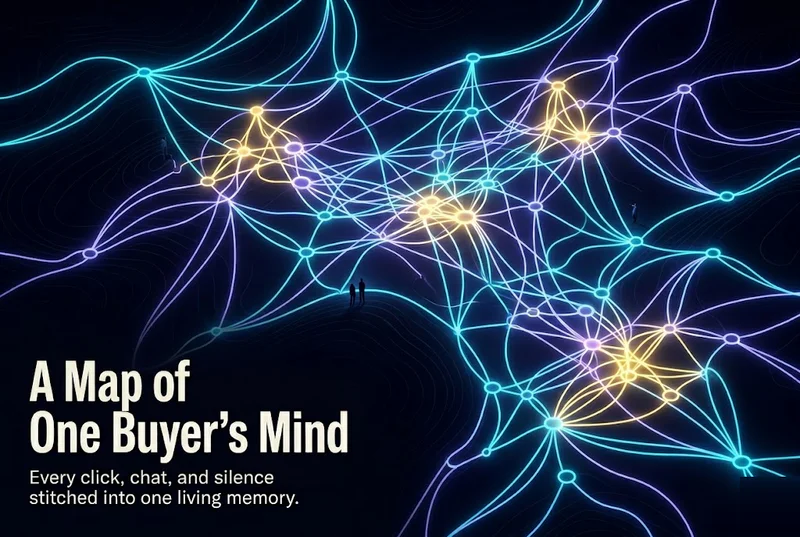
A conversation graph is a single living timeline per customer that captures every interaction across every channel, the clicks, chats, forms, and calls, and layers meaning on top of it: the intent, the urgency, and the sentiment, and how all three shift over time. It is not a list of events. It is the connected, evolving story of one person's journey, structured so software can read it and act on it as the story changes.
The meaning layer everyone drops
Sit with the second half of that, because it is the half everyone drops. Anyone can stitch interactions into one timeline. The hard, valuable move is reading what those interactions mean and tracking how the meaning moves. A flat log says Priya messaged on Monday and again on Thursday. A conversation graph knows she asked about pricing twice, hesitated, went cold, then came back warmer asking about onboarding. The first is data. The second is a buying signal you can act on before the window shuts.
From state-blind to stateful
The shift is from state-blind to stateful. A state-blind tool sees each trigger in isolation and forgets the rest. A stateful graph holds the whole arc, so the next action is shaped by the entire relationship rather than the last click.
Build the story, not the spreadsheet.

Is this just a context graph or a CDP?
Two labels keep getting slapped on this idea, and both quietly miss it. Worth naming them out loud, because the confusion is doing real damage.
The first is the context graph. It is a fashionable phrase in enterprise AI circles right now, usually tied to Graph-RAG and the project of feeding large language models a structured map of company knowledge so they answer with fewer hallucinations. Useful work. Different job. A context graph organizes what your organization knows, the documents, the policies, the product facts, so a model can retrieve it. A conversation graph tracks what one customer is doing and feeling across a live journey. One is a library card catalog for your knowledge. The other is a heartbeat monitor for a relationship. They are not the same organ, and treating them as synonyms blurs a distinction that decides whether your AI sounds informed or sounds present.
Why a CDP is not the same
The second label is heavier and more wrong. People call it a CDP, or worse, "just a data platform." A customer data platform unifies records into clean profiles so you can segment and target. It builds the audience. It assembles the list. That is genuine value, and the conversation graph does not replace it. But a CDP is a place where data rests. It does not read a chat thread mid-sentence, register that the buyer's tone just curdled, and decide to escalate her to a human in the next ten seconds. A data platform is a noun. A conversation graph is a verb. Filing the graph under "data platform" is how a living engine gets buried in a storage budget.
So say it cleanly. The conversation graph is not a context graph, which serves knowledge to a model. It is not a CDP, which stores profiles for targeting. It is the layer that understands a single customer's intent over time and feeds that understanding to the systems that act.
Name the misframe before it sticks.

What changes when workflows react to meaning, not events?
Strip away the architecture and the payoff is simple. Your software starts responding to what a customer means instead of what a customer triggered. Watch what that does to Priya's afternoon.
The event-driven way runs on triggers. Form submitted, so send the welcome sequence. Email opened, so wait two days and nudge. No reading of the room, no memory of the arc, just a clean line of dominoes falling on schedule. It is the way that emails a hesitating buyer a hard push nine minutes after she asked for space. The trigger fired. The relationship snapped.
The meaning-driven way runs on the graph. The same "let me think about it" is read as cooling intent, not closing intent, so the system holds the aggressive follow-up and quietly flags her for a softer check-in in a few days. When she returns asking about onboarding, the graph already knows the full thread, so an agent or an AI picks up exactly where she left off instead of greeting her like a stranger. The action fits the moment because the system finally has the moment in view.
The compounding effects show up fast once meaning drives the workflow. Workflows stop misfiring, because they react to intent rather than to raw activity. Handoffs stop resetting the conversation, because whoever picks up inherits the whole history. Leadership stops staring at a sanitized funnel chart and starts seeing the real journey, the hesitations and the recoveries that a stage-based view erases.
This is the part that resists copying. Anyone can send a message on a trigger. Reading intent, urgency, and sentiment as they move across fragmented channels, and holding that context as it evolves, is the hard thing. It is also why the teams who get it right tend to see meaningfully stronger conversion off the same traffic and a great deal less manual cleanup, because the system is doing the remembering that humans used to do badly and late.
React to intent, not to noise.
Where does the conversation graph sit in your stack?
Right where it should, which is on top, touching nothing you already trust.
The conversation graph is not a rip-and-replace. Your CRM stays the system of record. HubSpot or Salesforce keeps holding contacts, deals, and pipeline stages, and it should. The graph is the intelligence layer that sits above that record, reads the live conversation across channels, builds the timeline with meaning attached, and then acts back inside the tools you already run. It is HOW outcomes get delivered, the engine underneath, not another dashboard competing for a seat.
For Zigment, the conversation graph is the proprietary core of a Conversational Revenue Orchestration Platform. You do not buy the graph for its own sake. You buy faster conversion, fewer dropped leads, and a lot less manual stitching. The graph is the machinery that makes those outcomes repeatable. The customer feels the result. The graph does the work.
Sit on top of the stack, not in place of it.
The conversation graph in agentic AI, and why it matters more now
Agents raise the stakes on this. An AI agent acting on a customer is only as good as the memory it acts from, and a stack that logs without understanding gives an agent a stack of receipts and tells it to be helpful.
Give that same agent a conversation graph and it stops guessing. It picks up Priya's thread already knowing she hesitated on price, went quiet, and came back warmer on onboarding, so it speaks to the buyer she actually is rather than the blank profile a flat log hands over. The graph is the persistent memory and the shared state that lets autonomous systems behave less like a script and more like a colleague who was in the room the whole time.
That is the line worth holding as the term spreads. Plenty of tools will claim a conversation graph and ship a fancier transcript. The real one does the thing the receipts never could. It understands.
Back to Priya
Run her story one more time, with the graph in place. She types "let me think about it." The system reads cooling intent and holds its fire. No 11pm congratulations email, no pressure she did not ask for. Days later she comes back asking about onboarding, and instead of meeting a stranger she meets a thread that remembers her, picks up mid-arc, and answers the question she actually has.
Same buyer. Same channels. Same stack underneath. The only thing that changed is that something finally read what she meant instead of stopping at what she did.
Your tools already remember everything. The question is whether anything in your stack understands a word of it.
This is the page the rest of the story points back to. Once you accept that meaning, not memory, is the missing layer, every other question shifts. How an agent should carry context between channels. How attribution should follow the real journey instead of the first touch. How a single customer view becomes a living thing rather than a static profile. Start here, with what the conversation graph actually is, and the rest of the picture clicks into place.