
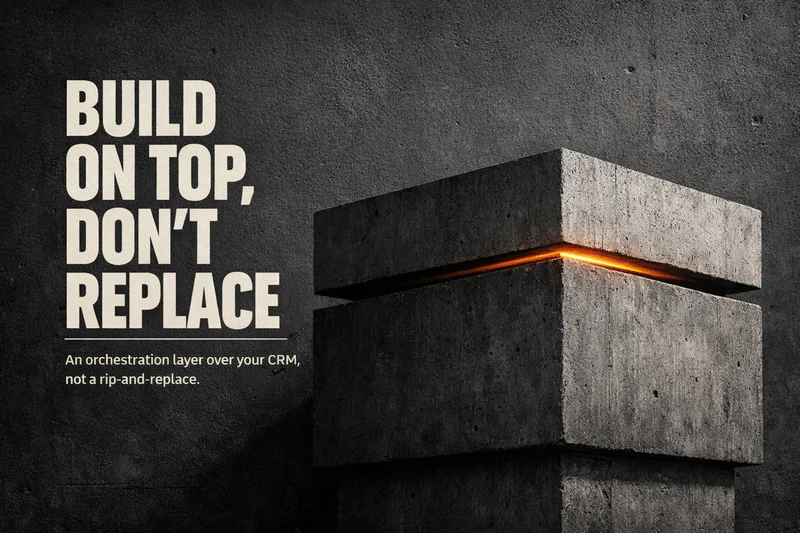
The pitch always lands the same way. A vendor leans in and says the quiet part out loud. "Rip out HubSpot. Start clean. Our platform does everything yours does, and the AI too." It sounds like courage. It is usually a year you never get back. We chose the opposite. We sit on top of HubSpot instead of replacing it.
We made that choice after watching a growth team try the other path. Forty people, eighteen months of pipeline history, a CRM stitched into billing, support, and three regional playbooks. They believed a full reset would fix their AI problem. Instead they spent a year migrating fields, retraining reps, and rebuilding reports that used to run themselves. The AI never shipped. The quarter did not wait.
That is the story that shaped how we build. Not because replacing a CRM is impossible. Because replacing it solves the wrong problem, and charges a fortune to do it. The revenue gap most teams feel is not a bad system of record. It is the absence of anything acting on the record in real time. So we built the thing that acts, and left the record exactly where your team already trusts it.
What does it mean to sit on top of HubSpot?
Sitting on top of HubSpot means adding an orchestration layer above your CRM instead of replacing it. HubSpot stays the system of record. The layer reads live conversational intent across chat, WhatsApp, email, and calls, then triggers the right agent, handoff, or follow-up. Your data stays put. Your team stops doing manual glue work and acts on what customers say.
Picture the CRM as the ground floor and the layer as the wiring that makes the building respond. One holds the truth. The other acts on it. You do not demolish a house to rewire a room.
The distinction matters because most teams conflate two very different jobs. Storing what happened is one job. Deciding what to do next, in the moment a customer is still talking, is another. HubSpot was engineered for the first. The layer exists for the second. Blur the two and you end up shopping for a replacement when what you actually lack is a reflex.
Keep the record. Add the reflexes.
The case against rip-and-replace
Every replatform starts as a spreadsheet and ends as a scar. We call it The Rip-and-Replace Trap, and it closes slowly.
First there is the migration. Every field, every automation, every dashboard your team half-remembers has to be rebuilt in a new dialect. That is The Migration Tax, and it is paid in quarters, not weeks. Reps who trusted the old muscle memory now hesitate on every screen. Adoption sinks before the new tool proves a thing.
Then there is data gravity. Your CRM is not a database. It is the accumulated weight of relationships, notes, and history that your whole company reaches for by reflex. That gravity is real, and it does not move for free. When you rip it out, you lose more than records. You lose the instinct your team built around them.
And there is the risk nobody prices in. A migration is a live surgery on the organ that pumps your revenue. Deals fall through cracks between the old system and the new one. Attribution goes dark for a quarter. Leadership loses the reports they steer by, right when they need them most.
The math rarely survives contact. Most teams that outgrow their workflows do not need a new system of record. They need a way to act on the one they have. If you recognize the symptoms, the honest first read is usually the signs you have outgrown HubSpot workflows, not the signs you need to abandon HubSpot.
Rebuild the reflexes. Keep the memory.
What HubSpot is genuinely great at
Here is the part the replacement crowd skips. HubSpot is very good at the job it was designed for. We build on top of it because it earns the foundation.
It is the system of record
Contacts, deals, companies, the whole relational spine of your revenue lives here in one trusted place. That single source is worth protecting, not scattering across a migration.
It runs the pipeline
Stages, forecasts, deal rooms, reporting your leadership already reads on Monday. The pipeline view is muscle memory for entire teams. Ripping it out costs more than the license ever will.
It automates the predictable
When A happens, do B. Enrollment triggers, sequences, and rule-based workflows handle the repeatable moves cleanly. For linear, predictable paths, this is exactly enough. A renewal reminder does not need to reason. It needs to fire on time, and HubSpot fires it well.
It is where your team already lives
Adoption is a feature. Your reps open HubSpot before their inbox. That habit is a moat, and any smart layer should reinforce it, never fight it.
Honor the foundation. Then ask what it was never built to do.
The gap HubSpot was never built to close
Meet Priya. She runs RevOps for a lender that lives on WhatsApp. A borrower asks about rates on chat at 9pm, fills a form the next morning, then calls the branch by noon. Three touches, three systems, one very ready human. By the time anyone connects the dots, the borrower has already signed with a competitor who called back first.
That is The Context Gap. HubSpot records what happened. It struggles to understand what is happening across channels in the same live moment. Workflows fire on events, a form submit, a page view. They do not reason over meaning, urgency, or the thread of a conversation that jumped from chat to call.
The worst version is what we call The Amnesia Handoff. A lead repeats their whole story to the third rep because none of the earlier context traveled with them. This is exactly what HubSpot workflows are missing, and it is not a flaw. It is a job the CRM was never designed for.
An event tells you a field changed. It does not tell you the borrower sounded anxious about a deadline, or that this is the third time they have circled back this week. Meaning lives between the events, and a workflow built on triggers cannot see it.
To close that gap you need continuous context. Ours lives in the Conversation Graph, one timeline per customer that holds clicks, chats, forms, and calls plus the meaning underneath them, intent, urgency, and sentiment over time. HubSpot stores the record. The graph carries the memory.
Stop losing the thread between channels.
What sitting on top actually looks like
The Old Way runs on stateless rules. A trigger fires, a message sends, and nobody remembers the conversation two steps later. The Better Way runs on live context. The layer reads intent as it forms, decides the next best action, and moves.
In practice, the layer does four things the CRM cannot. It listens across every channel at once. It reasons over the full conversation, not a single event. It acts by triggering an AI agent, a human handoff, or a CRM update. Then it writes the outcome straight back into HubSpot, so the record stays whole.
Replay Priya's borrower on the layer. The 9pm chat is answered instantly with real rate guidance. The morning form does not restart the conversation, it continues it. By noon a rep gets the call with the full thread already in front of them, intent scored, urgency flagged. Same three touches. One unbroken story. The borrower signs with Priya.
Nothing gets replaced in that scene. HubSpot is still the system of record. The layer is simply the reflex that fires on what the record cannot see in real time. This is the difference between why your HubSpot needs an agentic layer and why it needs a replacement, and only one of those is true.
If you want the mechanics, we have written the full build for how to add an intelligent layer to your HubSpot stack. The short version is a mindset shift. Stop automating, start orchestrating, and let context decide the move.
Add reflexes to the record you already trust.
The proof that the layer beats the rebuild
Philosophy is cheap. Here is what the layer does when it ships instead of a two-year migration.
Teams that add the orchestration layer see around 40% higher conversions from inbound demand, because a ready lead gets the next action in the moment, not the next morning. Manual follow-up drops by up to 80%, because the layer chases context so reps chase revenue. The return lands north of 3x, and it lands in a quarter, not after a replatform.
Then there is Bajaj Auto. Conversations move across more than 20 countries, and the handoff between AI and humans preserves context every time. No borrower repeats their story. No rep starts from zero. That is The Amnesia Handoff, cured, at a scale no rip-and-replace could have reached in the same window.
Notice what those numbers share. None of them required your team to learn a new home for their data. The uplift came from acting on the stack you already run, so the value shows up in weeks instead of after a painful cutover.
Compare the two paths honestly. One spends a year rebuilding what already worked. The other spends a month teaching what you own to think. One resets your team back to zero. The other compounds the habits they already have.
Ship the reflex, not the reset.
The bottom line
We did not build a better CRM. We built the layer that makes yours act. HubSpot keeps the memory of every customer. The layer gives that memory a voice, a decision, and a next move, all triggered by what people actually say. This is what we mean by Conversational Revenue Orchestration, and it is the whole reason we sit on top instead of tearing down.
So the real question was never whether HubSpot is good enough to keep. It clearly is. The question is what fires on the conversations your CRM records but cannot answer in time.
Keep your system of record. Add the layer that acts.