
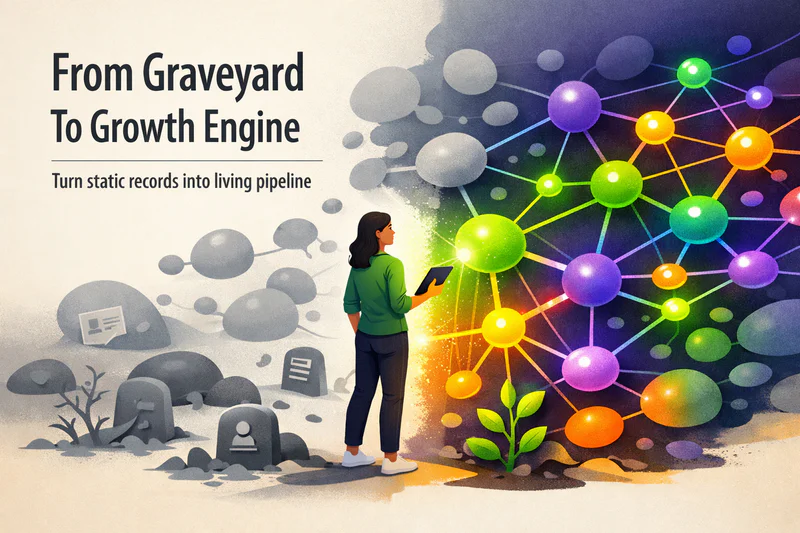
“CRM data decays by nearly 30% every year.” That’s the quiet number no revenue team likes to discuss.
Open Salesforce. Scroll through your leads from last year. The opportunities marked “follow up next quarter.” The contacts who downloaded a whitepaper and vanished.
Your Salesforce data is a graveyard.
Records pile up. Status fields stay frozen. Intent fades. Meanwhile, your pipeline report still looks full.
Here’s what we’ve learned working with revenue teams: the problem isn’t volume. It’s verification. Dirty data and dormant leads don’t scream for attention. They sit quietly, distorting forecasts and draining sales productivity.
Most teams try to solve this with enrichment tools or quarterly cleanups. The surface improves. Titles update. Duplicates shrink. Yet the core question remains unanswered:
Are these people still interested?
If your CRM never asks, it slowly fills with assumptions. And assumptions don’t close deals.
Let’s fix that.
The Hidden Cost of Dirty Data and Dormant Leads in Salesforce
Dirty data sounds technical. The impact is financial.
When dormant leads sit untouched, three problems develop quickly.
1. Forecast Accuracy Erodes
Open opportunities remain active long after momentum fades
Pipeline numbers inflate
Revenue projections lose credibility
Leadership begins making hiring and investment decisions on distorted information.
2. Sales Productivity Drops
Reps spend hours reaching out to:
Contacts who left the company
Prospects who deprioritized the project
Leads who never had real buying authority
Energy gets misallocated. Morale slips. Performance suffers.
3. Marketing Spend Becomes Inefficient
Campaigns continue targeting:
Unresponsive email addresses
Accounts already closed-lost
Prospects with zero current intent
Without active validation, marketing amplifies outdated assumptions.
Why Traditional CRM Data Hygiene Falls Short
Most CRM cleanup strategies focus on maintenance:
List scrubbing
Third-party enrichment
Deduplication
Periodic lead scoring updates
These efforts improve structure. They refine fields. They tidy dashboards.
They do not confirm intent.
Intent shifts faster than job titles. A contact who evaluated your solution six months ago may have secured budget elsewhere. Another might be restarting the initiative today. Without direct engagement, both records look identical in Salesforce.
Manual cleanup addresses format. It does not address reality.
Static scoring models rely on historical activity. They cannot interpret silence. They cannot follow up. They cannot ask clarifying questions.
As a result, dormant leads accumulate. Forecast confidence declines.
How Agentic AI Resurrects Dead Records in Salesforce
Your Salesforce data is a graveyard when records sit untouched. Agentic AI introduces movement.
Agentic AI operates with initiative. It reaches out. It follows up. It processes responses. It updates CRM fields automatically.
Here’s what that looks like in practice:
1. Direct Re-Engagement of Dormant Leads
Instead of waiting for inbound signals, it asks:
“Is this initiative still active?”
“Has your timeline shifted?”
“Should we reconnect later this quarter?”
Clear questions generate clear answers.
2. Real-Time Intent Interpretation
Responses trigger structured actions:
Positive interest → opportunity stage advances
Budget delay → forecast adjusts
No engagement → lead score recalibrates
Your pipeline begins reflecting live intent rather than historical activity.
3. Continuous Data Cleansing Through Interaction
If emails bounce, records are flagged.
If contacts change roles, fields update.
If priorities shift, opportunity status evolves.
Conversation becomes the cleansing mechanism.
From Static CRM to an Active Layer
Most CRM systems function as repositories:
They store records
They generate reports
They reflect past activity
An Active Layer introduces continuous motion.
This layer:
Initiates outreach autonomously
Evaluates replies
Adjusts scoring models dynamically
Updates opportunity stages in real time
Flags disengagement patterns
Salesforce remains the system of record. The Active Layer becomes the system of validation.
Verification shifts from quarterly projects to ongoing automation. Forecast discussions gain clarity. Sales conversations focus on confirmed opportunities.
What Changes When You Activate Your CRM
Let’s compare two scenarios.
Before Activation
20,000 leads in Salesforce
3,500 open opportunities
Limited visibility into engagement freshness
After Continuous Verification
6,000 validated contacts
900 high-intent opportunities
Clear next steps attached to every active deal
Additional impact:
Stronger forecast reliability
Increased sales efficiency
Reduced marketing waste
Shorter deal cycles
The difference lies in validation. Live confirmation replaces outdated assumptions.
Why Salesforce Alone Cannot Solve Dirty Data
Salesforce is a powerful CRM platform. It depends on input.
It does not:
Initiate follow-up sequences autonomously
Interpret extended silence
Confirm buying timelines automatically
Reclassify opportunities without triggers
Human teams remain responsible for updating fields and pursuing follow-ups. Over time, bandwidth limits create lag. Record age. Dormant leads accumulate.
CRMs document history. They require external systems to test current intent.
Zigment: Turning Your Salesforce Graveyard into a Living, Verified CRM
Salesforce organizes your pipeline. It tracks activity. It stores history. What it doesn’t do is verify intent on its own.
Over time, that gap creates decay. Dormant leads pile up. Open opportunities linger. Dirty data spreads quietly across reports and forecasts.
Zigment operates as an Active Layer across your CRM, including Salesforce. It proactively engages inactive leads, verifies interest through conversation, and updates records automatically based on real responses.
Here’s the impact:
Re-engages dormant leads
Updates opportunity stages based on intent
Cleans CRM data continuously
Validates pipeline health in real time
Your Salesforce data is a graveyard when it passively stores assumptions. Zigment keeps it alive by continuously testing and refreshing reality.
When your CRM reflects current intent, decisions sharpen and revenue follows.