
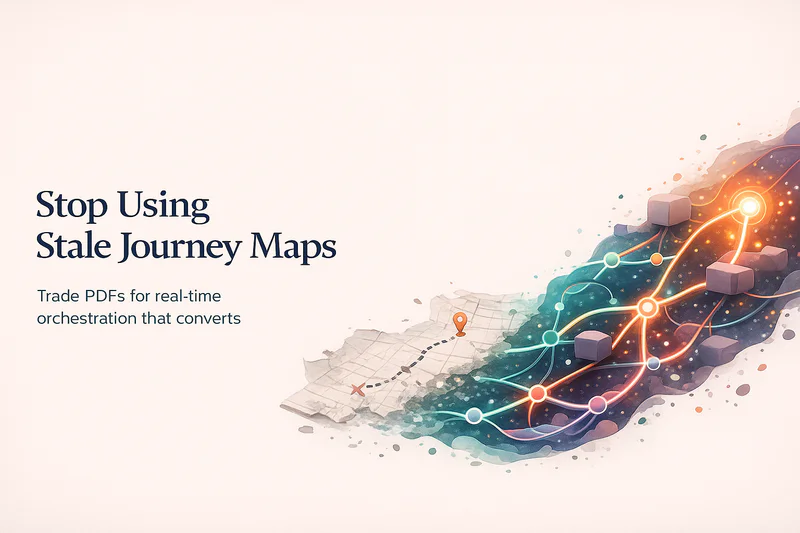
Customer journey optimization is the single most critical lever for revenue growth, yet 70% of digital transformation initiatives fail to reach their goals because they rely on static maps rather than dynamic terrain.
Most businesses treat the customer journey as a linear path, a neat straight line from awareness to purchase. In reality, your customers are zigzagging. They engage on WhatsApp, ghost your emails, browse anonymously on mobile, and then demand instant answers on web chat.
If your strategy relies on a PDF map created six months ago, you aren't optimizing; you are merely documenting history.
To capture revenue in this chaotic landscape, you must shift from passive observation to active orchestration. This article explores how to move beyond "flat" maps and deploy an intelligent, agentic layer that doesn't just watch the journey happen but actively steers it toward conversion.
What Is Customer Journey Optimization in the Age of AI?
Customer journey optimization is the strategic process of aligning business goals with customer intent in real-time to remove friction and maximize conversion value.
Traditionally, this meant A/B testing landing pages or tweaking email subject lines. Today, true journey optimization requires a fundamental shift in architecture. It is no longer about setting up rigid "if/then" rules in your CRM. It is about deploying systems that can perceive unstructured data like frustration in a chat message or urgency in a click pattern and instantly execute the Next Best Action (NBA).
Why Traditional Mapping Fails
Static maps are obsolete the moment they are drawn. They assume a rational customer moving through predictable gates.
- The Reality: Customers skip stages. A "retention" customer might suddenly exhibit "awareness" behavior for a new product line.
- The Fix: You need a system that adapts the map to the territory, not the other way around.
How Do Modern Customer Journey Phases Differ from Static Models?
To optimize effectively, we must first redefine the terrain. The standard customer journey phases, Awareness, Consideration, Decision, and Retention, are useful labels, but they are dangerous if treated as silos.

1. Awareness: The Signal in the Noise
In the old model, "awareness" was a metric measured by impressions. In an optimized model, awareness is the first capture of intent.
- Static View: A user visits your blog.
- Optimized View: A user asks a specific question about pricing on a generic blog post. An agentic system recognizes high intent immediately and triggers a specific engagement play, rather than dumping them into a generic "newsletter" bucket.
2. Consideration: The Context Gap
This is where most customer journey stages break down. A prospect is comparing you against competitors.
- Static View: They download a whitepaper. You send a drip sequence.
- Optimized View: The system recalls they previously asked about "integration security" on a different channel. Instead of a generic drip, the next touchpoint is a specific case study on security compliance. This is contextual continuity.
3. Decision: The Friction Point
The distance between "I want this" and "I bought this" is often filled with invisible friction (forms, login walls, slow support).
- Optimization Tactic: Eliminate the form. If a user signals intent on WhatsApp, complete the qualification in the chat. Don't force them to a landing page.
4. Retention: The Loop
Retention is not the end; it is a new beginning. Customer journey phases are cyclical. A happy customer effectively re-enters the "Awareness" phase for upsells.
- Agentic Insight: By monitoring sentiment in support tickets, an agentic layer can predict churn before it happens and trigger a "save" play autonomously.
Customer Journey vs. Customer Experience: Where Is the Disconnect?
It is vital to distinguish the map from the territory. The customer journey vs customer experience debate highlights a critical operational gap.
- Customer Journey: The internal process your company designs (the funnel, the stages, the touchpoints). It is what you want to happen.
- Customer Experience (CX): The emotional and practical reality of what actually happens to the user.
You can have a perfectly mapped journey that results in a terrible experience. For example, your journey map says, "Send SMS after 2 days."
The user’s experience is, "I just spoke to support an hour ago; why are you spamming me with a promo?"
The Orchestration Gap
The disconnect usually stems from a lack of "statefulness." Your marketing automation tool doesn't know what your support desk is doing. The journey is optimized for your internal efficiency, not the user's context. True optimization aligns these two worlds by ensuring every system shares the same brain.
Why Are Data Silos Problematic for True Optimization?
You cannot optimize what you cannot see. Why are data silos problematic? They fracture identity. When your data is siloed, you aren't optimizing a single customer's journey; you are optimizing five fragmented versions of that customer.
The Anatomy of a Silo Failure
Consider a standard high-value B2B interaction:
- Web: A user visits your pricing page (Tracked in Google Analytics).
- Chat: They ask a bot, "Do you support SSO?" (Trapped in Intercom/Drift).
- Email: They download a guide (Stored in HubSpot/Marketo).
- SMS: Your sales team texts them, "Hey, want a demo?" (Logged in a sales rep's phone or Outreach).
The Consequence: Identity Fragmentation
Without a unified data layer, the SMS system doesn't know about the SSO question. The sales rep sends a generic pitch instead of saying, "Yes, we support SSO, and here is the documentation."
- The Result: Friction. The customer feels unheard. The conversion probability drops.
To solve this, you need Identity Resolution powered by a Conversation Graph. This is a temporal knowledge graph that links identities, threads, intents, and sentiments across every channel. It creates a "Single Customer View" that allows the system to act with full context, regardless of where the interaction started.
How Do You Execute a Dynamic Customer Journey Strategy?
Moving from theory to practice requires a robust customer journey strategy. You need a framework that prioritizes journey optimization as an ongoing operational discipline, not a one-time project.
Step 1: Goal-Driven Planning
Stop building rigid flowcharts. Start building "Objective Functions."
- The Shift: Instead of programming "If X happens, send email Y," you define the goal: "Maximize demo bookings subject to a cost of $50 per lead."
- The Agentic Advantage: An AI agent evaluates the context. Is the user urgent? Send a WhatsApp. Is the user casual? Send an email. The system decides the path based on the goal, not a preset rule.
Step 2: Continuous Customer Journey Enhancement
Optimization is a loop: Perceive → Propose → Act → Observe → Learn.
- Perceive: Ingest signals (clicks, chats, mood).
- Propose: The system suggests the next best action.
- Act: Execute the action (send message, update CRM).
- Observe: Did they convert?
- Learn: Update the model for next time.
This loop drives measurable customer journey enhancement. It allows your strategy to self-correct. If open rates on emails drop, the system might shift volume to SMS or in-app notifications automatically.
Step 3: Governance and Safety
Automated optimization sounds risky to enterprise leaders. What if the AI promises a discount we can't honor?
- The Solution: Enterprise governance. You need policies that act as guardrails (e.g., "Never offer more than 15% discount," "Do not message after 9 PM"). This ensures your strategy is aggressive on growth but conservative on risk.

How Does Zigment Transform Optimization into Agentic Orchestration?
This is where the rubber meets the road. Most tools give you a dashboard to see the friction. Zigment gives you an agent to fix it.
Zigment is an agentic data and orchestration layer designed specifically for modern customer journeys. It solves the core problems of static maps and data silos through three specific capabilities:
1. The Conversation Graph (Solving Silos)
Zigment doesn't just store data; it maps relationships. Its Conversation Graph links intents, sentiments, and actions across channels. It remembers that the user who clicked "pricing" on the web is the same person who just WhatsApped you. This creates a "long-term memory" for your brand, ensuring every interaction is context-aware.
2. Real-Time Next Best Action (Solving Static Maps)
Zigment utilizes a Planner Loop (Perceive, Propose, Decide, Act). It doesn't follow a linear script. It assesses the user's current mood and intent to determine the optimal next move.
- Example: If a user expresses frustration ("mood: frustrated"), Zigment halts all marketing sequences (Policy: "Mask Marketing") and escalates to a human support agent immediately. A static map would have kept spamming them.
3. Autonomy with Guardrails (Solving Scale)
Zigment operates with Enterprise Governance. It can independently execute tasks like booking a meeting, updating a CRM record, or sending a quote but only within the strict policies you define. This allows you to scale personalized, "white-glove" journeys to thousands of customers without adding headcount.
The Era of the Self-Driving Customer Journey
The days of static PDFs and linear funnels are over. The modern customer journey is complex, non-linear, and incredibly fast. Trying to manage it with manual rules is like trying to control traffic with hand signals it doesn't scale.
Customer journey optimization is no longer about better maps; it is about better drivers. By adopting an agentic approach, you move from reactive fixes to proactive orchestration. You eliminate data silos, align experience with intent, and ultimately, drive higher revenue with less friction.