
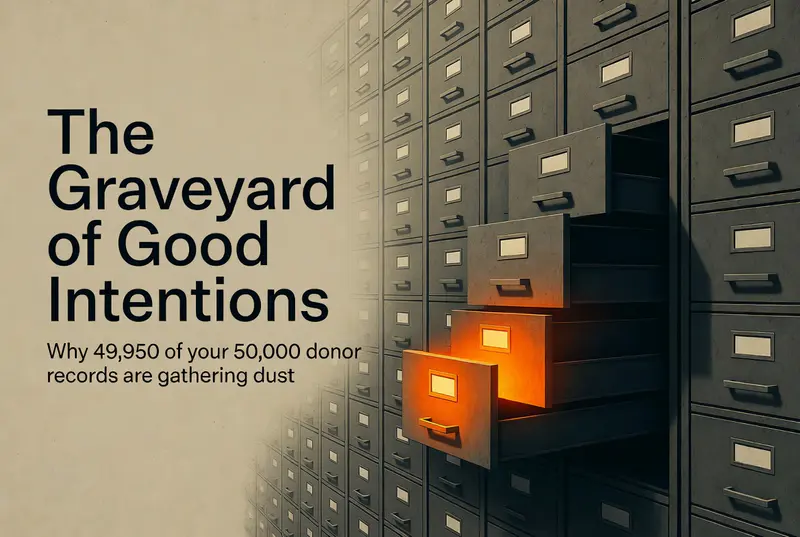
Your CRM is a graveyard of good intentions. It’s likely holding 50,000 records, yet your team only has the capacity to personally call 50 of them this week. The other 49,950 donors?
They sit there, static and silent, waiting for a newsletter they probably won’t open.
This is the "execution gap," and it is the single biggest revenue leak in the charitable sector today.
We have spent the last decade obsessed with data collection. We polished our "Database of Record," ensured our fields were clean, and patted ourselves on the back for having a "360-degree view" of the donor. But here is the hard truth for 2026: A view is worthless if you don’t act on it.
We are entering a new phase of technology. We are moving away from passive storage and toward active engagement. This is the era of Agentic AI for non-profits. It is a shift where your technology doesn't just store the history of what happened; it autonomously makes things happen.
The "Static Trap": Why Your CRM Isn't Enough
For years, the industry standard for success was "Database Health."
If your addresses were verified and your duplicates were merged, you were winning. But let’s be honest, does a clean database raise money? No. Asking for money raises money. Stewardships raise money. Relationships raise money.
The problem with the traditional CRM is that it is a "System of Record." It is a library. It requires a human librarian to walk in, pull a file, read it, and decide to do something.
The Bottleneck: The human librarian.
The Limit: You have limited staff hours.
The Result: 90% of your donors get generic, mass communication because you physically cannot afford to treat them like individuals.
We need to stop buying bigger filing cabinets and start hiring smarter assistants.
Defining "Agentic" in the Non-Profit Sector
You’ve heard of Generative AI. You’ve likely used ChatGPT to draft an appeal letter or summarize a grant report. That is useful, but it is passive. It waits for you to prompt it.
Agentic AI for non-profits is different. It doesn't wait.
Think of the difference between a map and a self-driving car.
Generative AI : Shows you the route. It says, "Here is a list of lapsed donors you should call." You still have to drive.
Agentic AI: Knows the destination and takes you there. It says, "I noticed these 50 donors were lapsed. I sent them each a personalized text message referencing their last gift. Three of them replied, and I’ve booked a call for you with the one who wants to upgrade their pledge."
This isn't sci-fi! It is the operational reality of 2026. Agents are software entities capable of perceiving their environment (your database), reasoning about how to achieve a goal (retain this donor), and executing actions (sending an SMS or email) to achieve it.
"The value of AI isn't in generating text; it's in generating results. We are moving from chatbots that talk to agents that work."
The New Metric: Action vs. Record
If we change the tools, we must change the rulers we use to measure them.
In a static world, we measured Records Managed. In an agentic world, we measure Actions Taken. As a RevOps leader or a Director of Development, you need to shift your focus to "Autonomous Actions Per Donor" (AAPD).
Here is what that looks like in practice:
1. Speed to Lead
When a donor makes their first gift online at 8:00 PM on a Saturday, what happens? Usually, they get a receipt. Maybe on Monday, a staff member sees the report.
The Agentic Shift: An agent detects the gift instantly. Within 5 minutes, it sends a warm, non-robotic message: "Hi Sarah, I just saw your gift come through. It means the world to us, thank you for jumping in to help."
2. Stewardship Density
How many times do you touch a mid-level donor ($500-$1,000/year)? Twice? Three times?
The Agentic Shift: An agent monitors their engagement. Did they click a link in the newsletter about clean water?
The agent follows up: "Saw you were reading about the new well project! I actually have a quick video from the field if you'd like to see it?"
You aren't increasing your headcount. You are increasing the density of your relationships by offloading the "thinking and doing" of routine follow-ups to an intelligent system.
Breaking the Silos with Orchestration
One of the biggest hurdles we face is that our data lives in one place (Salesforce/Raiser's Edge) and our communication tools live in another (Mailchimp/Twilio). Humans spend half their day copy-pasting between the two.
Non-profit AI orchestration solves this by sitting as a layer on top of your existing stack.
You don't need to rip and replace your CRM. You need an orchestration layer that acts as the "connective tissue." This layer allows the Agent to:
Read the donor profile from the CRM.
Decide on the best channel (Text? Email? Voice?).
Execute the message via your comms platform.
Write the result back to the CRM.
This seamless loop creates a "System of Action." It frees your major gift officers to do what they do best: sit in living rooms and build deep, human connections with your top 1% of supporters. The agents handle the other 99%, ensuring no one is ever ignored.
The Engine of the Agentic Non-Profit
This is where Zigment steps in. We aren't trying to sell you another database to clean. We provide the workforce that powers the one you already have.
Zigment is an AI orchestration platform designed to function as your autonomous sales and support team. In the context of a non-profit, we act as your AI Donor Relations Team.
Why does this matter for your bottom line?
24/7 Availability: Donors don't operate 9-to-5. Neither do we. Zigment agents engage donors instantly, day or night, capturing interest when it's highest.
Infinite Scale: Whether you have a campaign spike with 10,000 new leads or a quiet Tuesday, our agents scale up and down instantly. You never miss a conversation because your team is "too busy."
Real Conversations: We don't do "blasts." Zigment agents hold genuine, two-way conversations. They answer questions, handle objections, and nurture relationships until a human needs to step in.

The Choice is Yours
The non-profit sector is at a crossroads. You can continue to hoard data, hoping you'll eventually find the time to use it. Or, you can embrace the agentic shift.
Stop hiring more admins to manage your data. Start employing agents to work on it.
The organizations that win in 2026 won't be the ones with the cleanest records. They will be the ones that used Agentic AI for non-profits to turn every record into a relationship.
Ready to turn your static database into a revenue engine? Let's talk.