
TL;DR
Marketing automation runs preset if-then rules, usually one channel at a time, and is built around campaigns rather than people. Journey orchestration is a real-time decisioning layer that sits above those tools, reads intent and sentiment across every channel, and picks the next best action for each person.
Rule-based automation fails at an Optimization Ceiling. Past a point, adding more hard-coded branches lowers conversion because the logic cannot read human context. A customer who opens a billing ticket and gets a Buy Now upsell three minutes later is the visible symptom.
Orchestration is goal-driven instead of rule-driven. An agentic system like Zigment runs a Planner Loop that perceives the signal, proposes options against a Conversation Graph of past interactions, scores them on value, cost, and risk, then acts inside policy guardrails.
Most teams keep both. Automation handles linear flows like welcome series and receipts. Orchestration layers on top of HubSpot or Salesforce for replies that are unstructured, span weeks and channels, and carry a real cost when the message is wrong.
You can't code empathy into an "If/Then" branch. That single limitation is the whole case behind journey orchestration vs marketing automation.
Here is the short version. Marketing automation executes preset, rule-based workflows. If a user does X, send Y, on a fixed schedule and usually one channel at a time.
Journey orchestration is a real-time decisioning layer that sits above those tools, reads live signals like intent and sentiment across every channel, and chooses the next best action for each person. Automation scales execution. Orchestration scales judgment.
We've all seen the "Spam Cannon" effect. A loyal customer opens a support ticket about a billing error, and three minutes later the marketing automation platform blasts them with a "Buy Now!" upgrade email. The customer feels unseen. That is how loyal customers start to churn.
This is the "Optimization Ceiling," the point where adding more hard-coded rules to a legacy stack actually lowers conversion because the logic cannot read human complexity. The data backs it up. Salesforce found that 56% of customers routinely repeat or re-explain information to different reps, and 79% expect consistent interactions across every department. Rule-based sends cannot deliver that.
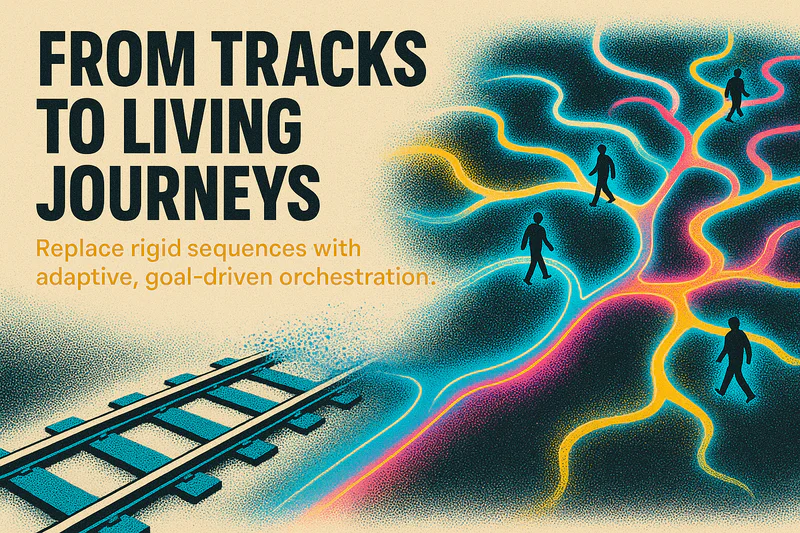
The industry is shifting. We are moving away from the rigid, linear tracks of traditional automation and toward the dynamic, goal-driven world of Agentic Journey Orchestration. This is a fundamental change in how a stack processes data, memory, and intent. If you run RevOps or own the lifecycle, this is the difference between broadcasting to a list and holding a real conversation.
Ready to stop the spam and start the conversation? Here is where the stack breaks.
Marketing Automation (MA) Explained
Let's be honest about what Marketing Automation really is. It is a logic engine built for scale, not nuance. It runs on simple input-output logic.
MA platforms excel at repetitive, administrative tasks. If a user fills out a form, send an email. If a user clicks a link, add 5 points to their lead score.
This is essential infrastructure. It also has a fatal flaw. It is campaign-centric, not user-centric.
The Core Limitations
Siloed Identity: MA systems often identify users by a single channel constraint, like an email address or a cookie. They struggle to resolve identity when a user jumps from an in-app chat to a WhatsApp message.
Blind Logic: MA sees behavior (a click), but it misses the context (the mood). It cannot tell the difference between a user clicking a pricing page because they are excited to buy, or clicking it because they are angry about a hidden fee.
The Maintenance Nightmare: To make MA feel "personal," you have to manually build thousands of branching logic trees. It does not scale.
When you let marketing automation limitations define your strategy, you end up with a fragmented customer experience. You react to the past, the click that just happened, instead of planning for the outcome.
If you are tired of fixing broken logic branches every week, look at the architecture rather than the workflow.
What Is Journey Automation?
Many teams try to patch the holes in MA by upgrading to customer journey automation.
This is the "Step Sequence" approach. Instead of blasting a single email, you chain a series of events together. You map a path. Send Email A, wait 3 days, check open status, send SMS.
It looks better on a whiteboard. It is still a rigid train track.
The Sequencing Problem
Linearity: Humans are chaotic. We don't follow linear paths. If a user replies to that SMS with a complex question, the automation usually breaks or ignores the text entirely because it was only programmed to look for a "Yes" or "No".
Lack of Memory: Journey automation tools rarely have long-term memory. They focus on the current thread but forget that this same user had a sales call six months ago and prefers not to be contacted before 10 AM.
When you compare marketing automation vs journey automation, you are often comparing a hammer to a hammer with a longer handle. Both tools lack the ability to think. They simply execute.
Sequencing is fine for simple onboarding. Does it handle the messy reality of a renewal conversation?
Journey Orchestration as the Agentic Layer
This is the leap forward. True journey orchestration is goal-driven, not rule-driven. If you want the conceptual version, our explainer on how journey orchestration fills the gap left by automation goes deeper.
In an orchestrated environment, you don't tell the system what step to take. You tell it what outcome to achieve. That requires an agentic brain, an AI layer that sits on top of your tools and makes real-time decisions based on full context.
How Does Agentic Orchestration Work?
Instead of a static workflow, an agentic system like Zigment runs a Planner Loop.
Perceive: The system reads the incoming signal (email, chat, form). It analyzes unstructured data like intent (what they want), sentiment (how they feel), and mood (urgent, curious, frustrated).
Propose: It consults the Conversation Graph, a temporal knowledge graph that links identities and history to understand the full context.
Score: It calculates the "Next Best Action" based on expected business value, cost, and risk.
Act: It executes the action, like booking a meeting via Google Calendar or creating a ticket in Zendesk.
This transforms how you map a digital customer journey. You aren't mapping every click. You are mapping objectives.
Old Way: If user replies "No," send a "Goodbye" email.
Orchestrated Way: User replies "No." Agent detects "Objection" intent. Agent checks history (user is high value). Agent proposes a discount or a demo. Agent executes the offer.
This is the only way to reach real customer journey optimization at scale. You give the system autonomy to navigate the path, as long as it stays inside your safety guardrails.
The RevOps Intelligence Test
For the Revenue Operations lead, journey orchestration vs marketing automation is not really about features. It is about governance, data integrity, and ROI.
A standard marketing automation ROI calculator often ignores the cost of bad experiences, the leads burned by irrelevant messaging. Orchestration fixes this by adding a layer of policy and governance.
Here is how the two approaches stack up in the enterprise.
1. The Brain (Logic & Decisioning)
Marketing Automation: Deterministic. "If X, then Y." If the user does something unexpected, the system does nothing.
Journey Orchestration: Probabilistic and agentic. It uses a Planner Loop to maximize business outcomes inside policy constraints. It can handle fuzzy inputs like unstructured text.
2. The Memory (Data Model)
Marketing Automation: Static fields (Last_Login_Date, First_Name). Flat data tables.
Journey Orchestration: A Conversation Graph. This is a temporal knowledge graph linking identities, threads, intents, sentiments, actions, and outcomes over time. It remembers that a user prefers WhatsApp over email and was confused during their last onboarding session.
3. The Guardrails (Governance & Safety)
Marketing Automation: Basic subscription management (opt-in/opt-out).
Journey Orchestration: Granular Policy Packs. You can define rules like "Escalate to a human for high-risk intents," "Mask PII in logs," or "Respect quiet hours per locale." The agent checks these policies before it acts.
4. The Outcome (Metrics)
Marketing Automation: Vanity metrics. Opens, clicks, form fills.
Journey Orchestration: Business outcomes. Qualified lead rate, demo booked, retention save.
Speed is not the point. Doing the right thing every time is the point. Is your current data model smart enough to know the difference?
When Should You Switch From Marketing Automation to Journey Orchestration?
Here is a simple test. If your touchpoints are linear and predictable, like a welcome series or a receipt, marketing automation handles them well and cheaply. Move to journey orchestration when replies are unstructured, when context spans channels and weeks, and when a wrong message is expensive.
McKinsey found that faster-growing companies drive 40% more of their revenue from personalization than slower rivals. Rule-based sends rarely clear that bar.
The honest answer to journey orchestration vs marketing automation is that most teams run both. They keep automation for the simple flows and add an orchestration layer for the decisions that matter. If you are weighing tools, compare the field of journey orchestration platforms before you commit.
How Zigment Sits Above Your Existing Stack
Do you have to rip out your CRM to get this? No.
This is where journey orchestration works as an architectural layer. Zigment is the agentic data and orchestration layer that sits on top of your existing tools, the same way it sits on top of HubSpot and Salesforce.
The Integrated Ecosystem
The Hands: Your existing tools are the hands. Salesforce holds the records. HubSpot sends the emails. Zendesk manages the tickets. Zigment connects to all of them through standard connectors (CRM, messaging, support, calendar).
The Brain: Zigment provides the intelligence. It ingests the unstructured signals, resolves identity, plans the next move, and then instructs HubSpot or Salesforce to act.
Why Does This Matter for ROI?
By decoupling the logic from the execution, you gain agility. You can deploy a "Renewal Rescue" play that listens for usage drops, checks account health, and drafts a personal email from the account executive offering a training session, all without a human lifting a finger. That is the kind of revenue motion buyers now expect from revenue orchestration platforms.
Zigment keeps context intact across channels. If a conversation starts on web chat and moves to SMS, the agent remembers. The user never repeats themselves. This is what continuity across channels actually looks like.
You already have the tools. You just need the conductor. Want to see how an agentic layer changes the day-to-day?
From Campaigns to Conversations
The era of "Blast and Pray" is ending. Modern customers expect you to know them, respect their time, and anticipate their needs. Marketing Automation delivered the scale. It also stripped away the context.
The verdict on journey orchestration vs marketing automation is not close. Journey orchestration brings that context back at scale.
With an agentic layer like Zigment, the system does more than automate tasks. It operationalizes intelligence, listening for intent and sentiment, reasoning through a Planner Loop, and acting across your integrations with the judgment of your best rep.
The tools on your stack already execute. The real question for next quarter is whether anything on it can decide.