Why Unanswered Questions Are Killing Your Jewelry Sales
"They just need time to think."
That is the comforting lie we tell ourselves in boardrooms. It explains away the bounce rates. It excuses the abandoned carts. It feels logical, doesn’t it? After all, buying a diamond necklace or an engagement ring is a high-stakes emotional decision. Surely, the customer needs to sleep on it.
But they aren’t sleeping on it. They are leaving because they are stuck.
The buying Reality is completely different from the traditional marketing narrative. Your customers don’t abandon purchases because they need more time; they abandon them because curiosity met silence. In the high-stakes world of luxury retail, questions are not interruptions to the sales process. They are the sales process.
When a potential buyer asks, "Is this conflict-free?" or "Will this resize easily?", they are at the peak of their emotional buying curve.
If you answer them instantly, you capture that emotion. If you make them search your FAQ page or wait 24 hours for an email response, the emotion evaporates. Logic takes over. And logic says, "I don't need this right now."
We mistake silence for patience.
If intent is met with a "leave a message" bot, the emotional momentum creates a vacuum. And in that vacuum, the sale dies!
Jewellery Doesn’t Lose Buyers. It Loses Them at the First Question.
Picture your ideal customer.
Let’s call him Arjun. Arjun is looking at a ₹3 Lakh rose gold solitaire ring for his wife’s anniversary.
He loves the modern setting. He’s ready to buy. But he has one hyper-specific question:
"Is this solid 18K rose gold alloy, or just standard yellow gold with a rose polish that will fade?"
Arjun scans the product description. Nothing.
He checks the shipping policy. Irrelevant.
He looks for a chat button, but it’s a bot asking for his email address.
Arjun closes the tab.
We categorize Arjun as a "browser." We tell our marketing teams to retarget him with ads for the next two weeks. But Arjun isn't coming back. The moment of highest intent has passed.
The funnel didn't break because the price was too high. It broke because the information gap was too wide.
In luxury retail, friction isn't just about a slow-loading page. Friction is the gap between a customer’s question and your answer. Every second that gap remains open, doubt creeps in. Doubt is the enemy of conversion!
The Clarity Gap: They want to know exactly how the piece looks in natural light versus studio light.
The Trust Gap: They need reassurance about returns or certifications immediately.
The Urgency Gap: They need to know if it will arrive by Friday, not "in 3-5 business days."
When you leave these questions unanswered, you aren't giving them space. You are giving them a reason to leave.
The "Time to Think" Myth vs. The Speed of Trust
There is a fundamental misunderstanding about how modern luxury consumers operate. We assume that high value equals slow speed.
Historically, this was true because the information traveled slowly. You had to visit a showroom, speak to a jeweler, and look at stones under a loupe.
But digital buyers move differently. They do 80% of their research before they ever reach your product page. When they arrive, they are not looking for general education. They are looking for specific validation.
In high-value purchases, questions are not interruptions. They are conversion moments.
If you treat a question as an operational burden, something for the support team to handle via email tickets, you lose. The Buying Reality dictates that whoever answers the fastest wins the trust.
Think about the psychology here. When a customer asks a question, they are vulnerable. They are admitting they don't know something. If you meet that vulnerability with immediate, expert guidance, you establish authority. You prove that you are not just a vending machine for shiny objects, but a partner in their purchase.
Speed signals competence. If you are fast with the answer, the customer assumes you will be fast with the shipping, the service, and the support. Silence signals the opposite.
The "Silence Gap": Where Revenue Actually Leaks
We have analyzed the data, and the drop-off points are shockingly consistent. It rarely happens on the homepage. It occurs deep in the product details, right where the commitment feels real.
Here is where the silence kills the sale:
The Provenance Pause: The buyer loves the stone but can't find the origin certificate instantly. They hesitate.
The Sizing Stumble: "I wear a 6, but since this is a wide band, should I size up?" Without an expert to explain how bandwidth affects fit or to confirm resizing constraints, the fear of a complex return process kills the impulse. They bail.
The Customization Cliff: "Can I swap this emerald for a sapphire?" If the answer requires a "Contact Us" form, the excitement dies instantly.
These are not objections. They are buying signals!
Imagine a client walking into a flagship Bond Street boutique. They point to a solitaire ring and ask, "Is this available in rose gold?" Now, imagine the salesperson turns their back, walks into a back room, and hands the client a form to fill out.
A customer asking about customization is mentally owning the piece already. They are visualizing it on their finger. By forcing them into an asynchronous channel (email/forms), you force them to stop visualizing and start waiting.
You are actively designing a funnel that pushes high-intent buyers away.
Why Standard "Chatbots" Fail the Luxury Test
Most jewellery brands have tried automation. You likely have a widget in the bottom right corner of your site. But standard chatbots are interaction killers.
Why? Because they operate on decision trees. They force a high-net-worth individual to navigate a "Press 1 for Support" menu when they are trying to spend thousands of dollars.
A luxury buyer does not want to navigate a menu! They want Goal-Driven Planning.
A standard bot waits for a keyword. An intelligent agent, powered by a Conversation Graph, understands context, sentiment, and urgency.
The Chatbot: "I am sorry, I didn't understand. Here is a link to our return policy."
The Agent: "That specific cut does sparkle differently in low light. I can show you a comparison video, or would you like to speak with our gemologist?"
The difference isn't just technology; it’s empathy at scale.
The Power of Identity Resolution: Never Ask Twice
Nothing kills a luxury vibe faster than having to repeat yourself.
If a customer asks about a specific necklace on Instagram DM, then clicks an email link two days later, they expect you to know who they are. They expect Omnichannel Continuity.
Legacy systems treat every session as a stranger. Zigment’s approach uses Memory and Identity Resolution to stitch these interactions together.
Short-term memory: The agent remembers the customer just asked about "Art Deco styles" five minutes ago.
Long-term memory: The agent recalls the customer bought a bracelet last year and suggests a matching piece.
Cross-channel context: The conversation flows seamlessly from a web chat to SMS without losing the thread.
When the technology remembers the details, the customer feels recognized. And in the jewellery business, recognition is the currency of loyalty.
Turning Questions into "Next Best Actions"
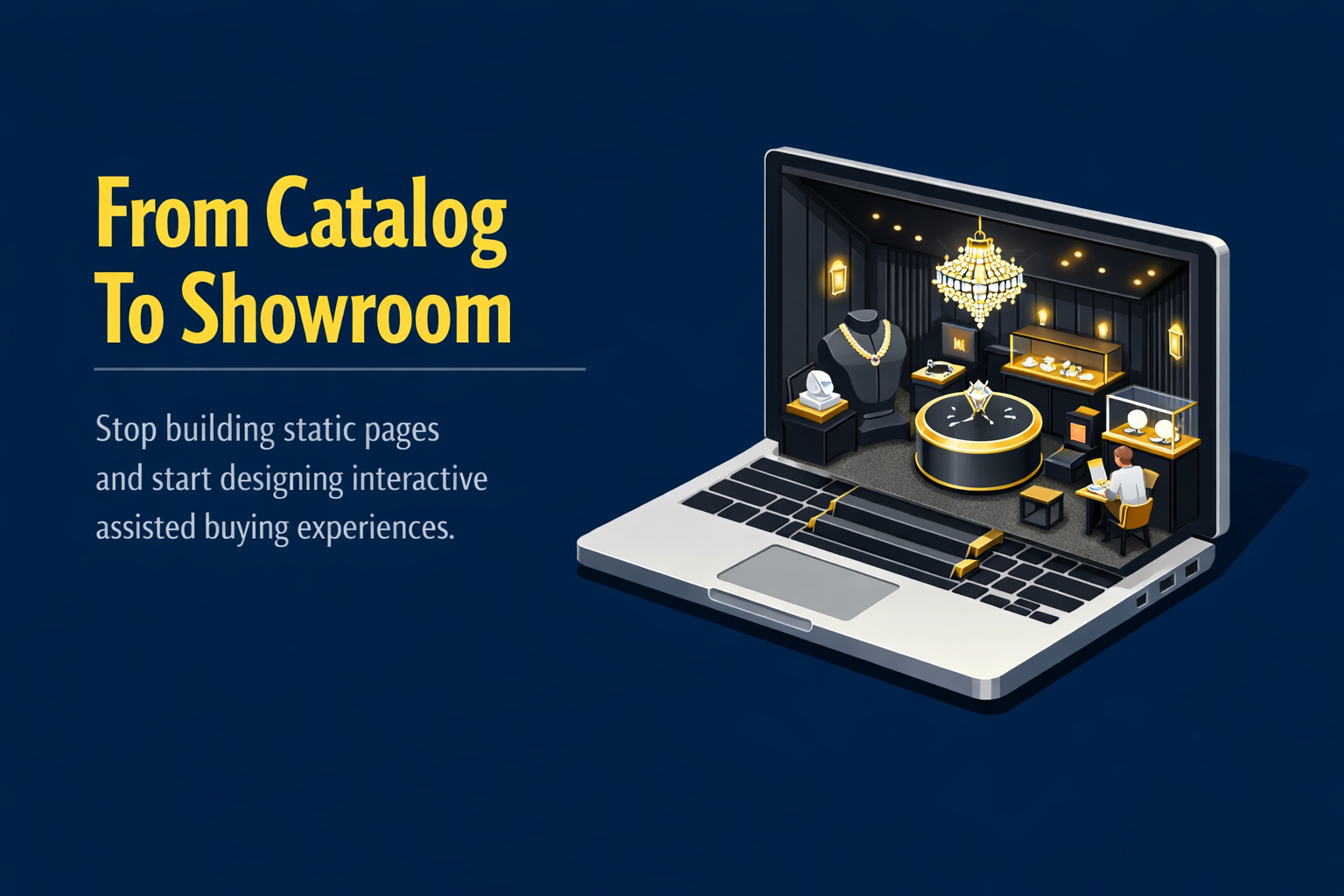
So, how do we fix this? We stop building websites that act like catalogs and start building experiences that act like showrooms.
We need to shift our mindset from "Customer Support" to "Sales Enablement."
In an Assisted Buying model, every question is a lever to move the deal forward. This requires the AI to determine the Next Best Action. It’s not enough to just answer the question; the agent must guide the journey.
Scenario: A user asks, "Do you have financing?"
Passive Response: "Yes, we use Affirm."
Agentic Response: "Yes, we offer 0% APR via Affirm. Since you’re looking at the Emerald cut, pre-approval takes about 30 seconds. Shall I send the secure link to your phone?"
See the shift?
The agent uses unstructured native understanding to detect the intent (financial hesitation) and immediately pivots to a solution that removes friction. It captures the demand while it is hot!
By integrating with your existing stack, whether it’s booking a demo, scheduling a store visit, or processing a deposit. he agent acts as your best sales associate, one who never sleeps, never takes a break, and never gets annoyed by "too many questions."
When questions are handled in real-time, three things happen inside a single conversation:
Awareness: You clarify exactly what the product is and isn't.
Confidence: You remove the risk by answering the specific fear (sizing, shipping, quality).
Action: You guide them directly to checkout while the dopamine is still high.
We have seen this approach collapse sales cycles from two weeks to twenty minutes. Why? Because you removed the latency.
You didn't give them "time to think" about why they shouldn't spend the money. You gave them the confidence to spend it now.
The Future of Digital Luxury
The era of "set it and forget it" e-commerce is over for the jewelry industry. You cannot automate intimacy. You cannot algorithm your way out of a trust deficit.
The brands that will win in the next decade are not necessarily the ones with the biggest ad budgets. They are the ones who understand that every unanswered question is a leak in the revenue bucket.
Jewellery buyers don’t abandon because they need time. They abandon when curiosity meets silence.
Look at your analytics. Look at the exit pages. Those aren't just statistics; they are people who had a question you didn't answer.
Are you ready to stop letting silence kill your sales?
Start answering, start selling.