
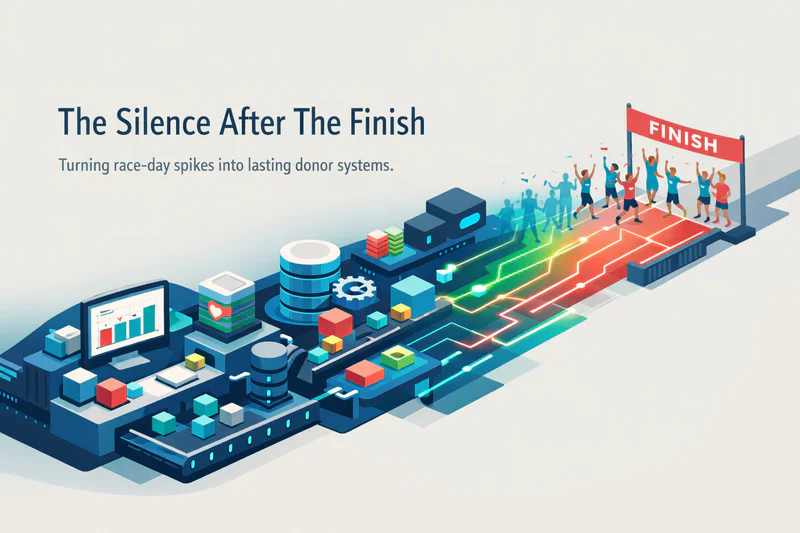
5K run fundraiser ideas usually focus on themes, turnout, sponsorships, and registration growth. And those matter. But if you’ve ever organized a race, you know what happens next.
Race day is electric.
The photos look great.
The finish line feels triumphant.
And then… silence.
The real challenge isn’t getting people to run. It’s getting them to stay.
Most nonprofits treat the 5K as the finish line of their fundraising effort. But from a revenue and retention perspective, it’s actually the starting line. The hours immediately after the race, when emotion is high and connection is strongest, are where long-term donor relationships are built.
If you’re not designing your 5K with retention in mind, you’re planning a spike. Not a system.
Let’s change that.
Why Most 5K Run Fundraiser Ideas Stop Too Soon
Search for 5K run fundraiser ideas and you’ll find creative themes:
Color powder runs
Glow night races
Corporate team competitions
Peer-to-peer fundraising leaderboards
VIP sponsorship tiers
All excellent for boosting participation.
But participation alone doesn’t drive donor lifetime value optimization.
Here’s the uncomfortable truth: a large percentage of event participants never engage again after race day. Not because they didn’t care, but because no structured post-event engagement strategy captured that care while it was fresh.
Traditional event guides optimize for:
Registrations
Day-of logistics
Sponsorship revenue
Very few optimize for:
30-day retention
Recurring donation conversion
Long-term donor stewardship
Attendance is acquisition.
Retention is growth.
And growth happens after the medals are handed out.
The 24-Hour “Runner’s High” Window
Picture this.
A runner crosses the finish line. They’re sweating, smiling, slightly exhausted and deeply proud. Volunteers cheer. Photos get taken. The medal hangs around their neck.
That’s dopamine at work.
Psychologically, this is the most powerful moment of the entire campaign. They feel:
Accomplished
Connected
Generous
Mission-aligned
This is what I call the Golden Window. the first 2 to 6 hours post-race.
Now here’s where most nonprofits miss it.
They wait.
They send a generic email the next day.
Or worse, a week later.
Email open rates hover in the teens. Meanwhile, text messages are read almost immediately. If you’re serious about SMS marketing for nonprofits, this is where it matters most.
Emotion decays quickly.
Speed preserves it.
5K Run Fundraiser Ideas for Post-Race Engagement (The Retention Edition)
Let’s shift from race planning to revenue planning.
Here are three 5K run fundraiser ideas designed specifically for retention and recurring donation conversion.
1. The Instant Impact Reveal
Instead of a simple “Thanks for running!” email, imagine this:
Within an hour of finishing, each participant receives a personalized message:
“Because you ran today, 12 families will receive meals this week.”
Even better? Include a short mobile-friendly video showing the exact impact.
This reinforces purpose while emotion is still high. It’s not a thank-you. It’s a reflection of meaning.
This approach strengthens automated donor stewardship while keeping the experience human and timely.
2. The Cooldown Conversation
Most post-event messages talk at participants.
What if you talked with them?
Instead of:
“Thanks for participating! Donate again here.”
Try:
“How did the race feel today?”
That one question opens a dialogue.
Some runners will say it was amazing. Some will share personal reasons they ran. Some will give feedback. Each response is insightful. Each response is connection.
This is where conversational automation becomes powerful, scaling personal engagement without overwhelming your team.
It’s the difference between a broadcast and a relationship.
(If you’ve explored topics like scoring engagement based on conversations or moving beyond static automation, you already see how this plays out.)
3. The Finish Line Challenge
You just asked someone to run 5 kilometers for your cause.
That’s not a small ask.
So here’s a reframing:
“You ran 5K today. Would you sponsor each kilometer with a small monthly gift?”
Suddenly, a recurring donation doesn’t feel like another transaction. It feels like a continuation of effort.
This is where recurring donation conversion becomes natural, not pushy.
Instead of asking for “another gift,” you’re inviting them deeper into impact.
And when structured correctly, even a modest percentage converting to monthly donors dramatically shifts overall donor lifetime value.
Why Traditional Automation Falls Flat After Events
Here’s what usually happens post-race:
A mass email blast
A social media photo album
A donation link dropped into inboxes
It feels transactional. Because it is.
Even generic SMS follow-ups often read like this:
“Thanks for attending! Donate here: [link]”
That’s not engagement. That’s a shortcut.
And let’s be honest, your team cannot manually call 500 runners in two hours. The human bandwidth simply doesn’t exist.
The problem isn’t effort.
It’s scale.
Without intelligent segmentation, every participant receives the same message, regardless of enthusiasm, intent, or potential.
And that’s where revenue leaks.
Operationalizing Post-Race Engagement with Agentic AI
Speed matters after a 5K. But speed alone isn’t enough.
You need initiative.
Agentic AI introduces something traditional automation lacks: autonomy toward a goal.
Instead of sending fixed messages, an AI agent operates with intent, for example:
“Convert emotionally engaged runners into recurring supporters.”
From there, it initiates individualized conversations immediately after the race.
It can:
Ask contextual follow-up questions
Interpret sentiment
Adapt messaging dynamically
Offer monthly giving only when alignment is high
Escalate complex concerns to human staff
This is not a static drip campaign.
It’s a living engagement system.
Where traditional automation says,
“Thanks for running. Donate here.”
Agentic AI asks,
“How did today feel?”
“What motivated you to join?”
“Would you like to keep this momentum going monthly?”
It responds in real time, similar to how intelligent outbound systems adapt based on buyer signals instead of rigid schedules.
And because it integrates with your CRM, it tags engagement levels, updates donor profiles, and strengthens future segmentation automatically.
The race becomes acquisition.
The AI becomes the follow-up team.
Retention becomes measurable.
Metrics That Actually Matter After a 5K
Instead of celebrating only registration numbers, start tracking:
Runner → Monthly Donor Conversion Rate
30-Day Post-Event Retention
Average Donor Lifetime Value
SMS Reply Rate vs. Email Open Rate
Cost Per Retained Donor
When you shift measurement from “event turnout” to “revenue pipeline,” everything changes.
The race becomes acquisition.
The system becomes growth.
And suddenly your annual 5K isn’t just a campaign, it’s a donor engine.
The Finish Line Is the Starting Line And Here’s Where Zigment Fits In
All of this sounds strategic, because it is.
But strategy without execution is just theory.
This is where Zigment becomes the infrastructure behind the momentum.
Instead of relying on static email sequences or manual follow-ups, Zigment deploys agentic AI-powered SMS agents that initiate real-time conversations the moment your event ends. It doesn’t just send messages, it understands responses, adapts dialogue, and guides engaged runners toward recurring support intelligently.
No extra headcount.
No rigid flows.
No missed Golden Window.
It turns race-day energy into structured, scalable engagement.
If your nonprofit already invests months planning a 5K, Zigment ensures that investment compounds, by converting emotional peaks into long-term donor relationships.
Because the finish line isn’t where fundraising ends.
It’s where intelligent systems begin.