
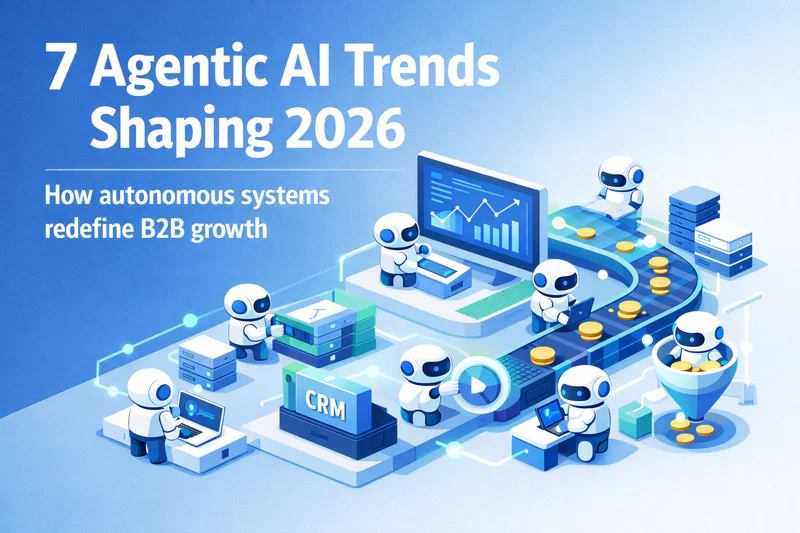
Across B2B organizations, a seismic shift is happening. This isn't just about efficiency; it's about competitive survival.
Agentic AI autonomous systems that actually do things rather than just suggest them is fundamentally transforming how marketing teams operate. These aren't your old, clunky chatbots. They’re intelligent agents that execute, optimize, and orchestrate entire marketing operations autonomously, acting as the ultimate digital RevOps Project Manager.
The results? They’re not incremental. They’re exponential, turning slow, sequential workflows into lightning-fast revenue streams.
"We went from spending 40 hours a week on campaign optimization to maybe 6," says Sarah Chen, VP of RevOps at a mid-sized SaaS company. "The agents handle everything else. And our conversion rates doubled."
The data is screaming:
2x ROI improvements across marketing spend (industry studies show companies generate $5.44 for every $1 invested in marketing automation).
2x engagement rates compared to traditional automation.
66% productivity gains in RevOps teams.
80% automation of customer interactions (Gartner forecast).
30% cost reductions in MarTech licensing.
The message is clear: the era of static marketing automation is dead. The era of the Autonomous Agent Fleet is here, and it demands a new playbook. Ready to ditch the busywork and claim the strategic high ground?
Let's dive into the 7 Agentic AI trends that are actually moving the needle in 2026. No hype. Just proven strategies that are reshaping B2B growth right now.

Trend 1: Low-Code Agentic Platforms Democratize Autonomous Marketing
Remember when you needed a developer to build every workflow? 2026 has made that obsolete.
"I built our entire lead qualification system in an afternoon," explains Marcus Rodriguez, a RevOps manager with zero coding background. "Drag, drop, test, deploy. That's it."
The democratization of agentic AI is the first mega-trend reshaping marketing in 2026. No-code and low-code platforms are putting autonomous marketing capabilities into the hands of RevOps teams no engineering required.
Here's what's changed:
- No-code interfaces let marketing teams deploy AI agents directly
- Pre-built templates for common use cases (lead scoring, nurture campaigns, churn prevention)
- Enterprise-grade security and compliance built in from day one
- Salesforce integration that actually works (finally)
According to Deloitte's 2026 Technology, Media & Telecommunications Predictions, by the end of 2026, as many as 75% of companies may invest in agentic AI, fueling a surge in spending on autonomous AI agents across SaaS platforms.
Companies using low-code agentic platforms are scaling from pilot programs to full production deployment in 6-9 months, compared to 18-24 months for traditional custom development. That's not just faster. That's the difference between leading your market and playing catch-up.
The Salesforce Integration Story
For B2B teams, Salesforce is the system of record. Period.
Modern agentic platforms connect directly to Salesforce APIs. Your agents can:
- Read opportunity data in real-time
- Update contact records automatically
- Log every activity for your sales team
- Trigger workflows based on deal stages
- Score leads based on actual CRM behavior
Our agents live inside Salesforce , Sales doesn't even know they're interacting with AI half the time. It just works... says Chen
GDPR Compliance That Doesn't Break Things
Here's where most automation fails. Privacy regulations.
Leading platforms now include:
- Automated consent tracking across every workflow
- Instant pause when consent is withdrawn
- Data anonymization on regulatory schedules
- Full audit trails for every automated decision
- Built-in compliance checks before agents take action
You can scale without worrying about a GDPR fine. That's the promise. And it's actually being delivered.
Trend 2: MCP Multi-Agent Orchestration Creates Marketing Swarms
Single agents are useful. Agent swarms are game-changing.
Model Context Protocol (MCP) lets multiple AI agents coordinate like a well-oiled team. They share context. They divide work. They execute together. This is what separates 2026's agentic AI from older automation tools.
Think about a typical demand gen campaign:
One agent monitors website behaviour. Another orchestrates email sequences. A third optimizes paid media. A fourth analyzes conversions.
They're not working in silos. They're sharing intelligence in real-time.
The Performance Gap
Organizations using MCP orchestration are seeing 2x engagement improvements over traditional tools like Zapier, according to industry analyses.
Why? Static automation runs if-then rules. MCP agents adapt dynamically based on:
- Real-time behavior signals
- A/B test results
- Seasonal trends
- Competitive actions
- Individual prospect patterns
B2B Dynamic Personalization
Here's where it gets powerful.
Your agents can synthesize signals from:
- CRM historical data
- Technographic intelligence
- Website behavior tracking
- Email engagement patterns
- Support ticket sentiment
- Product usage metrics
They detect that a target account is researching a specific solution. They automatically generate personalized content addressing that exact use case. They deliver it through the channel where that account is most active.
No human involved. Perfect timing. Perfect relevance.
Trend 3: Hyper-Personalized Customer Journeys Predict What Customers Need
Traditional automation follows fixed paths. But in 2026, this third trend is rewriting the playbook entirely.
Agentic AI creates living, breathing journeys that adapt every second based on predictive analytics.
"We're resolving 80% of customer issues without human input," says Jennifer Park, Director of Customer Success at a B2B platform. "Our agents predict problems before customers even notice them."
This is hyper-personalization at a scale that was impossible just 18 months ago. According to Gartner research, agentic AI will autonomously resolve 80% of common customer service issues without human intervention by 2029, leading to a 30% reduction in operational costs.
Live Intent Analysis
Modern agents monitor everything:
- Email opens and click patterns
- Website navigation behavior
- Support ticket sentiment
- Product usage trends
- Social media engagement
- Response times and frequency
They're looking for signals. Churn risk. Expansion opportunity. Support need. Purchase intent.
The Proactive Retention Workflow
Customer usage drops 30% over two weeks.
Your agent detects it. Immediately.
It sends a personalized email offering help. It schedules a check-in with your CS team. It delivers targeted content addressing common objections.
Customer engages positively? Journey adjusts.
No response? Human escalation before it's too late.
Omnichannel Unification
Email. WhatsApp. SMS. Chat. Phone.
Your agents maintain full context across all of them.
Start a conversation via email. Customer responds on WhatsApp. Agent continues seamlessly with complete history.
"It's like talking to someone with a perfect memory," explains Park. "Except it's instant, 24/7, and never forgets a detail."
The Efficiency Math
When agents resolve 80% of routine inquiries autonomously:
- Your team focuses on high-value interactions
- Response times drop to seconds
- Customer satisfaction improves
- Operational costs plummet
One RevOps professional can manage personalized journeys for thousands of accounts. That's not possible with traditional automation.
Trend 4: AIOps Transforms Campaign Optimization Into 24/7 Intelligence
The fourth major trend? Marketing operations that never sleep.
Your campaigns generate massive data. Ad networks. Email systems. CRM. Web analytics. Social platforms.
Humans can't synthesize all of it in real-time. But in 2026, AIOps agents can—and do.
The 66% Productivity Boost
Organizations implementing AIOps report 66% improvements in RevOps productivity, according to recent marketing automation research.
You're not reviewing dashboards manually. You're not making incremental adjustments. You're focusing on strategy while agents handle tactical optimization.
Real-Time Budget Management
Traditional approach: Review performance weekly. Manually shift budgets between campaigns.
AIOps approach: Continuous analysis. Real-time budget moves.
- LinkedIn campaign's CPL drops below target? Agent increases spend immediately.
- Google Ads CTR declining? Agent pauses underperformers, scales winners.
- New competitor enters the market? Agent adjusts bidding strategy.
Multi-Source Intelligence
Agents synthesize data from:
- CRM (lead quality, conversion rates, deal velocity)
- Ad platforms (impressions, clicks, spend, conversions)
- Marketing automation (engagement, email performance)
- Web analytics (traffic sources, conversion paths)
- Social media (reach, engagement, sentiment)
They identify patterns invisible to humans reviewing individual platforms.
Continuous A/B Testing
Agents automatically:
- Generate test hypotheses
- Deploy variations
- Analyze statistical significance
- Scale winning approaches
- Archive losers
Your campaigns optimize themselves. Forever.
Trend 5 : RAG-Enhanced Content and SEO: Content That Proves Itself
Creating high-quality B2B content at scale has been impossible. Until now.
Retrieval-Augmented Generation (RAG) changes everything. Your agents produce verifiable, factually accurate content that ranks.
How RAG Works
Agents combine language models with your authoritative data sources:
- Product documentation
- Industry research
- Customer case studies
- Company knowledge base
- Expert interviews
When generating content, they retrieve relevant information and cite sources.
The SEO Advantage
Search engines increasingly rely on AI to evaluate quality. RAG-generated content wins because it:
- Cites authoritative sources
- Demonstrates domain expertise
- Provides comprehensive coverage
- Uses structured data markup
- Maintains factual accuracy
Recursive Keyword Clustering
Agents identify low-competition topics with high intent signals.
- Low competition
- High search intent from target accounts
- Matches your ICP
Agent generates:
- Comprehensive guide optimized for this cluster
- Supporting blog posts
- Social media content
- Email copy
- Ad variations
All maintaining consistent messaging and factual accuracy.
Agent-Readable SEO
AI agents are becoming primary information gatherers for business professionals.
Your content must work for both humans and agents:
- Clear schema mark-up
- Structured data
- Comprehensive topic coverage
- Authoritative sourcing
- Logical information hierarchy
Trend 6: API-First Architecture Unifies Fragmented Martech Stacks
The sixth transformative trend addresses a pain point every marketer knows: fragmented systems.
Your martech stack is probably siloed. Data trapped. Integration limited by vendor partnerships.
In 2026, API-first architecture powered by agentic AI is breaking down these walls—and cutting costs by 30% in the process.
The 30% Cost Reduction
Organizations are reducing software license costs by 30% through API-first approaches, according to multiple enterprise case studies.
How? Eliminate redundant functionality.
You're paying for:
- Email in both CRM and marketing automation
- Analytics in both ad platforms and web tools
- Contact management in three different systems
API-first agents query data directly from source systems. No duplicate datasets. No redundant licenses.
Ambient Intelligence in Slack and Teams
Sales rep needs customer data? No Salesforce login required.
They ask their Slack agent: "What's the status of the Acme Corp opportunity?"
Agent queries Salesforce API. Returns real-time information. Instantly.
Conversational RevOps
Your team interacts with agents that have full context across all martech systems.
Questions like:
- "Which campaigns drove the most pipeline last quarter?"
- "Show me accounts that fit our ICP but haven't engaged in 60 days."
- "Update lead status for all contacts from yesterday's webinar."
- "What's our cost per opportunity by channel this month?"
Instant answers. No dashboard hunting. No manual reports.
ROI Timeline
Software cost reduction + productivity gains = payback in 3-6 months.
After that? Pure profit.
Trend 7: Governance Frameworks Make Autonomous Marketing Trustworthy
The seventh and perhaps most critical trend? Building systems you can actually trust.
Autonomous marketing sounds revolutionary until something goes wrong. That's why governance isn't optional in 2026 it's foundational.
This trend is what separates sustainable agentic AI implementations from risky experiments.
Bias Mitigation
Agents learn from historical data. If that data contains biased patterns, agents will scale those patterns.
Modern governance requires:
- Regular auditing of agent decisions
- Testing for disparate impact
- Continuous monitoring for drift
- Diverse training data
- Human review of edge cases
Human-AI Hybrid Roles
Not everything should be automated.
High-stakes activities need human approval:
- Campaigns over $10K spend
- Communications about sensitive topics
- Regulated product marketing
- Brand reputation decisions
Low-stakes activities can be fully automated:
- Routine email nurture
- Social media posting
- Lead scoring updates
- Report generation
The Ethics Committee
Forward-thinking organizations are establishing AI ethics committees.
Members typically include:
- Legal counsel
- Compliance officers
- Marketing leadership
- Technical experts
- Customer advocates
They review agent implementations. Define acceptable use policies. Investigate incidents.
Conclusion: The Strategic High Ground
If you’ve read this far, you've glimpsed the future, and it smells less like burnt coffee and more like pure strategic freedom.
The core message of 2026 is simple: the age of slow, sequential marketing is over. Your competitors aren't just getting 2x ROI; they're reclaiming time the ultimate competitive asset. The Agent Fleet handles the tactical noise (optimizing bids, cleaning data, personalizing journeys) with relentless, 24/7 precision.
The big choice is yours: Will you continue to babysit dashboards, or will you deploy your autonomous Project Manager and finally focus on the bold, human strategy that only you can deliver?
The market isn't waiting for permission. Are you ready to stop chasing data and start choreographing revenue?