
Here's something most marketing teams miss: you're sitting on a goldmine of customer intelligence, but you're only mining half of it.
Your CRM tracks clicks. Your analytics dashboard shows page views. Your email platform measures opens.
But what about the actual conversations happening across your channels?
That's where conversational AI and conversational analytics come in, transforming how businesses capture the "why" behind customer behavior instead of just the "what." Modern conversational AI systems don't just respond to customers they extract qualitative signals that reveal true customer intent and emotional state.
Why Your Single Customer View Is Incomplete
Let’s be honest: your "Single Customer View" (SCV) probably isn't that single.
Most integrations just pile up numbers. You see purchase history from your CRM, engagement clicks from your marketing tools, and a stack of support tickets. But a true SCV isn't just a ledger of past transactions it’s an understanding of the human context behind them.
The Missing Piece: Qualitative Signals
Your data layer is likely missing the "why." It sees a customer abandoned a cart, but it doesn't know they were frustrated by a shipping fee they mentioned in chat.
Without conversational analytics, you're missing:
Sentiment Shifts: Are they curious or losing patience?
Real Intent: Are they comparing prices or ready to buy right now?
Emotional Logic: The "human stuff" that actually drives a purchase.

Omnichannel vs. Multichannel: The Context Gap
In the omnichannel vs multichannel debate, the difference is intelligence. Multichannel just shouts at people on three different apps. True omnichannel engagement means the conversation you had on WhatsApp this morning informs the email you get this afternoon.
Without conversational AI feeding your data layer, you aren't orchestrating you're guessing. You need the connective tissue that turns abstract talk into a concrete, unified profile.
Want to see how conversation data could transform your customer profiles? Let’s map out what’s possible with your current tech stack.
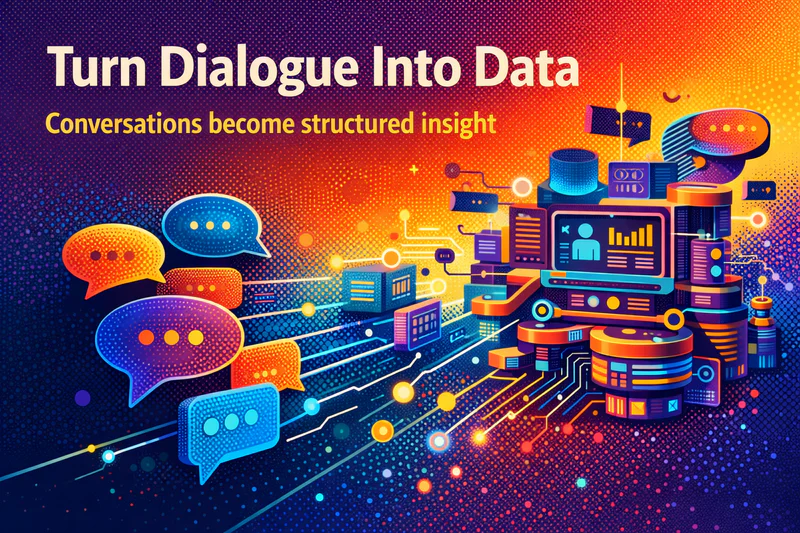
Conversational Analytics: Turning Dialogue into Data
Modern conversational analytics changes everything by implementing sophisticated intent and entity extraction alongside comprehensive sentiment and emotion pipeline capabilities.
Intent and Entity Extraction: Decoding Customer Signals
When a prospect asks "Can your platform integrate with Salesforce?" they're expressing both a specific need and broader buying intent. Intent and entity extraction decodes both layers, revealing true customer intent that traditional analytics miss.
The system identifies:
Expressed Intents: What's driving this conversation? Purchasing, troubleshooting, or comparing options? Understanding customer intent becomes the foundation for meaningful personalization.
Entity Recognition: Which specific products or timeframes are mentioned? The system tags these and links conversational context to your existing structured data.
Contextual Relationships: How do these points connect? These relationships transform isolated data into a narrative understanding.
This represents a massive evolution in voice of customer research. Traditional programs relied on retrospective surveys. Modern voice of customer research methodologies now prioritize real-time intent and entity extraction as the most authentic source of insight.
Sentiment and Emotion Pipeline: Quantifying How Customers Feel
The sentiment and emotion pipeline analyzes tone and linguistic patterns to assess emotional state throughout interactions. This technology extracts qualitative signals that predict customer behavior.
Polarity Detection: Basic positive, negative, or neutral classification provides immediate flags for escalation.
Emotional Granularity: Advanced systems in the sentiment and emotion pipeline detect specific states like frustration, excitement, or confusion.
Intensity Measurement: Scoring helps prioritize interventions—distinguishing "slightly annoying" from "completely unacceptable."
Sentiment Trajectory: Monitoring how the tone shifts reveals engagement patterns and predicts outcomes.

The real power emerges when you combine sentiment and emotion pipeline outputs with intent and entity extraction results. A customer expressing high purchase intent but negative sentiment about pricing is a specific opportunity for value demonstration, enriching your unified customer profile with actionable qualitative signals.
The Conversation Graph: Your Unified Customer Profile
Traditional customer data platforms aggregate information but remain disconnected from conversational context. They track support tickets but miss the sentiment predicting churn risk.
Zigment's proprietary Conversation Graph solves this by treating conversations as a first-class dimension in your unified customer profile, enabling unprecedented customer data integration across all touchpoints.
Building the Actionable Single Customer View
The Conversation Graph structures conversational intelligence across multiple dimensions, creating a true single customer view that includes both quantitative metrics and qualitative signals.
Temporal Continuity: Every interaction links to previous conversations. When a customer returns after three weeks, the system recalls their customer intent, sentiment, and resolution status. Disconnected contacts transform into a coherent journey narrative.
Cross-Channel Integration: The graph unifies conversations across email, chat, voice, and social channels into a single timeline. This is where the omnichannel vs multichannel distinction becomes operationally meaningful.
Intent Lineage: The graph tracks how customer intent evolves over time from an initial explorer to a qualified lead, then to a customer seeking implementation support.
Deep Customer Data Integration: Merging Qualitative and Quantitative
The true power emerges when the Conversation Graph performs deep customer data integration, merging real-time qualitative signals from conversations with historical quantitative data to create a comprehensive single customer view.
The graph creates bidirectional integration that powers your unified customer profile:
Enrichment from External Systems: When a conversation begins, the graph pulls relevant context. Customer tier, purchase history, and open support tickets all inform how the conversational AI interprets current inputs.
Feedback to External Systems: Conversational intelligence flows back to enrich profiles. When the sentiment and emotion pipeline detects frustration, the CRM receives an updated health score. When intent and entity extraction identifies cross-sell interest, the opportunity pipeline updates automatically.
This bidirectional flow creates a living unified customer profile through seamless customer data integration. Every decision uses the most current understanding of customer state.
The Marketing Memory Bank: Persistent Intelligence
One of the Conversation Graph's most significant innovations is the "Marketing Memory Bank" persistent storage of conversational context that creates a single customer view that actually remembers every conversation.
Traditional conversational AI systems operate with limited memory. A chatbot conversation stays within that session. Each engagement starts with minimal context, forcing customers to repeat information.
The Memory Bank eliminates this repetition within your unified customer profile:
Preference Learning — Over time, conversations reveal customer preferences. The Memory Bank stores these as structured attributes that personalize all future interactions, effectively conducting continuous voice of customer research.
Objection History — When prospects raise objections, the system records both the objection and how it was addressed, enabling proactive handling based on historical customer intent patterns.
Success Patterns — The graph identifies which conversation strategies correlate with positive outcomes, becoming playbooks guiding future engagement.
This persistent intelligence creates compound returns on your conversational data investment.
Real-Time Intelligence Drives Autonomous Action
The Conversation Graph's design ensures enriched profiles immediately generate real-time intelligence to trigger autonomous journeys, leveraging conversational analytics to power decision-making.
From Static Segments to Dynamic Orchestration
Traditional marketing automation relies on static segmentation. These fundamental limitations prevent a true single customer view:
Recognition Lag: Segment assignments update periodically. A customer whose needs change today won't be recognized until the next refresh cycle.
Loss of Individual Context: Segments aggregate customers, but the qualitative signals that matter most disappear.
The Conversation Graph continuously evaluates each individual’s current state their expressed customer intent, sentiment trajectory, and context captured through conversational analytics to dynamically determine the optimal next action. When a conversation reveals purchase intent, the system triggers actions immediately: scheduling a sales call, delivering case studies, or initiating personalized pricing.
Personalization at the Individual Level
With conversational intelligence feeding the Conversation Graph, the conversational AI system recognizes critical differences through sophisticated intent and entity extraction:
Prospect A expresses excitement about specific features. Their sentiment is positive, their customer intent clear. The system prioritizes immediate sales engagement.
Prospect B mentions budget constraints. Their intent is exploratory, sentiment cautious. The system routes them toward ROI calculators and value-focused content.
Same trigger, different responses. This is true personalization executed autonomously through conversational analytics.
True Omnichannel Engagement
The distinction between omnichannel vs multichannel marketing becomes operationally meaningful when conversational intelligence provides connective tissue through sophisticated customer data integration.
Multichannel marketing operates in silos. Email, support, and sales teams function independently, creating disjointed experiences.
True omnichannel engagement requires channel-agnostic understanding. The Conversation Graph captures context regardless of where it occurs and makes it available to all channels through your unified customer profile.
This is the fundamental advantage when comparing omnichannel vs multichannel strategies powered by conversational AI. When a customer's email reveals concern, that insight immediately appears in the CRM, support dashboard, and marketing platform. All channels operate from a shared understanding powered by continuous conversational analytics—creating a true single customer view across every interaction.
The Bottom Line
The future of customer engagement belongs to systems that understand not just what customers did, but why they did it through sophisticated conversational analytics that extract qualitative signals revealing true customer intent.
Zigment's Conversation Graph makes that future operationally real today by solving the omnichannel vs multichannel challenge through unprecedented customer data integration that creates a true single customer view.
The question for marketing leaders isn't whether conversational intelligence matters. It's whether your current data architecture can capture it through conversational AI, structure it with intent and entity extraction and sentiment and emotion pipeline technologies, enrich your unified customer profile with continuous voice of customer research, and act on it through seamless customer data integration before your competitors do.