
There's a scene most banking customers know too well. You open the app at 9 PM to dispute a transaction.
A cheerful little chat bubble pops up: "Hi! How can I help you today?" You explain your problem. It sends a link to a help article. You try again. It offers to transfer you to an agent. You accept. It tells you agents aren't available and to call back tomorrow.
You close the app. The transaction stays disputed. Your frustration stays very much open.
This is the Intelligence Gap the yawning distance between what banking customers expect and what most banks actually deliver. Customers today live in an Amazon world: instant, personalized, context-aware. But step into most banking interfaces and you're still in an IVR world: rigid menus, zero memory, and bots that give up the moment you color outside the lines.
That gap is getting expensive to ignore. The global conversational AI market in banking alone reached $2.13 billion in 2024 and is projected to grow at a 22.7% CAGR through 2033, according to industry analysis.
By end of 2026, 88% of financial organizations are expected to have AI integrated into at least one key function.
The race is on and the banks that win it will be the ones that understand the difference between a chatbot and a genuinely intelligent conversational AI system.
The Evolution From Scripted Bots to Intelligent Agents
Conversational AI in banking didn't arrive fully formed. It evolved through three distinct and increasingly capable phases.
Phase 1:
Rule-Based Chatbots. These were essentially glorified FAQ trees. They worked on rigid if/then logic type a keyword, get a pre-written response. Ask something slightly off-script, and the bot would either loop you back to the main menu or admit defeat.
Bank of America's early virtual assistant, before its significant AI upgrade, operated on roughly 700 pre-defined scripts. Anything outside those 700? Dead end.
Phase 2:
NLP-Powered Bots. Natural Language Processing (NLP) was a genuine leap forward. Instead of matching keywords, these systems learned to interpret intent understanding that "I want to move money" and "transfer funds" mean the same thing. JPMorgan's COIN platform, for instance, automated complex commercial credit document analysis and saved over 360,000 work hours annually.
But NLP bots still had a critical weakness: no memory. Each session started from scratch. Switch from the app to WhatsApp mid-conversation? Start over. Come back tomorrow? Blank slate.
Phase 3:
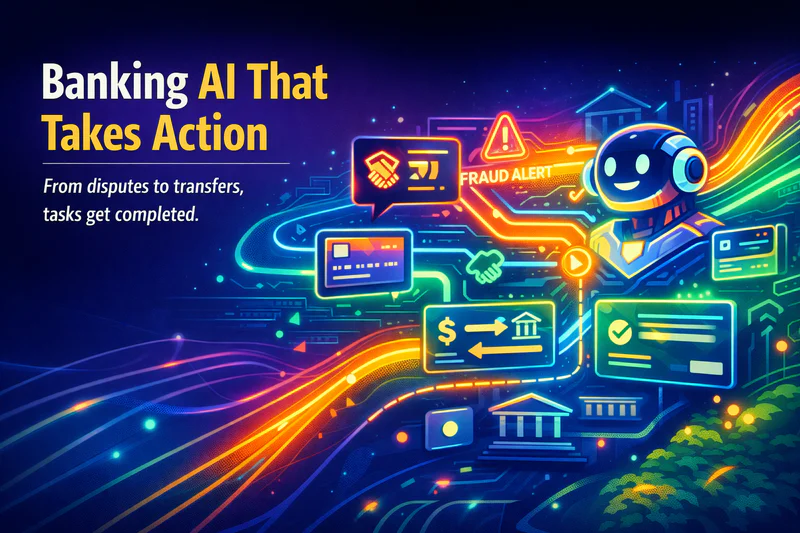
Agentic AI. This is where conversational AI banking is heading in 2026. Agentic systems don't just respond they act. They hold context across sessions and channels. They access live account data, initiate transactions, flag anomalies, and route complex cases to human advisors with the full conversation history already loaded.
Forrester's State of Conversational Banking, 2026 describes this as a "fundamental shift in how customers access banking services" moving from scripted answers to intelligent, autonomous task completion.
Key Use Cases in Banking CX
The gap between what conversational AI can do and what most banks are currently doing with it is significant. Here's where leading institutions are already deploying it effectively.
Onboarding Guidance and KYC Assistance. Digital onboarding is notoriously leaky. Customers drop off mid-form, get confused by document requirements, or simply give up.
AI agents can coach users through every step in real time answering compliance-sensitive questions, validating documents on the fly, and reducing drop-off rates significantly. Banks using AI for onboarding report a 91.3% self-service resolution rate for account opening tasks.
Transaction and Product Support. From balance checks to fraud dispute initiation, conversational AI now handles tier-1 queries with a 94.8% success rate for basic requests. More importantly, it frees human agents to focus on genuinely complex issues wealth management conversations, business lending, and high-stakes financial decisions where empathy still matters.
Cross-Sell and Product Discovery. A customer asking about mortgage rates at 11 PM isn't just curious they may be within days of making a decision. Agentic AI systems can detect buying signals in real time, surface the right product, and move the customer toward a next step rather than leaving them to come back tomorrow.
JPMorgan Chase credited AI-powered personalization with generating over $500 million in value at its 2023 Investor Day and the capability has only grown since.
Retention and Churn Prevention. This is arguably the highest-value use case. AI models trained on conversation patterns can detect early signals of churn a customer suddenly asking about account closure fees, or a shift in tone that suggests frustration.
Rather than waiting for a formal complaint, the system can trigger an intervention: a proactive outreach, a personalized offer, or a warm handoff to a human relationship manager.
Conversational AI vs. Traditional Chatbots
The difference isn't cosmetic. A traditional chatbot reduces call volume. An agentic conversational AI system changes the customer relationship.
The Data Advantage — Conversations as Revenue Intelligence
Here's the insight most banks are still sleeping on: every customer conversation is a data asset, and most of it is being thrown away.
When a customer types "I'm thinking about renovating my home," a traditional system logs it as a generic inquiry. A modern agentic system reads it as a high-intent signal cross-references the customer's savings rate, financial history, and past product interactions and treats that message as the opening of a sales conversation, not a support ticket.
This is the core principle behind what's emerging in 2026 as Conversation Graph architecture a persistent, contextual map of each customer's journey that captures intent, mood, urgency, and history across every interaction. Rather than storing a transaction log, it builds a living customer narrative. When a buyer's readiness peaks, the system doesn't just record it. It acts on it.
Traditional CRMs capture what customers do. Conversation intelligence captures what customers mean. That qualitative layer the ambition behind the inquiry, the frustration beneath the question is where real retention and revenue intelligence lives.
Implementation Reality — Deploying AI in a Regulated Environment
Let's be honest: banking isn't social media. You can't ship fast and fix it later. Every AI model deployed at a regulated financial institution needs documentation, risk assessment, and model committee approval. That's not an obstacle to agentic AI it's a design constraint that modern platforms are being built around.
According to Gartner, conversational AI technologies are projected to reduce labor costs by $80 billion in 2026. But capturing that value requires getting governance right from the start, not bolting it on as an afterthought.
What serious implementation looks like:
Automated PII Handling. Real-time redaction of sensitive data account numbers, identity information must be built into every conversation layer, not just the output.
Policy Guardrails. AI systems in banking need codified constraints that prevent off-script statements, regulatory missteps, or brand voice violations. These aren't optional the CFPB has already begun targeting banks with AI-driven "doom loops" that trap customers without recourse.
Human-in-the-Loop Escalation. The best agentic systems don't replace human bankers. They elevate them. By absorbing up to 98% of routine administrative queries, smart platforms free human agents to reclaim up to 12.7% of their workday for high-value, emotionally complex conversations the ones where a human still wins.
The Conversation-First Future
Banking is no longer a series of isolated transactions. It's a continuous relationship and that relationship now lives primarily in conversation. The banks that treat every dialogue as a data point, a trust-building moment, and a revenue opportunity will build the kind of loyalty no interest rate can buy.
The technology is ready. The customers have been ready for years. The only thing left is the decision to move from scripted bots to genuinely intelligent systems ones that remember, learn, act, and actually help.
See how Zigment's Conversation Graph™ can turn every customer dialogue into a bridge toward revenue and stop letting great conversations go nowhere.