
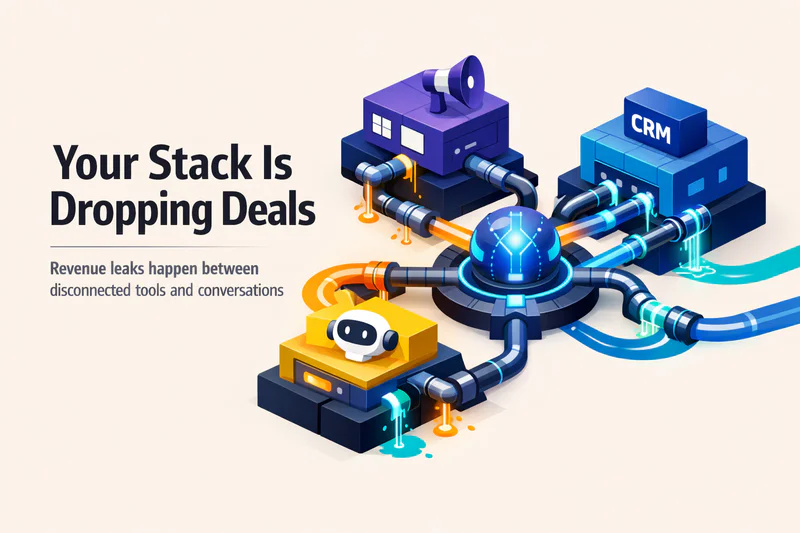
Here's an uncomfortable truth about your current marketing and sales stack: it has three jobs, and it's doing none of them particularly well.
Marketing automation tools manage campaigns. CRMs manage data. Chatbots manage... scripts.
They sit in their respective lanes, doing their respective things, while the actual revenue conversation the messy, multi-touch, cross-channel thing that moves a prospect from 'mildly curious' to 'just signed' happens in the cracks between them.
Nobody orchestrates the conversation-to-revenue pipeline. Nobody owns the arc from first question to closed deal. Nobody connects what a customer said in a chat to what they clicked in an email to what they asked on a call and then uses all of that to move them forward.
Marketing orchestration tools manage campaigns. CRMs manage data. Chatbots manage scripts. But who manages the conversation-to-revenue pipeline? Until now, nobody.
That gap has a name now: Conversational Revenue Orchestration. And for fintech companies where customer journeys are long, regulatory stakes are high, and generic tools fail spectacularly understanding this concept isn't optional. It's a competitive necessity.
This piece is going to walk you through what Conversational Revenue Orchestration actually means, why it's genuinely different from what you're doing now, and why fintech is the industry most urgently in need of it.
The Problem With Your Current Stack (Be Honest)
Let's walk through a typical fintech customer journey and watch the existing stack fail in real time.
A prospective user lands on your site after clicking a Google ad for 'best investment app for beginners.' They chat with your bot. The bot answers three FAQs and offers to send an email. They opt in. Your marketing automation tool fires a welcome sequence. They click email #2 the one about your low fees and then go dark for 11 days.
Then they're back. They start your KYC flow, get 60% through, and bounce. Your CRM logs a 'partial onboarding.' Your team has no idea why they left. Nobody follows up with anything relevant because nobody knows what happened.
That's not a data problem. That's an orchestration problem.
What the current stack actually does:
Marketing automation (email blasts and drip sequences) — fires pre-written messages based on time delays and click triggers. It knows 'they clicked,' not 'why they clicked' or 'what they're actually trying to accomplish.'
CRM (data storage and pipeline management) — records that something happened, not what was said. Deal stages are manually updated. Conversations are buried in notes or absent entirely.
Chatbots (scripted responses) — follow decision trees. If the customer says something the tree doesn't expect, the bot apologizes and offers a human. The data from that conversation? Usually goes nowhere actionable.
None of these tools orchestrate the actual revenue conversation. None of them treat conversation as data. None of them connect what a customer says to what your revenue team does next.
This is what customer journey orchestration has been missing. And it's particularly brutal for fintechs, where the customer journey isn't a funnel it's a maze.
Defining Conversational Revenue Orchestration
Let's define the category properly, because 'conversational AI' and 'revenue operations' are both real things that mean something adjacent but not identical.
Conversational Revenue Orchestration (CRO): The practice of using AI-powered conversations as the primary engine for customer acquisition, onboarding, and retention treating every conversation as a simultaneous act of data collection, engagement, and revenue generation.
The key word is 'orchestration.' Not just having AI conversations. Not just logging what customers say. Orchestrating the pipeline from first touchpoint to closed deal and beyond — using conversation as the connective tissue.
The core insight that changes everything:
Conversations are not just a communication channel. They are simultaneously:
→ Conversations as Data: Data — every utterance reveals intent, concern, readiness, and objection
→ Conversations as Engagement: Engagement — the act of conversation is itself a retention and trust-building mechanism
→ Conversations as Revenue: Revenue — properly orchestrated, conversations directly move customers through the pipeline
Marketing orchestration platforms understand campaigns. Customer journey automation tools map clicks and sessions. But neither treats the actual words customers use as revenue intelligence. That's the gap. That's the category.
Conversational revenue orchestration says: what your customer says is what they need. And what they need is exactly what your revenue team should be doing next.
The Three Pillars of Conversational Revenue Orchestration
CRO isn't a single feature it's a framework built on three interlocking pillars. Each one is necessary. Together, they form a system that your current stack can't replicate.
Conversational Engagement: AI Agents Across Every Channel
The first pillar is about presence. Your customers don't live in your app. They're on WhatsApp, email, SMS, web, and sometimes all four in the same week. Conversational engagement means deploying intelligent AI agents across all of these channels agents that don't just respond, but remember, adapt, and advance the relationship.
This is not a chatbot. A chatbot follows a script. An AI engagement agent follows the customer picking up context from previous interactions, adjusting tone based on the conversation history, and knowing when to escalate to a human vs. when to close the loop itself.
The outcome: customer engagement automation that actually engages, across the entire customer journey, not just during the initial support ticket.
Conversation Intelligence: What Customers Say = What They Need
This is the pillar that's almost entirely missing from the current stack.
Conversation intelligence is the systematic extraction of revenue signals from qualitative conversation data. It's the difference between knowing a customer 'completed step 3 of onboarding' and knowing a customer 'said they were confused about the fee structure during step 3 and almost dropped off.'
That second piece of information is infinitely more actionable. But it only exists if you're treating conversation as structured data running NLP across your conversation corpus, identifying recurring objection patterns, flagging intent signals, and feeding all of that into your revenue workflows.
This is what conversation analytics and conversational data really mean in practice. Not sentiment scores. Not CSAT surveys. Real-time, pipeline-connected intelligence from the actual words your customers use.
A customer who asks 'what happens to my money if I close the account?' is not just asking a question. They're revealing risk aversion, possible churn intent, and an objection your team can address right now if your system is smart enough to catch it.
Revenue Orchestration: Connecting Conversations to Pipeline
The third pillar is where it all comes together. Revenue orchestration means that your conversation data doesn't stay in the conversation layer — it flows into your pipeline, your playbooks, and your revenue operations workflows.
A lead says they're comparing you to a competitor? That triggers a specific follow-up sequence — maybe a case study, maybe a pricing conversation. A user drops off at a specific onboarding step three times? That triggers a proactive outreach from a human advisor. A high-value customer mentions they're opening a business? That routes them to a different engagement track entirely.
This is what revenue operations has been missing: a feedback loop between qualitative customer signals and quantitative pipeline action. Marketing channel orchestration can tell you which channel converted. Revenue orchestration tells you why and what to do next.
Why Fintech Specifically — Generic Tools Fail Here
At this point you might be thinking: okay, but couldn't any industry use this? And the answer is yes eventually, they will. But fintech needs it now, and more urgently than almost any other vertical.
Here's why generic marketing orchestration and customer journey automation tools fail specifically in financial services:
Regulated Conversations
Every conversation in fintech is a potential compliance event. Mis-selling, financial advice without licensing, inadequate disclosure — these aren't hypotheticals, they're enforcement actions. A generic AI chatbot optimised for conversion doesn't know the difference between persuasion and improper inducement.
Conversational Revenue Orchestration in fintech requires conversation intelligence that includes compliance guardrails — flagging potentially problematic exchanges, maintaining audit trails, and ensuring every AI-generated touchpoint meets the regulatory bar.
Complex, Multi-Step Onboarding
The average fintech onboarding journey involves KYC verification, identity checks, suitability assessments, product selection, and often regulatory disclosures — all before the customer has done anything with the product. Drop-off at any stage means zero revenue.
Journey orchestration platforms that treat onboarding as a linear funnel don't work here. The journey branches, stalls, and loops based on documentation status, risk profiles, and customer readiness. You need an orchestration layer that can hold context across days or weeks, re-engage intelligently when a customer goes dark, and know exactly which conversation to have at each stall point.
High-Value Customers, High-Stakes Conversations
In retail banking or wealth management, a single customer relationship can be worth tens or hundreds of thousands over a lifetime. The revenue economics mean that even small improvements in activation, retention, or cross-sell have massive impacts — and equally, a clunky automated experience that feels impersonal can kill the relationship before it starts.
High-value fintech customers expect personalisation that generic customer engagement automation can't deliver. They've already been burned by scripted responses and irrelevant email sequences. They want conversations that reflect their actual situation — not a drip campaign written for a demographic.
Multi-Step Revenue Journeys
In fintech, revenue isn't a single conversion event. It's a series of activations: first deposit, first investment, credit product adoption, referral, renewal, upsell. Each of these is a revenue moment. Each requires a different conversation.
Revenue operations in fintech means orchestrating across all of these moments — not just acquisition. And that requires a system that can track the full conversation history across the entire customer lifecycle, not just the top-of-funnel.
Generic tools were built for simpler journeys. Fintech journeys aren't simpler. They're regulated, multi-step, high-value, and deeply conversational. CRO is what the stack has been missing.
The Conversation Graph — How Zigment Unifies It All
The reason most companies can't do Conversational Revenue Orchestration today isn't effort or intent. It's architecture. Their data is siloed by design qualitative conversation data lives in one place, quantitative behavioural data in another, pipeline data somewhere else entirely.
Zigment's Conversation Graph solves this by creating a unified layer where qualitative and quantitative data aren't separate they're the same record.
What is the Conversation Graph?
Think of it as a continuously updated, AI-enriched record of every conversation a customer has ever had with your brand across every channel merged with their behavioural and pipeline data. It's not a CRM. It's not a conversation log. It's revenue intelligence built from the intersection of both.
→ Structured Intent: Every AI conversation generates structured intent data, not just transcripts
→ Cross-Customer Intelligence: Recurring themes, objections, and signals are surfaced across the customer base not just per customer
→ Real-Time Orchestration: Conversation signals trigger revenue workflows pipeline updates, human escalations, personalised follow-ups
→ Unified Customer View: Every touchpoint builds a richer customer record — no data siloes, no lost context
The Conversation Graph is how Zigment connects what customers say to what your revenue team does. It's the connective tissue between conversation intelligence and revenue orchestration the thing that makes CRO a system rather than a concept.
For fintech specifically, this means: compliance-flagged conversations auto-logged, onboarding drop-off triggers auto-detected, high-value customer signals auto-routed, and cross-sell moments auto-identified all from conversational data that was previously sitting idle.
Conclusion: The Category Is Emerging. Early Adopters Win.
Conversational Revenue Orchestration is not a feature that exists in your current stack. It is a new category one that sits above marketing orchestration, customer journey orchestration, and revenue operations, and connects all three through the medium of AI-powered conversation.
The companies that recognise this category early and build their revenue motion around it will have an advantage that compounds. Every conversation they have makes their Conversation Graph richer. Every rich graph makes their orchestration smarter. Every smarter orchestration generates more revenue per customer touch.
Their competitors will still be wondering why their email open rates are declining.
For fintech specifically, the case is even more stark. The complexity of your customer journeys, the regulatory weight of your conversations, and the lifetime value of your customers make every conversation too important to leave unorchestrated.
The tools that manage campaigns and store data have been around for decades. The tool that orchestrates the conversation-to-revenue pipeline is just emerging. The question is whether you're an early adopter or a late follower.
Zigment is building the infrastructure for Conversational Revenue Orchestration starting with the Conversation Graph, the AI engagement layer, and the revenue workflow integrations that connect them. If you're in fintech and you're tired of watching high-intent customers disappear between the cracks of your current stack, it's worth exploring what a truly orchestrated revenue conversation looks like.