
Let's be honest: we've all been sold the same dream.
Implement a powerful CRM, and suddenly your customer relationship management process will transform into a seamless, revenue-generating machine. Your sales team will close deals faster. Your marketing will be laser-targeted. Your customer team will prevent churn before it happens.
The reality? For most companies, the CRM becomes an expensive digital graveyard where good intentions go to die.
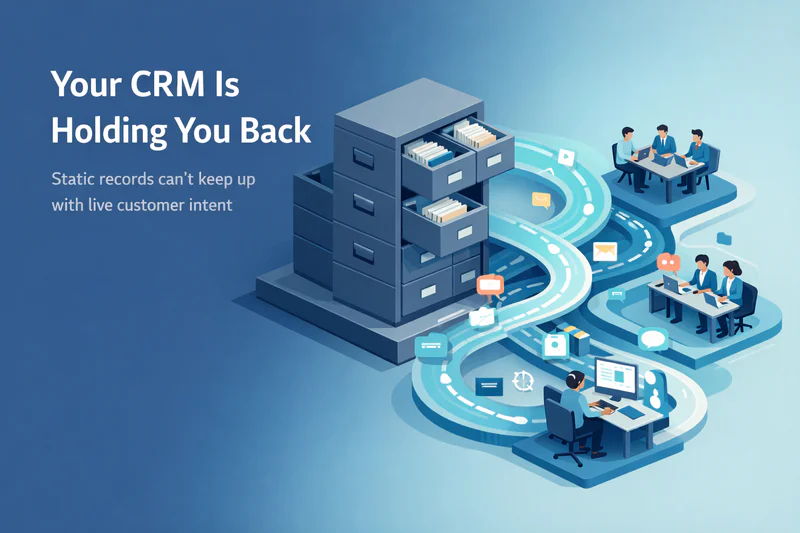
Don't get me wrong CRMs are essential. They're the bedrock of any solid customer relationship management strategy. But here's what nobody talks about: a CRM is fundamentally a System of Record. It's a historian, not a strategist. It documents what happened, but it rarely drives what happens next.
And that gap? That's where revenue leaks, customers churn, and your best salespeople become glorified data entry specialists.
The CRM as Your Data Bedrock
To understand why we need orchestration, we first have to respect the foundation.
Think of your CRM as the "brain" of your business operations. It centralizes every interaction, profile, and touchpoint to support the broader customer relationship management process.
It provides that crucial 30,000-foot view of your lead generation and loyalty metrics. It tells you who bought what, when they bought it, and how much they paid. In the early days of a business, this is enough. But as you scale, the "storage" aspect of a CRM starts to become a bottleneck.
The problem is that most CRMs are passive!
They are world-class libraries, but libraries don't write books they just house them. If a customer’s behaviour changes on a Sunday night, the CRM sits there quietly, waiting for a human to log in on Monday morning, run a report, and decide to take action. In a world where lead response time is measured in seconds, "waiting for a human" is a recipe for lost revenue.
The Critical Limitation: Why Systems of Record Can't Execute Dynamic workflows
Here's the uncomfortable truth about most CRM processes: they're passive observers, not active participants.
Your CRM excels at recording what happened. But when it comes to orchestrating what should happen next especially across multiple systems, channels, and departments it struggles. Hard.
The Rigidity Problem
Traditional CRM automation is built on rigid, if-then logic.
If a lead fills out this form, then send this email."
This works fine for simple, linear workflows. But modern customer journeys? They're anything but linear.
A prospect might download a whitepaper on mobile, ghost you for three weeks, attend a webinar from a work laptop, visit your pricing page at 11 PM on a Saturday, ignore your follow-up emails entirely, then slide into your LinkedIn DMs asking about enterprise features.
Try programming that sequence into a traditional CRM workflow. You'll end up with a tangled mess of conditional logic that breaks the moment reality deviates from your assumptions (which it always does).
The Cross-System Execution Gap
Your customer relationship management strategy doesn't live in a vacuum. It spans your CRM, marketing automation platform, billing system, support desk, product analytics, communication channels, and more.
The problem? Your CRM might integrate with these systems (meaning they can technically "talk"), but it can't orchestrate them (meaning they work together intelligently toward a common goal).
When a customer exhibits churn signals declining product usage, a missed payment, and a frustrated support ticket all within 48 hours your CRM might record each event separately. But does it automatically alert the CSM with full context, trigger a personalized retention offer, pause the next upsell campaign, and queue up proactive outreach?
Probably not. That requires human interpretation, manual coordination, and precious time you don't have.
The Response Time Reality
According to Harvard Business Review, companies that respond to leads within an hour are seven times more likely to qualify that lead. But here's what a typical crm sales process looks like: lead shows intent, data gets logged, human checks CRM, human decides what to do, human takes action.
By step three, you've likely already lost the deal. Your competitor with an orchestration layer? They responded in 60 seconds, automatically, with perfect context.
The CRM recorded the intent. But it didn't act on it.
Key Stages in the CRM Life Cycle
The crm life cycle isn't a clean, predictable funnel where prospects march obediently from Awareness to Purchase. It's a chaotic, looping journey where customers move at their own pace.
The Five Critical Lifecycle Stages
Awareness → Acquisition: The customer moves from "I have a problem" to "I think this company might help." Generic, delayed follow-ups kill momentum before it even builds.
Acquisition → Activation: They've signed up or started a trial. This is the most critical transition. If they don't experience value quickly, they'll churn silently. Yet most CRMs treat this as just another stage label, not a moment requiring precision orchestration.
Activation → Retention: Value has been realized, but consistency is key. This requires continuous monitoring across product usage, communication history, and sentiment signals data that rarely lives in the CRM alone.
Retention → Expansion: The customer is ready for more, but timing is everything. Pitch too early and you seem pushy. Wait too long and a competitor swoops in. Orchestration detects readiness signals and strikes at the perfect moment.
Expansion → Advocacy: Turning satisfied customers into champions requires thoughtful, personalized asks delivered at moments of peak satisfaction—not automated through a quarterly NPS survey.
Where Traditional CRM Processes Fail the Lifecycle
At each transition, execution speed and contextual intelligence matter more than data visibility.
A traditional crm process might tell you that 100 customers are "at risk" based on declining login frequency. Great! Now what? By the time you decide, 20 of them have already churned.
An orchestration layer would have detected the declining usage in real-time, cross-referenced it with other signals, automatically triggered personalized interventions, and escalated the highest-risk accounts with full context all before the customer consciously decided to leave.
That's the difference between recording the lifecycle and operationalizing it.
Why Customer Relationship Management Strategy Needs an Orchestration Layer
A customer relationship management strategy built solely on your CRM is like trying to conduct a symphony by staring at sheet music. The notes are all there, perfectly documented. But without a conductor actively directing musicians in real-time, you don't get music. You get chaos.
The orchestration layer is your conductor.
What Makes Orchestration Different from CRM Automation
Traditional CRM automation operates on static rules: "When Field X changes to Value Y, do Action Z."
Orchestration operates on dynamic intelligence: "When this customer exhibits Pattern X across Systems Y and Z, trigger Response A through Channel B, unless Condition C exists, in which case do D instead."
CRM Automation Example: "When Lead Status changes to 'SQL,' assign to sales rep and send email template."
Orchestration Example: "When a lead visits the pricing page, downloads the ROI calculator, and their company size matches enterprise tier, but they haven't booked a demo, trigger an SMS within 90 seconds from their regional account executive with a personalized message referencing their specific industry pain points."
One is a task. The other is a strategy executed with precision.
The Three Core Capabilities of Workflow Orchestration
Cross-System Intelligence: An orchestration layer sits above your CRM, marketing automation, billing system, support desk, and product analytics. It pulls data from all of them, identifies patterns humans would miss, and triggers actions across any of them.
Event-Driven Execution: Instead of scheduled batch processes, orchestration responds to events as they happen. A customer cancels? Don't wait for the monthly churn report. Trigger a win-back sequence immediately.
Agentic Agility: Modern orchestration powered by AI agents can make contextual decisions that would require dozens of nested if-then statements in a traditional CRM workflow. These agents understand nuance and respond accordingly.
Ways Orchestration Supercharges the CRM Sales Process with Personalized Triggers
Orchestration doesn’t replace the CRM sales process—it upgrades it with real-time intelligence.
Traditional CRM automation is rule-based and predictable. It fires emails on schedules and field changes, often resulting in generic outreach that feels robotic. Orchestration flips this model by using personalized triggers rooted in live customer behavior and intent.
Instead of asking, “What email should we send next?” orchestration asks, “What does this customer need right now?”
Here’s how that plays out in practice:
The Re-engagement Trigger
A lead that went silent six months ago suddenly revisits your website or pricing page. Orchestration recognizes renewed intent and initiates a contextual outreach not a cold email blast. The message is sent through the channel the lead previously engaged with, such as WhatsApp or SMS, and references their past interaction. The result feels natural, not intrusive.
The Friction Trigger
A user spends an unusual amount of time stuck on a specific in-app screen. Orchestration interprets this as friction, not curiosity. Instead of waiting for a support ticket, it alerts a success agent or agentic assistant to proactively offer help—like a quick two-minute screenshare. The problem is resolved before frustration turns into churn.
Why This Works
Personalized triggers shift sales from reactive to proactive. They reduce response time, increase relevance, and eliminate guesswork for sales teams. Most importantly, they build trust. Customers feel seen and supported—not tracked or pushed.
When orchestration powers the CRM sales process, every interaction signals intent awareness. And trust, not follow-ups, is what ultimately accelerates revenue.
The Shift to Workflow Orchestration
To truly master the lifecycle crm, we have to stop thinking about "integration" and start thinking about "orchestration." Integrating tools just means they talk to each other; orchestrating means they work together toward a specific goal.
This is where event driven crm management comes into play. Instead of scheduled blasts, your system triggers actions based on specific "events" a price page visit, a missed payment, or even a specific sentiment expressed in a chat.
By integrating marketing automation tools into a centralized orchestration layer, you ensure that the CRM remains the record, but the orchestration layer remains the pilot.
Think of it like a symphony. The CRM is the sheet music (the record of what should happen). The orchestration layer is the conductor (the one making sure everyone plays at the right time and volume). Without the conductor, the sheet music just sits on the stand, silent.