
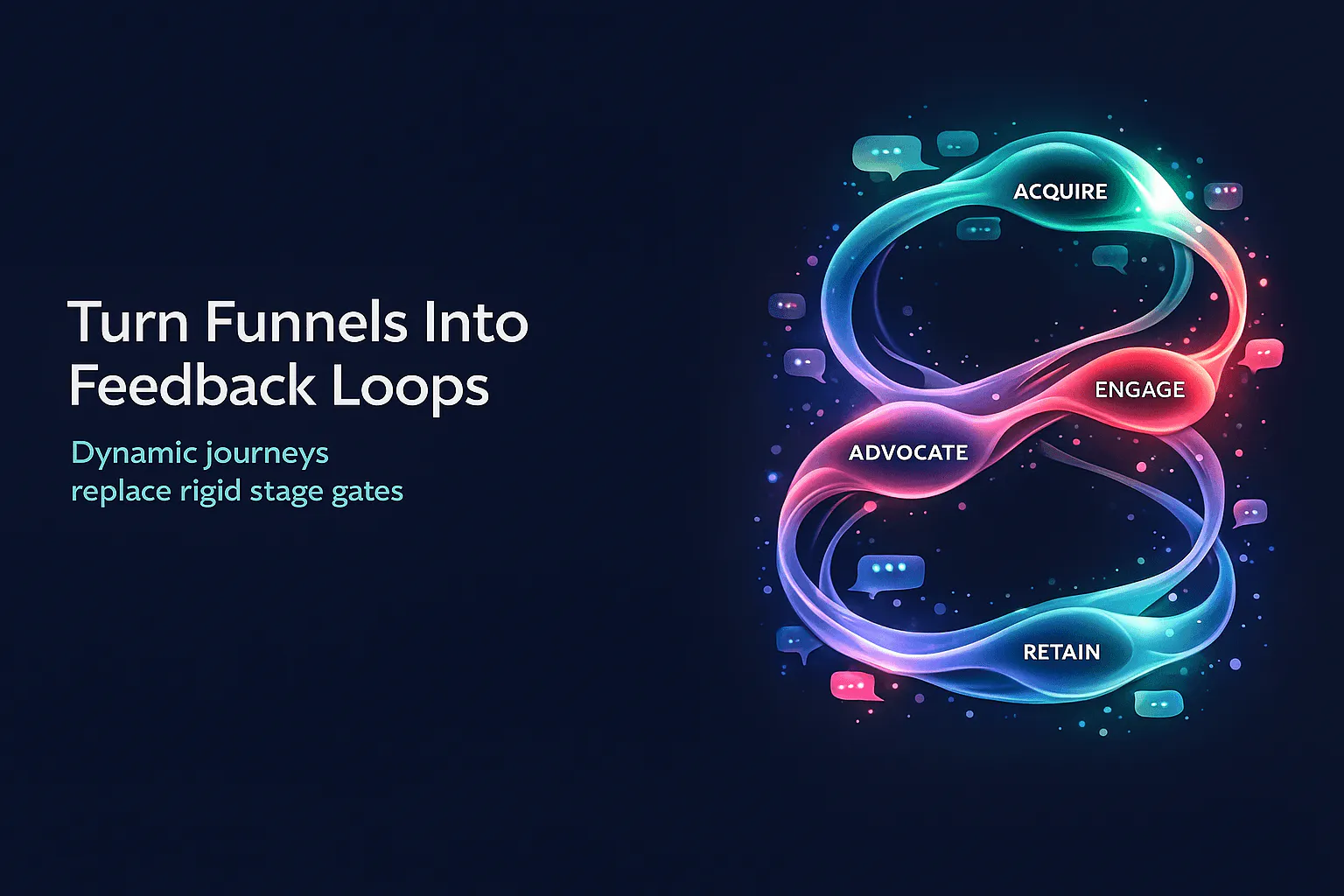
Here is the hard truth: customers do not live in linear funnels. They don't politely march from "Awareness" to "Consideration" just because your CRM says they should. In the real world, a prospect might click an ad, ghost you for three weeks, reappear on WhatsApp with a support question, and then decide to buy.
Is your customer lifecycle strategy built for that reality?
Most marketing teams are still operating on outdated maps. They treat the lifecycle as a relay race - handing the customer from Marketing to Sales to Support - hoping nobody drops the baton. But in the age of AI, hope is not a strategy. To win, you must understand the foundational stages and then dismantle the rigid silos that separate them.
We are going to break down the classic models, expose where they break, and show you how Agentic AI is rewriting the rules of the client lifecycle.
What Are the 4 Life Cycle Stages?
Before we can break the rules, we have to master the fundamentals. If you are asking, "what are the 4 life cycle stages?", you are looking for the framework that defines how a stranger becomes a loyal advocate. While the terminology shifts depending on who you ask, the core progression remains consistent.
Here is the blueprint:
1. Acquisition (Awareness & Consideration)
This is the "Hello, world!" moment. In our system, this is where a "canonical entity" (like a Person or Identity) is first created.
- The Goal: Turn an anonymous visitor into a known lead.
- The Old Way: Static forms, generic eBooks, and "spray and pray" ad campaigns.
- The Reality: Users are skeptical. They want answers, not sales pitches.
2. Engagement (Conversion & Onboarding)
This is the friction point. It is where intent moves to action - specifically, the transition from interest to a demo_booked event or a purchase.
- The Goal: Drive the first value exchange.
- The Old Way: Drip emails that nag rather than nurture.
- The Reality: Speed matters. If you don't respond in minutes, the engagement dies.
3. Retention (Loyalty & Support)
The sale is done, but the relationship has just started. This stage is about lifting repeat purchases and reducing time to resolution.
- The Goal: Keep them happy, keep them paying.
- The Old Way: Generic newsletters and reactive support tickets.
- The Reality: Retention is about anticipation. You need to solve problems before the customer even complains.
4. Advocacy (Growth & Referral)
The holy grail. This is where sentiment translates into growth.
- The Goal: Turn customers into your best sales channel.
- The Old Way: Sending an automated NPS survey once a year.
- The Reality: Advocacy happens in micro-moments of delight, not in quarterly reviews.
Takeaway: These marketing lifecycle stages provide the map, but they don't tell you how to drive the car.
See how agents handle this.

The Flaw in the Funnel: Why Linear Models Fail
The model above looks neat, doesn't it?
That is exactly the problem.
Traditional customer lifecycle stages assume a straight line. But modern journeys are messy loops. A "Retained" customer might suddenly jump back to "Consideration" if they see a competitor’s offer. A "Lead" might skip "Engagement" entirely and jump straight to a support question on Twitter.
When you rely on linear models, you create data silos.
- Your Marketing tool knows the user opened an email.
- Your Support tool knows the user is angry about a bug.
- But they don't talk to each other.
So, while your support team is trying to put out a fire, your marketing automation blindly sends a "Buy Now!" email. The result? You look tone-deaf. The customer churns.
Without a unified "Conversation Graph" - a shared memory that links identities, threads, and intents across all channels - you are flying blind. You aren't managing a relationship; you're just managing tickets and clicks.
"Lifecycle stages must be viewed dynamically, not linearly."
Fix your funnel leaks now.
From Static Stages to Dynamic Orchestration
This is where the game changes. To survive, we must shift from management to orchestration.
Customer lifecycle management is about recording what happened. Agentic Orchestration is about making things happen.
At Zigment, we move beyond rigid, rule-based automation (if this, then that) to dynamic, intent-based workflows. This is the realm of the AI Agent. An agent doesn't just follow a script; it follows a Planner Loop:
- Perceive: It reads the incoming message (SMS, Email, WhatsApp) and understands the context.
- Propose: It looks at the available tools (calendar, CRM, support).
- Score: It calculates the best move based on policy and history.
- Decide & Act: It executes the Next Best Action autonomously.
This allows you to treat the lifecycle not as a series of gates, but as a fluid conversation. The agent maintains "long-term memory" of the customer's preferences and history, ensuring that every interaction feels personal, regardless of the stage they are currently in.
Upgrade to agentic workflows.
Optimizing Each Stage with Intelligent Agents
Let's get practical. How does an agent actually improve these customer lifecycle stages? It’s not magic; it’s engineering. By deploying specific "Plays" - pre-configured workflows designed for specific outcomes - we can automate complex decisions.
Here is what that looks like in the wild:
1. Smarter Acquisition: The "Lead to Demo" Play
Forget the static "Contact Us" form.
- The Scenario: A prospect lands on your site and asks, "Can I see pricing?"
- The Agentic Difference: Instead of forcing them to fill out a form and wait 24 hours, the agent engages immediately via Web Chat or WhatsApp.
- It uses NLU (Natural Language Understanding) to qualify the lead.
- It checks the sales team's availability using the calendar.find_slot tool.
- It books the meeting instantly.
- The Result: You capture the lead at the moment of highest intent.
2. Seamless Engagement: Omnichannel Continuity
Customers get distracted. They start a chat on your website, get a phone call, and walk away.
- The Scenario: A user drops off halfway through onboarding.
- The Agentic Difference: The agent recognizes the drop-off. Respecting "Consent" policies, it switches channels, sending a helpful nudge via SMS: "Hey, looks like you got stuck on step 3. Want me to finish the setup for you?"
- The Result: Continuity. The conversation moves with the user, not the device.
3. Proactive Retention: The "Renewal Rescue" Play
This is the ultimate safety net.
- The Scenario: A long-time customer chats in, asking about cancellation policies.
- The Agentic Difference: The system detects a sentiment: negative or intent: cancel signal in real-time. It doesn't just log a ticket. It triggers a "Save" workflow. The agent can autonomously check the customer's lifetime value and offer a tailored incentive, like a discount or a free trial extension, to resolve the issue right there.
- The Result: Churn prevented before a human manager even wakes up.
Automate your next best action.

Future-Proofing Your Lifecycle Strategy
The tools you use today will define your success tomorrow.
If your strategy relies on disconnected apps and manual CSV exports, you will lose to competitors who are running on autopilot. The future of the customer lifecycle belongs to those who build a "Marketing Memory Bank."
You need a system that creates a Single Customer View - an append-only event log that tracks every ConversationEvent across every channel. This isn't just about data storage; it's about context.
When you have this data, you stop optimizing for vanity metrics like "email open rates" and start optimizing for business outcomes:
- Qualified Lead Rate
- Demo Booked Rate
- Retention Save Percent
This is the shift from being a reactive marketer to a proactive orchestrator.
Build your memory bank.
Conclusion
The customer lifecycle isn't a checklist; it's a relationship.
The 4 stages - Acquisition, Engagement, Retention, Advocacy - are useful signposts, but they shouldn't be walls. Your customers expect you to know them, remember them, and help them, regardless of where they fall in your funnel.
By adopting Agentic Orchestration, you do more than just manage these stages; you master them. You move from static forms to dynamic conversations, and from linear funnels to adaptive loops.
Are you ready to stop managing your lifecycle and start orchestrating it?