
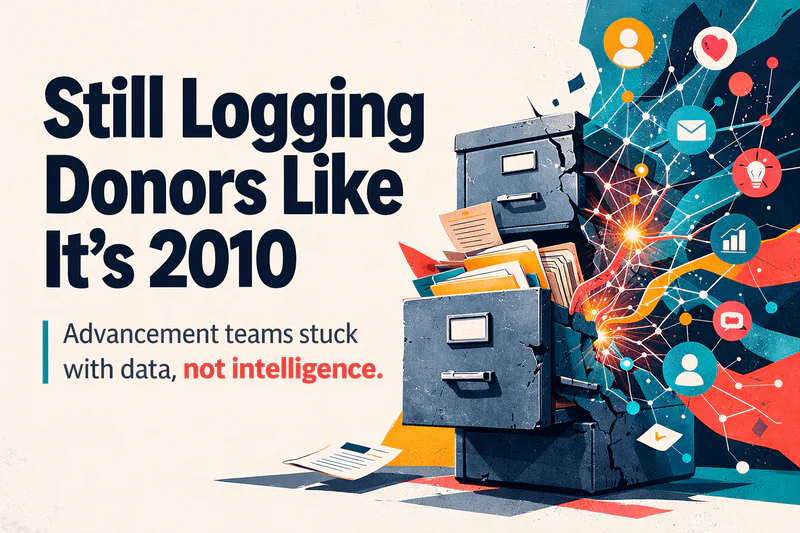
Let's be honest: most fundraising teams are running a 2010 operation in a 2026 world. Your CRM is full of gift histories and contact records, but ask it what a donor was feeling when they gave last year or what cause made them pause on your last email and it will stare back at you blankly.
That gap, between data you have and intelligence you actually need, is costing organizations millions in missed major gifts and avoidable donor churn.
The good news? That gap is about to close. And the teams that prepare now will not just survive the next wave of technology. They will use it to fundraise in ways that feel less like asking and more like genuine relationship building at scale.
The Advancement Cliff and the Force Multiplier You Need
Head into 2026 and the pressures are stacking up fast. Budgets are tighter, donor fatigue is real, and experienced gift officers are spending way too much of their time on the wrong tasks, qualifying low intent prospects, manually updating CRM records, and chasing people who were never going to give this quarter anyway.
This is what we call the Advancement Cliff: the point where the old way of doing things, more staff, more manual outreach, more hours, simply cannot scale anymore. The organizations that will thrive are not the ones that hire faster. They are the ones that deploy smarter tools.
Enter agentic fundraising orchestration. Think of it as a layer of intelligence that sits above your CRM and actually does things, not just reports on them. It qualifies leads, responds to donor queries in real time, flags when a prospect is showing signs of increased giving capacity, and hands off to a human gift officer at exactly the right moment. It is not a chatbot. It is closer to having an exceptionally well briefed colleague who never sleeps and never forgets a conversation.
Moving from a static donor logbook to a VIP concierge, one who understands mood, ambition, and the right moment to ask.
Building the Donor Memory Bank
Here is a thought experiment: imagine your best major gifts officer has a perfect memory. Every conversation they have ever had with a donor, the offhand comment about loving environmental causes, the moment of hesitation when asked about a capital campaign, the email where someone mentioned they had just sold their business, all of it instantly accessible and automatically connected to every future interaction.
That is essentially what a Donor Memory Bank does. Unlike a traditional CRM, which is a record of past transactions, the Donor Memory Bank is a living, continuously updated profile that blends giving history with qualitative donor signals, things like passion areas, communication preferences, emotional cues, and stated intent.
Donor data management has always focused on the what (what they gave, when, to which fund). The shift happening now is toward capturing the why and the when next. When you know that a donor just attended a campus event and mentioned their grandchildren in follow up correspondence, that is a signal. When you can capture it automatically and act on it intelligently, that becomes a competitive advantage.
The End of Manual Data Entry (Yes, Really)
If there is one thing that eats gift officer time and degrades data quality simultaneously, it is manual CRM updates. Notes get skipped. Calls go unlogged. Nuance gets lost in dropdown fields that were never designed to capture human emotion.
Conversational AI for fundraising is changing this entirely. When a donor has a chat exchange on your website, or sends an email about their interest in a scholarship fund, or calls your advancement office, that entire interaction can now be automatically parsed, summarized, and stored as query ready intelligence. No manual entry required.
By 2026, the end of manual data entry is not a prediction. It is already happening at forward thinking institutions. The question is not whether AI will extract and structure donor intelligence from unstructured conversations. The question is whether your organization will be set up to use it.
Think about what this unlocks: every touchpoint becomes data. Every email thread, every chat session, every event check in adds another layer to the Donor Memory Bank. Information silos between your events team, major gifts staff, and annual fund managers start to dissolve because everything is flowing into one unified, intelligent record.
Predictive Analytics: Spotting the Intent to Give
Not every donor interaction signals readiness to transact. Some people are in research mode, gathering information, exploring options, building trust. Others are one well timed conversation away from a significant commitment. The problem is that without predictive analytics, most teams treat both groups exactly the same way.
Predictive donor analytics changes that equation. By analyzing behavioral patterns, response rates, content engagement, the types of questions a donor is asking, and how their language shifts over time, AI can identify when someone has moved from curious to ready. That is the signal your major gift officer needs to step in.
This is the concept of Next Best Action for high gift prospects. Instead of your gift officers cold calling their entire portfolio every quarter, the system surfaces the three people who are showing the strongest signals right now. It tells you: this donor opened your impact report three times this week, asked two specific questions about your naming opportunities, and mentioned a significant life event in their last email. This is the moment.
That is not just efficiency. That is the kind of intelligence that turns a $50,000 donor into a $500,000 donor.
Scaling Empathy Across Every Channel
Here is a scenario that happens more often than it should: a donor has a meaningful conversation with your AI powered assistant on your website on Monday, then calls your office on Thursday, and the person they speak to has no idea any of that happened. The donor has to re explain themselves. The context is lost. The relationship takes a small but real hit.
Maintaining identity continuity across donor touchpoints is one of the biggest unsexy challenges in advancement and one of the most impactful to solve. Whether a donor reaches you via WhatsApp, email, web chat, or a phone call, the context needs to follow them seamlessly. Their history, their preferences, their last conversation, all of it should be present for whoever or whatever is handling the next interaction.
This is what omni channel donor experience actually means in practice. Not just being present on multiple platforms, but having a coherent, continuous relationship across all of them. Donors do not think in channels. They think in relationships. Your technology should reflect that.
Zigment: The Agentic Brain for Advancement Teams
This is where Zigment comes in. Rather than replacing your CRM, whether that is HubSpot, Salesforce, or a sector specific platform, Zigment adds a stateful intelligence layer above it. It is the connective tissue between the conversations happening across your channels and the actions that need to follow.
The core of how it works is the Conversation Graph™. A dynamic map of every interaction, signal, and intent marker that a donor has expressed across touchpoints. This is not just a transcript. It is structured intelligence that Zigment uses to trigger revenue focused autonomous actions, automatically sending the right follow up, surfacing a prospect to a gift officer at the right moment, or routing a complex query to a human with full context already loaded.
Responses happen in under five seconds. Escalations to human staff come with complete context, so your gift officers step in informed, not cold. And the human in the loop model means your team stays in control. The AI handles the 80 percent of interactions that are routine and qualifying, freeing your best people for the 20 percent that require genuine relationship expertise.
The result is not just efficiency. It is a fundamentally different kind of advancement operation. One where technology handles the volume and humans handle the depth, and where every interaction makes the next one smarter.
The 2026 tech landscape is not coming. It is already here. The organizations building their Donor Memory Bank and deploying agentic orchestration today are the ones that will be closing major gifts at scale tomorrow. The question is whether your team will be one of them.
Curious how Zigment fits your advancement operation? Let’s talk.