
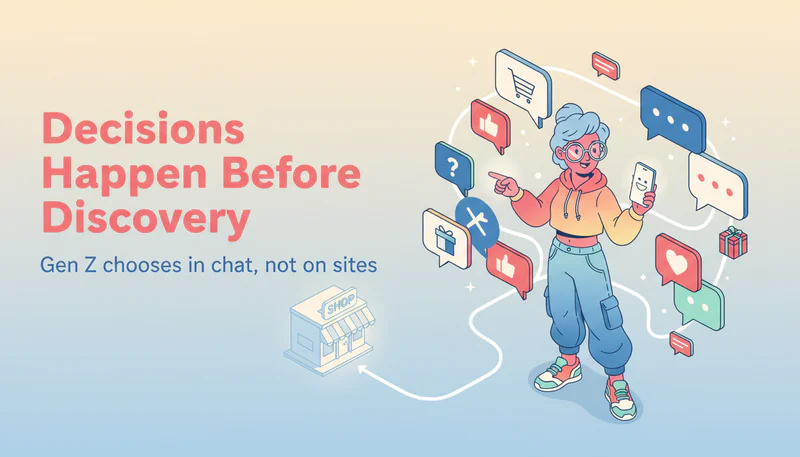
Gen Z doesn’t scroll and search like previous generations. They chat first, ask questions, compare options, and build confidence before even visiting a website. The moment a brand thinks a potential customer has “discovered” them, the real decision-making is already happening elsewhere.
Brands that ignore this pre-shopping conversation are invisible when it matters most. But there’s a huge opportunity here. By understanding how Gen Z uses chat to pre-shop, we can capture intent early, guide decisions intelligently, and build trust before a single click or cart action occurs. The right approach combines conversational AI, agentic AI, and a holistic view of the customer.
How Gen Z Uses Chat to Pre-Shop Before They Ever Visit a Brand
Gen Z doesn’t treat chat as a side channel. For them, it’s the starting point of exploration, the place where curiosity meets decision-making. Before visiting a brand website or browsing a marketplace, they’re already asking questions, comparing options, and weighing pros and cons in real time.
Here’s what this looks like in practice:
Exploration without commitment
They ask questions to test ideas. “Which of these products fits my style?” or “Would this work for my needs?” These conversations aren’t about immediate purchases, they’re about narrowing choices.Peer-style validation
Gen Z wants reassurance. They check opinions, seek advice. They trust this interactive, conversational space over static product pages.Context-rich comparison
Chat lets them compare features, prices, and experiences in a conversational way. They don’t just gather data, they interpret it in context.
The result is that by the time a Gen Z buyer reaches your website, a lot of the decision-making is already done. They aren’t just browsing, they’ve already mentally pre-shopped.
This is why brands can’t afford to ignore chat. Being present in these early conversations isn’t optional. It’s where intent is formed, questions are answered, and trust starts to build.

Pre-Shopping Is a Conversation, Not a Funnel
Traditional marketing funnels assume a linear journey: awareness, consideration, decision. Gen Z doesn’t follow that path. Their pre-shopping process is fluid, iterative, and conversation-driven.
Every chat interaction shapes intent. Each question, recommendation, or objection moves them closer to a decision even before they visit a brand site. Think of it as a living dialogue rather than a checklist of steps.
Here’s how to understand it:
Intent emerges across interactions
A single question in chat can spark a series of internal evaluations. Gen Z may start by asking about one product, then compare alternatives, and finally validate with peers, all before engaging with a brand directly.Decisions form before commitments
They test ideas, explore options, and mentally filter out products that won’t fit. By the time they “convert,” they’ve already built a shortlist.Brands need to listen, not just broadcast
Showing up in chat with context-aware guidance can influence choices at the exact moment intent is forming. Brands that wait until later stages are essentially invisible.
Understanding pre-shopping as a conversation shifts how we approach marketing, sales, and customer experience. It’s no longer about capturing clicks, it’s about participating in the dialogue where choices are made.
The Hidden Cost of Fragmented Conversations
Gen Z moves effortlessly across channels. One moment they’re messaging friends about a product, the next they’re browsing social feeds, then visiting a website, all while forming decisions in chat. For brands, this creates a fragmented view of intent.
Without a unified perspective, conversations are treated as isolated events. That’s where opportunities slip through the cracks. Brands see individual sessions, tickets, or leads but miss the bigger picture: a single, continuous journey that shapes purchase decisions.
Here’s what fragmentation costs brands:
Lost context
Each interaction starts from scratch. Questions get repeated. Preferences aren’t remembered. Friction builds, and trust erodes.Missed intent signals
Early-stage curiosity isn’t captured. Brands fail to see which products or features excite a potential customer, losing the chance to influence choices.Disjointed experiences
Marketing, sales, and support teams operate in silos. Gen Z expects conversations to flow seamlessly, not restart every time they switch channels.
This is why a Single Customer View is crucial. By connecting interactions across chat, social, email, and web, brands gain a complete picture of intent. They can anticipate needs, personalize guidance, and intervene at the right moment, turning fragmented signals into actionable insights.
Why Conversational AI Is the New Front Door for Brands
For Gen Z, chat isn’t just a channel, it’s the first step in how they explore products and make decisions. If your brand isn’t there, it’s invisible at the most critical moment. That’s where conversational AI comes in.
Unlike traditional chatbots that react to messages, modern conversational AI understands intent, remembers context, and engages dynamically. It transforms passive interactions into guided conversations that help potential customers navigate choices with confidence.
Key benefits include:
Understanding intent in real time
Conversational AI can detect what a user is looking for even if they aren’t asking directly. It interprets questions like “I need something versatile for work and travel” and provides tailored guidance.Retaining context across interactions
Every conversation builds on the previous one. Users don’t need to repeat themselves. Preferences, questions, and objections carry over naturally.Adapting responses dynamically
It can offer suggestions, clarify doubts, and escalate complex queries to human agents seamlessly, creating a frictionless experience that aligns with how Gen Z thinks and decides.
By showing up in the pre-shopping conversation with conversational AI, brands can capture intent early, guide decisions intelligently, and become part of the dialogue rather than an afterthought.
Agentic AI Turns Conversations Into Outcomes
Conversational AI can guide, suggest, and answer but Agentic AI takes it a step further. It doesn’t just respond. It acts. It reasons across interactions, interprets signals, and takes steps that move the customer journey forward automatically.
For brands, this is where pre-shopping conversations become actionable. Gen Z isn’t just looking for answers they want guidance, clarity, and momentum in their decision-making. Agentic AI delivers all three.
Here’s what it enables:
Proactive engagement
Instead of waiting for the user to ask, Agentic AI can suggest next steps based on context, preferences, and past interactions.Cross-channel action
It can trigger personalized follow-ups, offer product comparisons, or even schedule demos across multiple touchpoints without human intervention.Decision-shaping guidance
It interprets signals from chat, social, and email to provide recommendations that feel natural and relevant. The user feels guided, not pushed.
By turning conversations into measurable outcomes, Agentic AI ensures your brand is present in the moments that matter, shaping intent early and capturing opportunities before competitors even realize they exist.
omnichannel Is Not Presence. It’s Continuity.
Most brands believe they are omnichannel because they show up everywhere. Website chat, email, social DMs, support tools. The boxes are checked.
Gen Z doesn’t see it that way. For them, omnichannel means one conversation that continues, no matter where it happens. When context is lost between channels, the experience feels broken. Fast.
Here’s what Gen Z expects instead:
One memory across channels
A question asked in chat should inform what happens on email. A preference shared on social should shape website interactions. Repetition signals disinterest.One evolving conversation
Conversations shouldn’t restart just because the channel changes. Pre-shopping decisions build over time, and every interaction should acknowledge what came before.One consistent experience
Tone, guidance, and recommendations should feel connected. Gen Z notices when advice changes depending on where they engage.
True omnichannel design preserves continuity. It allows brands to meet Gen Z where they are without forcing them to start over. And when continuity exists, trust follows naturally.
The Conversation Graph: Where Pre-Shopping Intelligence Lives
Every chat interaction leaves behind more than text. It carries intent, hesitation, preferences, and timing. Most brands store these as disconnected transcripts. That’s a mistake.
What Gen Z creates through pre-shopping is a network of conversations, not isolated messages. This is where the conversation graph comes in.
A conversation graph connects and structures conversational data across time and channels. It doesn’t just record what was said. It understands how decisions are forming.
Here’s what a conversation graph captures:
Intent signals
Early curiosity, comparison behavior, readiness cues. These signals appear long before a form fill or checkout.Preferences and constraints
Budget ranges, use cases, style choices, objections. These evolve across conversations and should shape future guidance.Decision paths
Which questions led to which outcomes. What reduced friction. What caused drop-off.
With this structure in place, brands can move from reactive responses to predictive guidance. Conversations become a source of intelligence that improves recommendations, timing, and relevance.
The real value? Pre-shopping is no longer invisible. It becomes measurable, understandable, and actionable.
From Capturing Demand to Shaping It
Most brands are built to capture demand once it shows up. A search query. A site visit. A demo request. By that point, Gen Z has already made several decisions quietly, often in chat.
That’s the shift we need to acknowledge. Pre-shopping conversations are where demand is shaped, not where it’s captured.
When brands participate early, a few things change:
Guidance replaces persuasion
Instead of convincing someone to buy, you help them decide. That feels supportive, not sales-driven.Intent becomes clearer earlier
Questions asked in chat reveal priorities and constraints. Brands can respond with relevance, not guesswork.Timing improves dramatically
Outreach happens when curiosity is active, not after interest fades.
This approach doesn’t rush Gen Z. It respects how they think. When brands show up with clarity and continuity during pre-shopping, trust builds naturally. And trust drives decisions.
What This Means for Modern revenue Teams
Pre-shopping conversations don’t belong to one team. They affect every part of the revenue engine.
Here’s how different teams benefit when conversational and agentic AI work together:
Marketing teams
You gain visibility into early intent, not just clicks. Messaging becomes more grounded in real customer questions.Sales teams
Conversations arrive with context. Preferences, objections, and timelines are already known. Selling feels less like discovery and more like alignment.Customer experience teams
Fewer repetitive questions. Smoother handoffs. Conversations feel continuous instead of transactional.RevOps teams
Conversations become a data asset. Intent is trackable. Decisions are measurable. Attribution starts earlier and becomes more meaningful.
When conversations are connected, revenue teams stop reacting late and start influencing early.
If You’re Not in the Pre-Shopping Conversation, You’re Not in the Decision
Gen Z isn’t waiting to be marketed to. They’re already deciding in chat. Quietly. Thoughtfully. Across conversations that most brands never see.
The opportunity isn’t more messages or louder campaigns. It’s better presence. Presence powered by conversational AI that understands intent, agentic AI that takes action, a single customer view that preserves context, omnichannel continuity that builds trust, and a conversation graph that turns dialogue into intelligence.
This is exactly the gap platforms like Zigment are built to solve. By connecting conversations across channels, retaining context, and enabling AI to reason and act on real customer intent, Zigment helps brands participate in the pre-shopping moment instead of discovering it too late.
When brands show up here, they stop chasing demand. They start shaping it. And that’s where sustainable growth begins.