
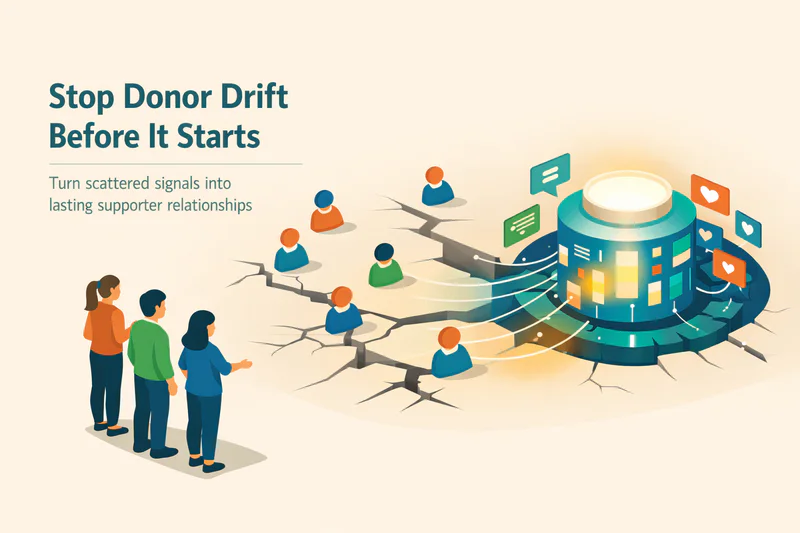
The average nonprofit loses more donors each year than it retains. More than half of first-time supporters never give again. That’s not a fundraising problem. It’s a retention blind spot.
If you’re focused on learning how to reduce donor churn, the solution isn’t louder campaigns or more reminders. It’s memory, timing, and relevance. Donors leave when they feel unseen, overwhelmed, or disconnected from impact.
We’ve seen retention improve dramatically when nonprofits unify their data, listen closely to conversations, and respond in real time. The shift is subtle but powerful. Instead of chasing lost revenue, you prevent it from slipping away.
Here’s a practical listicle you can use to strengthen donor relationships and protect recurring support.
How to Reduce Donor Churn with a Unified Donor Memory Bank
When donor data is scattered across tools, your team lacks context. One system knows billing history. Another tracks email clicks. A separate inbox holds conversation threads. No one sees the full picture.
Create a Single Customer View that unifies:
Donation history and recurring status
Engagement behavior across campaigns
Volunteer participation
Conversation transcripts and sentiment
This becomes your Donor Memory Bank.
Imagine a long-time supporter reaching out to update their payment method. With a unified profile, you instantly see their giving history, preferred causes, and recent questions about impact. The interaction becomes thoughtful and personal.
How to Reduce Donor Churn by Detecting Early Warning Signals
Churn rarely comes without warning. It shows up in language before it appears in reports.
Donors express:
Frustration about donation frequency
Confusion about billing
Financial stress
Intent to pause support
AI-powered conversation analysis can surface these signals in real time across email, chat, SMS, and social channels.
When someone writes, “I may need to stop my monthly donation,” that’s not casual feedback. It’s a retention moment.
Instead of waiting for a cancellation notice, you can respond immediately with options:
Offer to lower the monthly amount
Suggest a temporary pause
Share a meaningful impact update tied to their cause

How to Reduce Donor Churn with Real-Time Next Best Actions
Insight without action doesn’t change outcomes.
Many nonprofits rely on static workflows triggered by time. Monthly reminders. Quarterly newsletters. Manual churn reports. The response comes long after the donor’s frustration began.
Shift to intent-based journey orchestration.
When a risk signal appears, your system should automatically trigger the most relevant next step, such as:
Sending a personalized impact story
Offering flexible giving options
Routing the donor to a relationship manager with full conversation history
Initiating a smart payment retry process
The speed of response matters. Acting immediately shows attentiveness and care.
How to Reduce Donor Churn Through Identity Continuity Across Channels
Donors move fluidly between channels. They click emails, reply via SMS, browse your website, and use chat support. They expect continuity.
If they must repeat their story each time, trust erodes.
Maintain identity continuity by ensuring:
One unified donor profile across every touchpoint
Conversation history accessible to support teams
AI agents capable of flexible, natural interactions
When someone updates their payment details in chat after receiving an email reminder, the system should recognize them instantly. No repetition. No friction.
Simple requests such as pausing a membership or changing fund allocation should be resolved smoothly, without escalating frustration.
How to Reduce Donor Churn by Managing Frequency and Fatigue
Burnout drives quiet exits.
When donors receive multiple messages in a short span across different channels, goodwill declines. Even loyal supporters can feel overwhelmed.
Instead of relying on a rigid campaign calendar, introduce intelligent frequency management.
Apply:
Suppression rules for low-engagement donors
Recency logic to prevent overlapping messages
Priority rules based on donor intent and engagement level
For highly engaged donors, maintain consistent storytelling and updates. For those showing lower engagement, reduce volume and focus on value-driven content.
Respecting attention strengthens long-term relationships.
How to Reduce Donor Churn by Measuring What Matters
Retention improves when you track the right signals.
Monitor:
Overall donor retention rate
Recurring donor cancellation trends
Lifetime value growth
Time between risk detection and intervention
Save rates after proactive outreach
These metrics reveal whether your strategy is reactive or proactive.
Turning Retention into a System
Reducing churn requires more than good intentions. It requires coordination.
When you unify donor data into a Single Customer View, detect qualitative churn signals early, orchestrate instant next best actions, maintain identity continuity across channels, and manage communication frequency thoughtfully, retention becomes intentional.
This is where Zigment plays a critical role.
Zigment connects disparate systems into one unified orchestration layer. It builds and activates the Single Customer View, analyzes conversational signals in real time, and triggers the most relevant next action across channels. It also ensures identity continuity and applies intelligent fatigue management logic.
Donor churn doesn’t happen suddenly. It builds through small moments of friction.
When you remove that friction and respond with relevance and care, donors stay.