
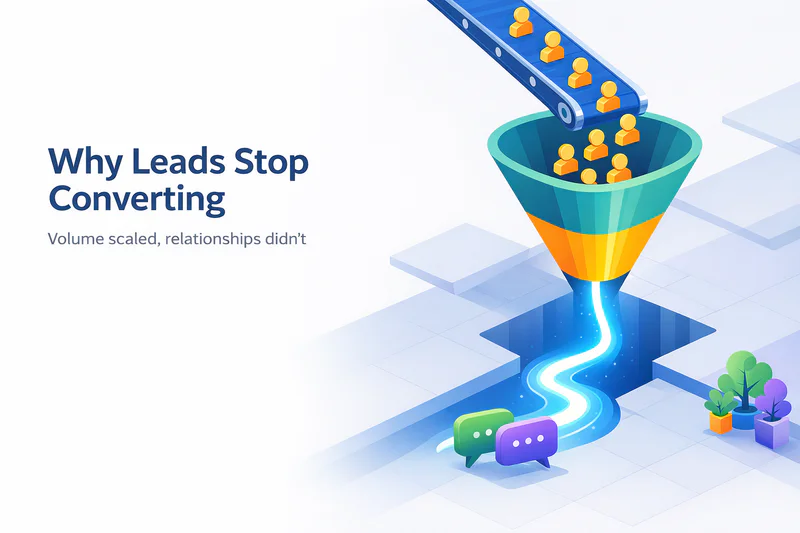
We’ve been taught that the path to revenue is a math problem: more traffic equals more leads.
Today’s buyer doesn't follow a linear path from Email A to Form B!
They jump from LinkedIn to WhatsApp, then to a chatbot, then back to an email all while expecting you to remember exactly what they said five minutes ago.
For mid-market and enterprise teams, there is a point where volume becomes the enemy. When you generate 1,000 MQLs but only 19 close, you haven't built a growth engine you’ve built a $120,000 noise machine.
Your "lead gen" isn't fueling sales; it’s burying them in data without context.
Why HubSpot Lead Generation Saturates (And What Breaks First)
Here's the uncomfortable truth: lead generation hits a ceiling. Fast.
You built the standard stack: landing pages, forms, lead scoring, automated workflows, SDR routing. Three years ago, it worked beautifully. Today, it creates three compounding problems no optimization can fix.
Volume Without Context
Your HubSpot lead generation tools capture everything downloads, page views, email clicks. But behavioural data alone doesn’t explain why someone engages.
A contact downloads three whitepapers in a week. Lead score hits 87. SDR calls. They’re a grad student writing a thesis. Twenty minutes wasted. Trust in marketing drops. The issue isn’t data it’s tracking activity, not intent.
Channel Fragmentation
Buyers interact across LinkedIn, chat, email, SMS, forms, and cold calls. Each touchpoint lives in a separate system.
Context gets lost. Buyers get asked the same questions multiple times, receive contradictory messaging, and choose the vendor who understands them, not the one who spammed them.
Rules Break at Scale
Workflows like “If lead score >50 AND job title = VP, send Email 3B” are simple until you have 127 active workflows. Conflicting logic triggers loops. Journey orchestration collapses into chaos.
The revenue impact is real: one mid-market SaaS company ran 11,000 MQLs over 18 months. Only 340 spoke with sales. Nineteen closed. 0.17% MQL-to-customer rate. Leadership blamed “lead quality.”
The real culprit? Capture-focused systems, not continuity.
What Relationship Generation Actually Means
Relationship generation flips the model. Instead of optimizing for lead volume, you optimize for relationship depth and continuity.
Lead gen asks: "How many people entered our funnel this month?"
Relationship gen asks: "How many meaningful conversations are we advancing right now?"
A relationship isn't a form fill. It's a series of connected interactions where both sides learn. The buyer learns if you can solve their problem. You learn where they are and what matters most.
It means persistent context. When a prospect asks about pricing on chat Tuesday, then emails about implementation on Friday, you don't start from zero. You remember Tuesday. You connect the dots. You pick up where the conversation left off regardless of channel.
Think about your own buying experience. You hate repeating yourself. So do your prospects.
It means goal-driven orchestration. Old approach: "If form fill, then send email 1, wait 3 days, send email 2." New approach: "Goal is book demo. This prospect mentioned compliance concerns on WhatsApp and opened the security doc. Next best action: SMS from our compliance lead with a relevant case study."
The system thinks in outcomes, not triggers.
It means omnichannel continuity. A prospect's journey doesn't respect your org chart or tech stack. They'll ask a chatbot question, text your sales rep, and email support all about the same deal. Relationship Gen treats that as one conversation thread, not three separate tickets.
It means measuring what matters. Not MQL volume. Not form fills. But engagement depth. Context retention. Time to meaningful conversation. Pipeline velocity from relationship, not cold outreach.
Gartner predicts 72% of B2B teams will pivot to relationship-based orchestration in 2026. The early movers are already seeing results.
Priya piloted this approach. "Demo bookings jumped 48%. Cycles dropped from 85 days to 52. Sales actually said, 'Finally, warm leads!' And we didn't touch HubSpot's core setup."
The Three Signals That Actually Predict Momentum
Most HubSpot marketing teams track the wrong signals: opens, clicks, page views. These activity metrics tell you what happened, not whether it mattered. To track relationship health, you need different signals.
Signal 1: Sentiment
Is the engagement tone positive, neutral, or frustrated?
A reply like “Not right now, but keep me posted” differs from “This is exactly what we need, can we talk Thursday?” Yet most HubSpot email marketing systems treat both the same.
Sentiment shows up in:
Language in form submissions (“desperately need a solution” vs. “just browsing”)
Tone in chat or email replies
Clarifying questions vs. vague deflections
Response speed and emoji use
Detecting this requires natural language understanding, not just tracking engagement.
Signal 2: Recency
How fresh is the last meaningful interaction?
A lead active six months ago is not the same as one who visited pricing yesterday, clicked three features, and requested a demo. Most HubSpot marketing automation workflows weight historical behavior equally. Decay scoring and prioritizing recent engagement is far more predictive.
Signal 3: Reciprocity
Is the buyer investing effort back?
Reciprocity predicts deal quality. It shows up when a buyer:
Completes a detailed needs assessment
Invites colleagues to calls
Shares internal context (“VP wants this by Q1”)
Responds thoughtfully instead of one-word replies
A contact who ghosts early will likely ghost later; one who engages signals real intent.
Curious how to turn these signals into actual revenue plays?
Orchestration on Top of HubSpot, Not a Replacement
You don't need to rip out HubSpot.
Your stack already works workflows, forms, landing pages, email templates. Keep them. What's missing isn't infrastructure. It's context.
That's where Zigment fits for teams like yours mid-market to enterprise B2B running HubSpot with 10+ sellers or CSMs, juggling email, WhatsApp, SMS, and chat, with a RevOps leader who owns pipeline speed and journey continuity.
Zigment layers on top of HubSpot and adds three critical capabilities:
Persistent memory via a Conversation Graph. Every interaction email, chat, SMS, WhatsApp, phone call gets stored in a unified graph that tracks the full relationship, not just individual touchpoints.
When your AE picks up a conversation, they see what was discussed two weeks ago on chat, what objection came up during the demo, and what the buyer asked yesterday. One conversation. Full context. No repetition.
Goal-driven planning with Next Best Action logic. Instead of static workflows, Zigment uses agentic reasoning to decide what should happen next based on current conversation state, buyer sentiment and recency, deal stage, and channel preference.
If a buyer asks about pricing on LinkedIn, you don't send them a top-of-funnel ebook email. You respond based on where they are, not where your workflow thinks they should be.
Omnichannel continuity with enterprise governance. Zigment orchestrates across email, web, app, SMS, and WhatsApp while maintaining compliance and audit trails, human-in-the-loop controls for sensitive moments, and policy enforcement.
You get the speed of automation with the safety of human oversight.
That's relationship generation. Not more leads. Better relationships!
Measured by signals that matter, grown through plays that advance real conversations.