
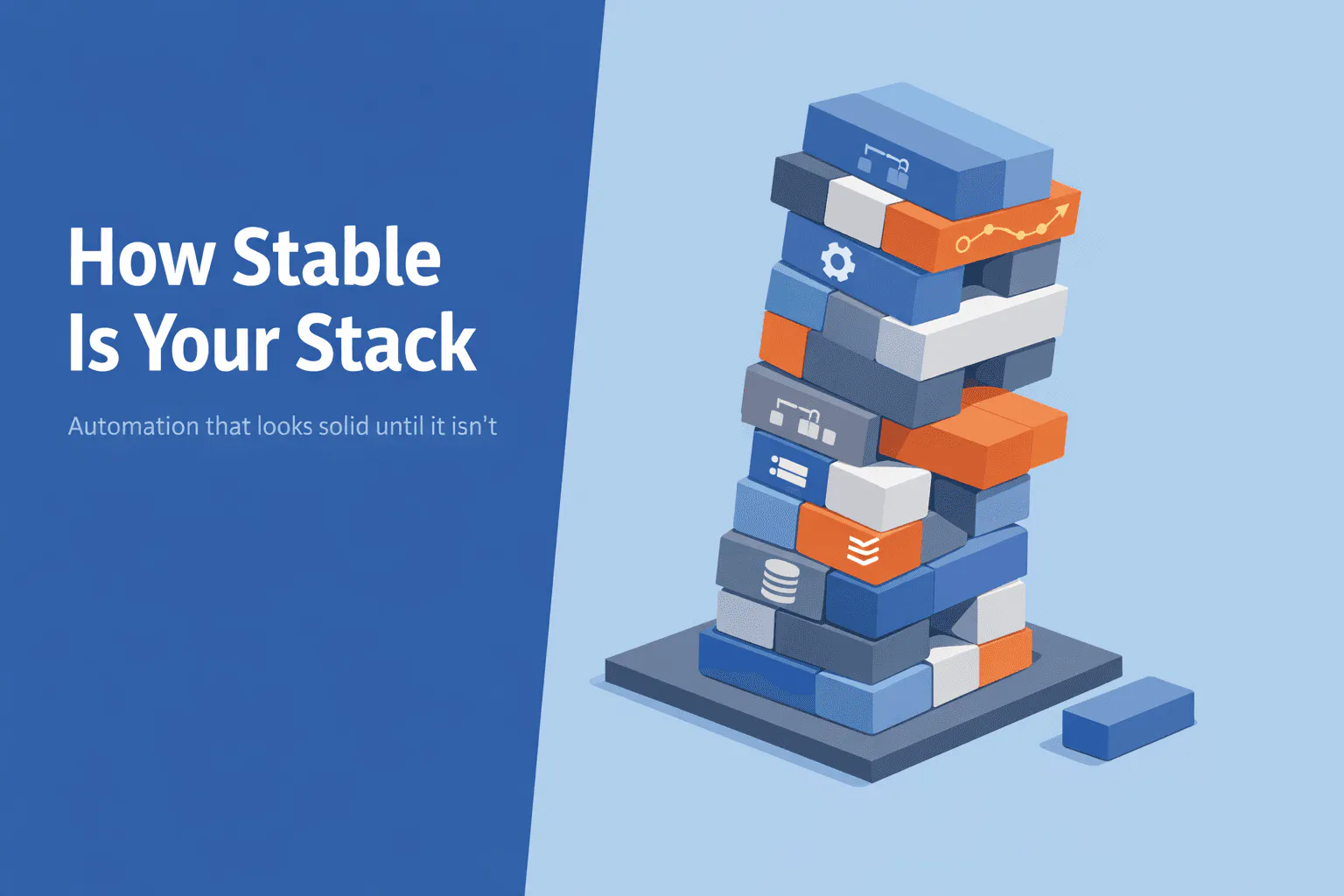
Automation should compound momentum, not hold it together with duct tape.
If your HubSpot workflows feel like they’re glued together with duct tape and hope, you’re not imagining it. Welcome to the HubSpot + Zapier Jenga Stack, a system that looks solid until a single misfired Zap sends everything tumbling. Every lead, follow-up, and customer interaction depends on dozens of moving pieces. One delayed notification. One misconfigured workflow. Boom! Momentum lost, revenue at risk.
We’ve seen teams spend hours untangling Zaps just to fix the same broken pattern, wondering why automation meant to save time is instead slowing them down. In this article, we’ll break down where these setups fail, why these failures cost more than you think, and how to move toward a safer, decision-driven, cross-channel automation strategy.
What the “Jenga Stack” Actually Looks Like in HubSpot Programs
Picture this: a new lead fills out your HubSpot form. Instantly, a Zap fires, sending a Slack notification to sales. Another Zap triggers an SMS or WhatsApp alert. Meanwhile, HubSpot workflows are updating deal stages, firing nurture emails, and tagging contacts based on interactions.
Each Zap feels small, harmless, even convenient. Individually, they work fine. But together? They form a brittle, wobbly tower, the Jenga Stack.
Teams lean on Zapier because it’s fast and flexible. Need to connect HubSpot to a niche tool? Zap. Want to auto-notify a manager? Zap. But as the number of Zaps grows, the logic spreads across multiple places: workflows, Slack alerts, SMS automations, even manual processes. One change in a workflow can ripple across five different Zaps.
The reality is this: Zapier + HubSpot integrations are event-driven, not decision-aware. They react, but they don’t reason. And when you rely on them to coordinate multiple channels, you’re stacking fragility on top of fragility, waiting for the next piece to fall.
The Hidden Costs: Latency, Drift, and Silent Revenue Loss
The most dangerous automation failures are the ones you never see.
Your HubSpot + Zapier Jenga Stack might look tidy on the surface, but the costs are hiding in plain sight. Let’s break them down.
1. Latency: Each Zap adds a delay. Some poll every 5 minutes, some trigger instantly, but in practice, multi-step Zaps can stretch from seconds into minutes. In sales, minutes matter. A slow first response can mean a missed opportunity before your competitor even emails.
2. Logic Drift: Rules spread across HubSpot workflows, Zapier automations, and even manual processes. One minor change, a field update, a new deal stage, can break multiple Zaps. Teams end up firefighting, duplicating fixes, and still wondering why leads fall through the cracks.
3. Silent Failures: Zaps hit task limits. Webhooks change. Notifications fail quietly. No one knows until a deal is lost, a follow-up is missed, or a nurture sequence stops mid-flow.
These “invisible” failures are measurable. Slower lead follow-ups mean fewer booked demos. Inconsistent communication reduces conversions. And poor orchestration? That’s churn waiting to happen.
Hidden costs aren’t just tech headaches, it is revenue leaking your pipeline, unnoticed until it’s too late.
When Zapier Is the Right Tool and When It’s a Smell
Zapier is fantastic… when used for the right reasons. Lightweight tasks, one-off notifications, or connecting niche tools that don’t merit a full integration? Perfect. Quick wins that keep teams moving.
But there’s a tipping point. Zapier becomes a smell when it’s making decisions for you. Who should be contacted? When should a follow-up happen? Which channel should carry the message? Once Zaps start handling these choices, the Jenga Stack starts wobbling.
Signs your stack is overextended:
A Zap named “Don’t touch this” because everyone’s afraid to break it
Sales asking, “Why did this lead get that message?”
Multi-channel campaigns behaving inconsistently
The truth: even the best HubSpot integrations can’t solve coordination at scale if every channel relies on separate, stateless Zaps. Zapier should enhance workflows, not replace reasoning or memory.
Consolidating Logic into Decisions
Here’s the shift: rules don’t scale. Workflows based on static “if/then” logic work fine in a vacuum, but as soon as multiple channels, campaigns, and Zaps get involved, chaos creeps in. The answer isn’t more Zaps. It’s decision-centric orchestration.
Instead of asking, “Does this lead meet condition X?” we ask, “What is the best next action for this lead, right now, across every channel?” That’s the difference between reactive automation and strategic, goal-driven engagement.
Why it matters:
Leads are treated consistently, no matter the channel, email, SMS, WhatsApp, or in-app messaging.
Teams can respond to real-time signals instead of rigid workflows.
HubSpot stays the system of record, but logic isn’t scattered across dozens of Zaps.
Webhooks in HubSpot become conduits, not crutches. Events flow out, decisions flow back in. Your automation now remembers, coordinates, and adapts, rather than just reacting blindly.
This approach reduces errors, accelerates follow-ups, and keeps your leads moving smoothly through the funnel.
Reference Patterns for Common Zaps
Good orchestration replaces dozens of triggers with one clear intent.
Let’s replace brittle Zaps with decision-driven patterns. Here’s what that looks like in practice:
New lead comes in:
Old: Form → Zap → Slack alert → workflow
New: Lead event → decision engine → best next action across email, SMS, or WhatsApp
No response after X minutes:
Old: Time-delay Zap
New: SLA-aware decision triggers escalation or alternative channel outreach
Multi-touch nurturing:
Old: Linear HubSpot workflow
New: Goal-driven lead nurturing adapts based on prior engagement, preferences, and stage

These patterns reduce duplication, keep logic in one place, and ensure HubSpot marketing automation and lead nurturing campaigns act intelligently rather than mechanically.
The lesson: it’s not about eliminating Zaps entirely, it’s about strategic orchestration, so every automation decision is context-aware and cross-channel.
A Safer Architecture on Top of HubSpot (Without Ripping It Out)
You don’t have to abandon HubSpot to fix the Jenga Stack. The key is layering intelligence on top, not ripping everything out.
HubSpot remains your CRM, marketing automation backbone, and reporting hub. The new layer handles:
Stateful orchestration: remembering past interactions and lead context
Decision logic: determining the best next action across channels
Cross-channel coordination: ensuring email, SMS, WhatsApp, and web touchpoints are aligned
The result? Fewer Zaps. Cleaner workflows. Predictable automation at scale. Teams can focus on strategy and engagement instead of firefighting broken Zaps.
By consolidating logic into a single, decision-aware layer, your HubSpot ecosystem finally behaves like a unified platform, rather than a patchwork of event-driven triggers.
Where Zigment Fits, and the Outcomes Teams See
This is where Zigment comes in. Instead of juggling dozens of Zaps, Zigment adds a stateful, agentic layer on top of HubSpot, bringing memory, context, and decision-making to your automation.
Here’s how it works:
Persistent memory through a Conversation Graph, so every lead’s history is available for smarter decisions
Goal-driven planning and Next Best Action, replacing brittle if/then rules
Trueomnichannel continuityacross web, app, email, SMS, and WhatsApp
Enterprise governance with human-in-the-loop, keeping control and compliance intact
The outcomes are tangible: higher qualified leads and demo-booked rates, faster first responses, and better retention. Your HubSpot workflows stay clean, automation becomes predictable, and every interaction is coordinated across channels.
With Zigment, the Jenga Stack finally stabilizes. Automation stops being a liability and becomes a driver of consistent revenue and customer experience.