
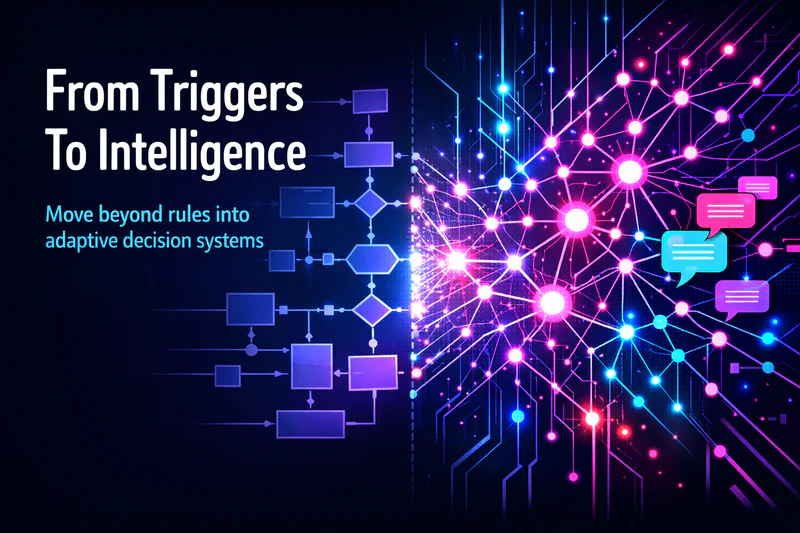
There's a dirty secret buried in most enterprise marketing stacks. The workflows aren't working the way anyone thinks they are.
Not because the tools are bad. Not because the ops team is incompetent. But because the architecture was designed for a world where customers moved in straight lines. Open email. Click link. Fill form. Buy product.
Customers stopped doing that a long time ago.
Here we are in 2026, and the data is blunt: 79% of leads never convert without proper nurturing. Nearly half that problem traces back to sequences that fire at the wrong moment with zero awareness of what happened in the conversation five minutes earlier. The automation ran. The lead went cold anyway.
That gap has a name. Call it the automation ceiling. Almost every marketing operations team is crashing into it.
The Automation Ceiling: From Task Firing to Marketing Workflow Management
Linear workflows are seductive because they're legible. You can draw them on a whiteboard. Marketing manager to CFO, ten minutes, everyone nods.
The problem isn't the flowchart. The problem is the assumption inside it that a customer's intent and urgency are static between first engagement and the moment your sequence fires.
They're not. They never were.
A prospect who fills out a demo form at 11 PM because their board just questioned their vendor choice is not the same intent-state as someone who skimmed your pricing page for 45 seconds on a Tuesday afternoon. Your CRM logs both as "Demo Request Status: New." Your sequence treats them identically. One needed a call within the hour. The other needed a case study. Both got a four-day email drip.
This is the intelligence gap. Not a data gap. Not a tool gap. A context persistence gap and it's the core failure of automated task firing at scale.
True marketing workflow management doesn't just execute steps. It coordinates intent. It remembers. It adapts mid-conversation.
Beyond Simple Flowcharts: The Process Workflow Problem
Most teams confuse two very different things.
A process workflow is a documented sequence of operational steps. It tells you what happens next. It's a recipe essential for compliance, consistency, and audit trails. The backbone of any serious marketing operation.
A living workflow is that recipe given a nervous system. It reads signals from real-time conversations. It adjusts the next step based on qualitative context not binary trigger conditions. It holds a running model of where this specific customer sits in their actual decision journey.
The difference comes down to one capability: real-time signal extraction.
A traditional trigger fires on behavior. A page visit. A form fill. A link click. A living workflow reads dialogue. This customer mentioned a deadline. This one signaled budget anxiety. This one named a competitor by name. These aren't events you can encode in a rules engine. They're context that has to be extracted, interpreted, and remembered or it evaporates.
Agentic AI changes the architecture entirely. Not the interface. The architecture.
LayerFive, Agentic AI in Marketing Automation, 2026
For sectors like BFSI, EdTech, Healthcare, and Luxury Retail where a misread signal doesn't cost a click-through rate, it costs a policy renewal or a three-year referral relationship this distinction is not theoretical. It's revenue-critical.
Components of Modern Marketing Workflows
The marketing automation market hit $8.08 billion in 2026 and is tracking toward $13.97 billion by 2030, per Polaris Market Research. The spending is real. But look at what it actually produces.
Only 10% of marketing teams have fully automated customer journeys. Another 25% are "mostly automated." The remaining 65% live in the patchwork middle automation firing in some places, humans firefighting in others, context evaporating at every handoff.
The ROI is real when marketing workflow tools are used well. Companies return an average $5.44 for every $1 spent a 544% ROI, per Flowlyn's 2025 analysis. But 42% of AI-powered marketing projects fail specifically because of bad data and broken workflows underneath.
Automation is graduating. We are no longer just automating tasks we are automating intelligence.
Flowlyn Marketing Automation Statistics Report, 2025
Modern marketing workflows need three components that most stacks still lack:
Event-driven triggers with qualitative context. Not just "form submitted" but what the prospect said in the form, what their tone indicated, what they've asked before.
Persistent memory across channels. WhatsApp, SMS, email, web chat the customer's second conversation must pick up where the first left off. Not from a blank slate.
SLA timers with intelligent escalation. When a high-intent lead goes quiet, the system shouldn't wait for a human to notice. It should flag, escalate, and route automatically.
Scaling Through Process and Workflow Management
While the front-of-house conversation runs, there's an enormous backstage operation most teams are running almost entirely on human effort.
Lead qualification. Prerequisite checks. Site visit booking. Multi-team handoffs. Approval routing. Compliance gating.
These are the operational tasks that happen between touchpoints. They are where most marketing ops hours disappear.
The Marketing AI Institute's 2025 State of Marketing AI Report found that 82% of marketers say their primary goal with AI is to reduce time on repetitive, data-driven tasks. But the tools most of them use leave all the judgment-layer work sitting on a human's desk.
A lead comes in. A human qualifies it. A human routes it. A human approves the discount. The customer waits. The clock runs.
Time spent manually nurturing leads is time wasted. Sales reps don't need to track lead activity, monitor scores, and write follow-ups. AI tools do this for you.
Artisan, AI Lead Nurturing Guide, 2025
This is talent dilution at its most expensive high-cost Marketing Operations Leads and Revenue Operations Directors spending the majority of their time on work that is, in principle, automatable. Effective process and workflow management means these high-touch tasks run 24/7: lead qualification against live ICP criteria, consultation booking from conversation signals, multi-team handoffs with full context transferred. Without headcount scaling. Without context loss.
The Human-in-the-Loop Advantage
"Human-in-the-loop" has been unfairly associated with slowdown. When architected correctly, it's the opposite.
A human approval node is only a bottleneck when the human arrives at it without context. Annotate it this lead scored 87, sentiment shifted from curious to urgent at 14:32, recommended action is immediate outreach, fallback is case study sequence and the decision takes seconds, not hours.
Over 60% of enterprise AI projects now integrate human oversight to prevent errors and maintain trust, per MindStudio's 2026 research. The question isn't whether to include humans. It's whether those nodes are set up to accelerate or obstruct.
The human step should be binary: approve, correct, or re-route. The more open-ended it is, the more likely the step becomes a bottleneck.
Anthony May, HITL workflow practitioner, via n8n Blog, 2026
Human-in-the-loop orchestration done right means the AI layer does the cognitive heavy lifting preparing a full decision brief, surfacing the journey context, recommending an action with a confidence score. The human's role becomes judgment under confidence, not judgment under uncertainty. That's the difference between a 4-hour approval cycle and a 30-second one.
Zigment: The Stateful Agentic Brain
Every architectural problem described in this piece traces back to one missing layer: a stateful intelligence layer that sits above the CRM and across every channel simultaneously.
This is what Zigment is built to be.
Zigment's Conversation Graph™ doesn't just log what happened in a dialogue. It builds a live, evolving map of where each customer is in their decision journey extracting qualitative signals like urgency, objections, and competitive mentions from unstructured WhatsApp, SMS, and web-chat conversations in real time.
That graph powers revenue-focused autonomous actions executed in under five seconds: instant lead qualification against live ICP criteria, consultation scheduling triggered by intent signals, compliance-gated handoffs with full context transferred to the next human or system in the chain.
Unlike current systems that require full context each time, agentic systems maintain persistent memory, learn from interactions, and can autonomously orchestrate complex workflows.
MIT/NANDA Report on Generative AI Pilot Failures
For Lifecycle Marketing Managers drowning in broken sequences, for Revenue Operations Directors watching high-cost specialists spend 80% of their time on manual qualification, for Marketing Ops Leads managing fragmented stacks across BFSI or EdTech or Healthcare Zigment adds the one thing rule-based tools can never provide: identity continuity and context persistence across every touchpoint, at every hour, without additional headcount.
The automation ceiling is an architectural problem. Zigment is the architectural answer.