
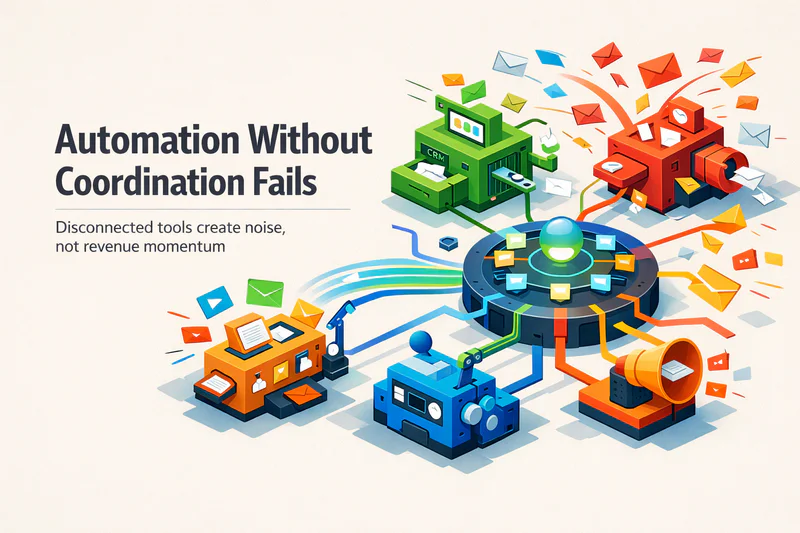
Why your stack is already automated and still broken?
Picture this. A high-value prospect fills out your demo form at 11pm on a Friday.
By Monday morning, they've received four disconnected emails. From three different systems. None of which know what the others said.
That's not marketing automation failing. That's the absence of orchestration.
Most enterprise revenue teams don't have an automation problem. They have a coherence problem. Every tool in the stack fires its own playbooks, maintains its own contact records, and makes decisions with partial information.
The result? A ceiling. A point beyond which adding more tools stops generating returns and starts generating noise.
This post breaks down exactly why enterprise marketing automation hits that ceiling and what it actually takes to break through it.
The Integration Gap: When Your Stack Becomes a Silo
Here's the uncomfortable truth about modern enterprise stacks: they're incredibly capable in isolation. HubSpot fires sequences. Salesforce runs flows. Your CDP tracks behavior. Webhooks trigger at every touchpoint.
But no single layer knows what all the others are doing.
Consider a real scenario in EdTech lead qualification:
A prospect visits your pricing page twice in one week. Then starts a WhatsApp conversation about enterprise plans. Then opens a mid-funnel case study from your email campaign. Three signals. Three systems. Zero coordination.
Without a unified layer reading all three signals together, no automation knows this lead is ready for a sales conversation let alone how urgent that intent is.
This is the information silo problem made concrete. Individual tools are optimized for their channel. Not for your customer's non-linear, multi-touch journey.
And they absolutely cannot capture what you might call fuzzy signals the urgency behind a follow-up question, the frustration in a re-engagement, the intent behind a midnight pricing-page visit.
67% of enterprise RevOps teams cite data fragmentation as their #1 automation barrier. 3.4* more tools in the average enterprise marketing stack vs. five years ago and < 5 sec response SLA that separates high-converting AI agents from lagging ones according to Forrester, 2025
From Task-Firing to Flow: A Mental Model Shift
The dominant mental model for marketing workflow tools is still the flowchart.
"If a contact fills out this form → wait two days → send email B."
Linear. Time-based. Condition-triggered. For the 2010s, it worked well enough.
Modern buyer journeys don't follow your flowcharts. They jump channels. Pause for weeks. Research competitors. Come back with new questions. And they expect you to remember everything they already told you.
The moment your automation treats them like a fresh contact because their last touchpoint happened in a different system you've lost the thread. And usually, the deal.
Task-Firing vs. Intent-Based Orchestration
Task-firing automation responds to discrete triggers in isolation. Intent-based workflow orchestration maintains a running model of where a contact is in their journey and coordinates actions across your entire stack accordingly.
The practical difference is enormous.
With intent-based marketing automation integration, a high-priority lead showing buying signals at 2am doesn't wait until Monday. The system evaluates live behavioral data. Routes accordingly. Fires a WhatsApp message, an internal Slack alert, or a calendar invite — all within seconds.
No human in the loop required for every step.
What Workflow Orchestration Tools Actually Do
There's a meaningful technical difference between an automation platform and an orchestration layer. Understanding it matters before you evaluate workflow orchestration tools.
Standard Automation Platform
• Executes predefined steps when conditions are met
• Stateless each trigger fires independently
• No cross-tool visibility or context sharing
• Silent failures with no retry or alert logic
Orchestration Layer
• Manages state across sessions and channels
• Handles retries, SLA enforcement, and fallback paths
• Coordinates human-in-the-loop handoff steps
• Routes contextually across channels
• Maintains event-driven playbooks with full context persistence
The category of workflow orchestration tools has grown significantly in 2025–26. From developer-centric engines like Temporal and Prefect to enterprise-grade platforms built specifically for go-to-market use cases.
Choosing the right one depends on a single key question: do you need a general-purpose workflow engine, or something with marketing-specific primitives built in contact scoring models, channel preference logic, and compliance guardrails for regulated industries?
RevOps: Integration Is Revenue Infrastructure
Marketing automation integration is too often framed as a data engineering problem. Syncing records. Deduplicating contacts. Maintaining field mappings.
That framing undersells the opportunity by an order of magnitude.
When your integrations are stateful when every system reads from and writes to a shared understanding of the customer you stop moving data and start enabling revenue-focused autonomous actions.
What That Looks Like in Practice
The goal isn't to automate your marketing. It's to make your entire revenue team smarter by giving them a system that remembers, reasons, and acts on behalf of your customers 24 hours a day.
For enterprises in BFSI, EdTech, and Healthcare, where compliance requirements shape every customer interaction, this also means building enterprise marketing automation that is audit-ready from day one. Audit trails. Consent management. Data residency controls. Human-override protocols at every decision point.
The Stateful Agent Problem Nobody Talks About
Most AI agents are stateless. They handle one conversation, then forget everything.
For enterprise environments where a customer might touch your brand across WhatsApp, your website, an email campaign, and a sales call all in the same week statelessness isn't a limitation. It's a dealbreaker.
The architecture that solves this is what Zigment calls the Conversation Graph™.
Every interaction regardless of channel is logged as a node in the graph with its full context: channel origin, intent signals, outcome, and resulting system state. When a contact re-engages days or weeks later through a different channel, the system reconstructs full context before responding. Identity is continuous. The conversation never starts over.
This solves the identity continuity problem that plagues most enterprise stacks.
A lead who had a detailed pricing conversation on WhatsApp last Tuesday doesn't get asked "can you tell me about your use case?" when they book a demo on Friday. The system knows. And it surfaces that context to the sales rep the moment the meeting confirms.
Why Sub-Five-Second Response SLA Is a Revenue Metric
Speed-to-response is one of the highest-impact variables in lead conversion particularly in high-competition verticals.
A <5 second SLA isn't a product spec to impress at demos. It's structural. Built into the agent architecture. Not dependent on a rep being awake or a Zapier webhook not timing out.
When an orchestration layer handles first-touch qualification autonomously, at any hour, in any channel, that response time becomes a competitive moat.
Build vs. Buy: The Real Question
If you're a RevOps leader reading this, the question isn't whether your team needs workflow orchestration.
At a certain scale, the answer is obviously yes.
The question is: are you going to build that layer yourself stitching together general-purpose tools with custom middleware and hoping it holds or invest in infrastructure purpose-built for go-to-market orchestration?
Consider the Build Path Honestly
Custom middleware requires ongoing engineering investment
General-purpose engines lack marketing-specific primitives
Compliance features (audit trails, consent flows) must be built from scratch
Every new channel integration is a new engineering project
The Buy Path Wins When
Time-to-value matters more than full customization
Your stack spans 5+ tools across 3+ channels
You operate in a regulated industry with strict audit requirements
Your team is spending >20% of sprint cycles maintaining workflow glue code
The companies winning on revenue efficiency in 2026 aren't the ones with the most automations. They're the ones whose automations share a single, coherent model of the customer and act on that model in real time, across every channel, without a human in the loop for every step.
The Orchestration Advantage
The automation ceiling is real. And it's not a technology problem it's an architectural one.
You can keep adding tools. You'll keep hitting the ceiling.
Or you can add a layer that makes all your tools work together one that remembers, reasons, and routes with the full context of every customer interaction you've ever had.
That's the difference between enterprise marketing automation and true workflow orchestration.
And right now, it's still early enough to be the differentiator in your category.