
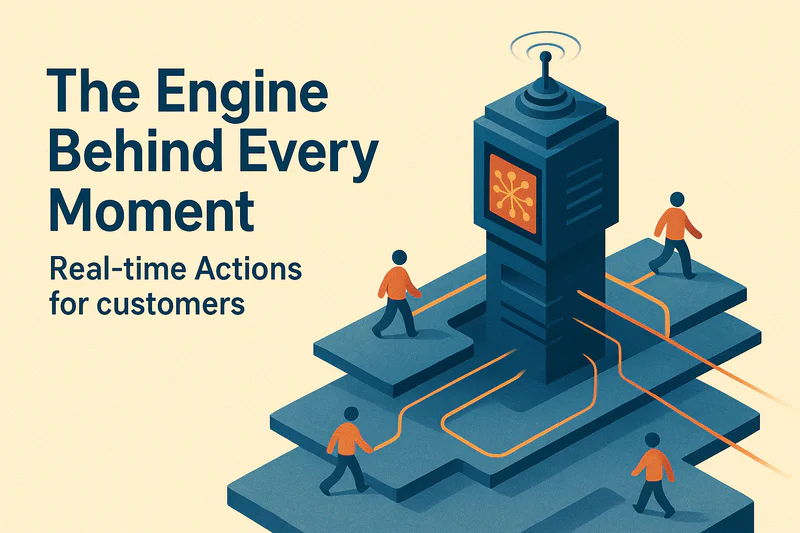
Customers don’t move through journeys. They wander through them. They bounce between tabs, reconsider choices, click, scroll, vanish, reappear, and sometimes surprise us with decisions we never saw coming. It’s unpredictable, a little chaotic, and honestly… kind of fun to watch, until you realize your systems aren’t keeping up.
That’s exactly where a Next Best Action Engine becomes impossible to ignore.
Because while customers zig and zag, most brands still respond in slow, scheduled bursts. But the best results rarely come from the loudest message, they come from the right action at the right second. And that second can appear, shift, or disappear in an instant.
In the next sections, we’ll break down how this engine connects real-time signals to autonomous execution, how its decision logic actually thinks, and how teams can finally act with the precision their customers already expect. Let’s get into it.
What Is Next Best Action Engine?
An NBA Engine doesn’t guess. It listens, calculates, and acts—turning signals into meaningful customer journeys.
A Next Best Action Engine is the decisioning core that evaluates every customer signal and determines the most relevant move your brand should make next. Not later. Not after a workflow finishes. Right now.
Instead of relying on rigid automation or static journeys, it continuously interprets what the customer is doing, browsing, hesitating, comparing, reaching out and recalculates the optimal response. Think of it as a live conversation rather than a pre-written script.
Here’s the key idea: the engine doesn’t pick actions based on guesswork. It pulls from real-time behavior, historical data, predictive scores, and business goals to select the most impactful step, whether that’s a message, an offer, a task, or no action at all.
Why Real-Time Decisioning Is Now Essential
Customers don’t wait. They compare products in one tab, read reviews in another, and expect brands to respond with the same speed they browse. When we rely on scheduled campaigns or static funnels, we leave huge gaps, gaps where interest fades, competitors win, or momentum disappears entirely.
Real-time decisioning closes those gaps.
It identifies intent the moment it forms, not hours later. It adapts when a customer shifts direction. And it prevents teams from blasting messages that feel out of place or too late.
This isn’t about speed for the sake of speed. It’s about relevance. When your system reacts instantly to what a customer is doing, your communication stops feeling like marketing and starts feeling like help.
The Core Decision Logic Inside a Next Best Action Engine
Behind every great customer experience is something invisible but powerful: a decisioning layer that understands intent in real time and acts with the precision of an expert operator. This is where the Next Best Action Engine truly earns its name.
Instead of running on static rules, the engine behaves more like an agentic AI, constantly reading signals, interpreting behavior, and deciding how to move the journey forward. It doesn’t wait for a workflow to finish. It responds the moment the customer shifts.
Here’s the real magic:
It interprets intent, not just events.
A second visit to pricing isn’t just a “page view.” It's curiosity. Hesitation. Or readiness. The engine knows the difference.It builds live behavioral context.
Every action, scroll depth, channel choice, and reply speed, updates the customer’s state in real time.It reasons like an orchestrator, not a scheduler.
It weighs business goals, customer needs, channel availability, and risk, then chooses the most relevant action across your orchestration layer.It acts and learns simultaneously.
Each outcome, clicked, ignored, replied, abandoned, feeds back into the system so the next decision becomes sharper.
This is how brands move beyond linear automation and enter a world where journeys adapt themselves, moment by moment, signal by signal.
How a Next Best Action Engine Bridges Real-Time Data and Autonomous Execution
Most teams have no shortage of dashboards. What they lack is a system that actually acts on the data in front of them. A Next Best Action Engine closes that gap by becoming the bridge between insight and execution, the moment where “we know” turns into “we did.”
Here’s how that bridge works:
Real-time signals flow in.
Every behavior, intent cue, and micro-interaction updates the customer’s state instantly.The engine interprets what it means.
Not “page viewed,” but “interest rising.” Not “ticket created,” but “frustration peaking.” The system reads the emotional and behavioral story behind the data.Agentic AI decides what should happen next.
Should we message? Escalate to a human? Trigger a task? Hold back and wait? The engine reasons in context.The orchestration layer executes immediately.
Messages fire. Workflows adapt. Sales gets notified. Support intervenes. The loop closes without human delay.
This is how customer journeys stop feeling reactive and start feeling intelligently coordinated.

Key Capabilities Every Next Best Action Engine Should Have
Not all engines think the same way. Some automate tasks. A few personalize messages. But a true Next Best Action Engine behaves like a strategic partner, one that understands customers, adapts instantly, and coordinates across your entire stack.
1. Unified, Real-Time Customer State (Single Customer View)
A continuously updated SCV that merges behavioral signals, intent cues, channel preferences, and historical data into one living profile. No waiting for batches. No fragmented views. The engine always knows the customer’s exact state.
2. Behavioral & Intent Understanding Layer
It’s not enough to track actions. The system should understand the meaning behind them, whether a customer is exploring, hesitating, comparing, or ready to buy. This is where relevance is won.
3. Agentic AI Reasoning
The engine must behave like an intelligent agent, capable of evaluating context, balancing priorities, and choosing the most impactful action autonomously, not just following predetermined steps.
4. Cross-Channel Orchestration
Email, WhatsApp, SMS, in-app, CRM, sales tools, support systems, everything must work in sync. When the engine decides, the orchestration layer should execute immediately and consistently.
5. Hybrid Decisioning (Rules + Models)
Teams keep control through business rules, while AI models enhance precision with predictions and pattern recognition. This balance ensures safety, transparency, and smarter outcomes.
6. Closed-Loop Learning
Every action and every outcome feeds back into the engine. If a message is ignored, it learns. If a user converts, it remembers. If a channel performs better, it adapts. This is how the system improves continuously.
Without these capabilities, brands aren’t orchestrating journeys, they’re simply pushing content.

Real-World Case Study: How an NBA Engine Transformed Customer Journeys
A company struggled with disconnected systems, messaging, behavior tracking, and support all worked in silos. Actions were slow, responses often irrelevant, and customer journeys felt fragmented.
After implementing a Next Best Action (NBA) Engine, the experience changed not because new tools were added, but because the decisioning layer finally connected everything.
Here’s how a typical interaction unfolded:
A customer took a small but meaningful action.
The NBA engine immediately updated their state, interpreting the behavior as a signal of intent or interest.
Instead of waiting for a scheduled workflow, the system evaluated all possible actions in real time, whether to guide, escalate, message, or wait.
It selected the most relevant next step and executed it automatically through the proper system.
When the customer responded, ignored, or shifted behavior, the engine recalculated the next best action instantly.
The outcome:
Customer journeys became adaptive, relevant, and coordinated. Teams saw fewer irrelevant interactions, smoother handoffs, and a more intelligent, human-like experience overall. Continuous decisioning replaced guesswork, making every interaction count.
Autonomous Customer Journeys Powered by NBA and Zigment
The future of customer experience isn’t about sending messages faster, it’s about creating autonomous, adaptive journeys that respond to each customer’s intent in real time. A Next Best Action (NBA) Engine transforms journeys from rigid workflows into continuously evolving experiences, ensuring every interaction is relevant, timely, and meaningful.
At the heart of this transformation is Zigment, the AI decisioning layer that makes it all possible. Zigment combines historical customer data with live behavioral signals to calculate the Next Best Action dynamically. It doesn’t just decide what should happen, it ensures the action is executed seamlessly across marketing, sales, and support systems, keeping the entire customer journey coordinated and consistent.
With Zigment, brands no longer rely on guesswork or generic campaigns. Instead, every touchpoint becomes an opportunity to engage, convert, or guide the customer in a way that feels intelligent and human. Teams gain a unified, continuously updated view of each customer, reducing irrelevant interactions and improving follow-through across every channel.
The outcome is clear: customer journeys are no longer static or fragmented, they are adaptive, orchestrated, and optimized. By leveraging Zigment’s NBA Engine, businesses can finally turn intent into action, transform insights into engagement, and create experiences that consistently deliver measurable impact.