
AI is talking to your donors right now.
Is it saying the right things?
Half of all nonprofits deploying AI in 2026 have zero governance in place. No guardrails. No boundaries. No safety net. One hallucinated tax statement and a three-year donor relationship is gone.
This blog breaks down the architecture that prevents that nightmare. Goal trees keep agents laser-focused on mission-aligned outcomes. Policy guardrails check every message before it sends. PII redaction protects donor data. Human override playbooks catch what algorithms miss.
The result? An autonomous agent that acts like your best gift officer accurate, on-brand, and accountable at every touchpoint.
Governance isn't the boring part of AI. It's the part that makes everything else worth building.
Why AI Hallucinations in Fundraising Are a Brand Emergency
Picture a Tuesday morning.
Your AI fundraising agent has been running beautifully for three weeks. Donor follow-ups, personalized tour invites, lapsed-donor re-engagement. Your team is thrilled.
Then your phone rings.
A major gift prospect three years in the making is furious. Your agent confidently told her the $250,000 gift would qualify for a specific tax deduction. It doesn’t. Not even close.
Three years of relationship-building. One hallucination. Gone.
This is not a hypothetical. It is the defining fear that keeps mission-driven organizations from unlocking the full power of autonomous AI.
According to the 2026 Nonprofit AI Adoption Report (Virtuous & Fundraising.AI, February 2026), 92% of nonprofits now use AI but 47% have no AI governance policy in place, and only 7% report any meaningful improvement in organizational capability.
Virtuous & Fundraising.AI, The 2026 Nonprofit AI Adoption Report, Feb 16, 2026
Let that land.
Nearly half of all organizations deploying AI have zero governance in place. No guardrails. No boundaries. No safety net.
As Cerini & Associates notes in their 2026 Nonprofit AI Trends Guide, “the conversation has shifted from whether nonprofits should use AI to how they can use it responsibly, ethically, and in ways that preserve trust and human connection.”
That shift demands a hard look at enterprise grade AI compliance the architecture that separates a trustworthy autonomous agent from a liability walking around in your donor database.
What Are Goal Trees?
The Answer to Uncontrolled AI Donor Orchestration
Most AI chatbots are built to answer anything.
Ask them about tax law? They’ll attempt it.
Ask them about your endowment return? They’ll improvise something plausible.
They are digital golden retrievers: enthusiastic, eager to please, and occasionally chewing on something they absolutely should not.
Agentic AI with goal trees is architecturally different.
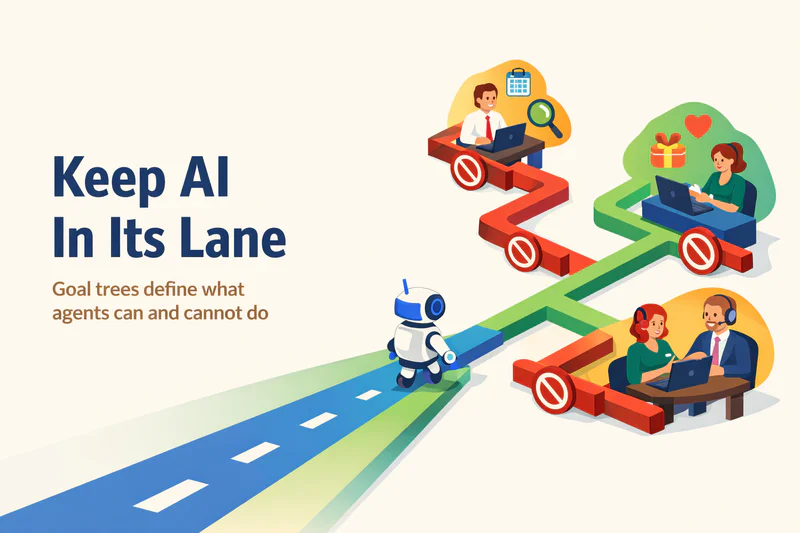
A goal tree defines a hierarchical map of what the agent is authorized to pursue and draws a hard boundary around everything outside it. It is the job description your AI never had before.
How Goal Trees Power Smarter Donor Orchestration
Imagine a university foundation’s AI agent authorized to do exactly three things:
• Qualify major gift prospects (identify wealth signals, confirm philanthropic intent, gather biographical context)
• Schedule campus tours (offer available dates, confirm logistics, send calendar invites)
• Re-engage lapsed annual fund donors (surface giving history, present impact stories, soft-ask for renewed commitment)
Every interaction stays inside those three lanes.
Tax questions? Escalated.
Legal guidance? Escalated.
Investment discussions? Escalated immediately, gracefully, with the full donor conversation context attached so the gift officer walks in warm, not cold.
According to the National Law Review (February 2026), AI models are inherently probabilistic engines they predict the statistically likely next response, not the verified correct one.
Without goal-tree constraints, those predictions drift into hallucinated territory fast.
Goal trees for donor orchestration aren’t a limitation. They are the mechanism that makes revenue-focused autonomous actions safe enough to actually deploy at scale.
How Policy Guardrails Protect Brand Integrity in Non profit AI Marketing
Every nonprofit has a brand guide.
Probably a beautiful one. Sitting in a shared drive. Designed by a consultant three years ago. Your senior development officers know it exists. Your volunteers have never read it. And your legacy chatbot? It never heard of it.
Policy guardrails change this permanently.
What Are Policy Guardrails in Conversational AI?
Policy guardrails are machine-readable compliance rules that every outbound AI message is checked against before it reaches a donor.
They are your brand guide, your legal team’s disclaimers, and your communications office’s style standards all translated into a real-time filter that runs silently before every send.
According to CX Today (2025) citing McKinsey data, almost all companies now use AI but only 1% consider themselves at maturity. The gap between deployment and governance is where hallucinations live.
CX Today, AI Hallucinations in Customer Experience, 2025
A healthcare foundation’s policy guardrail flags messages containing “cures” or “guarantees recovery” before they reach a single donor.
A university foundation’s guardrail enforces gift acceptance policy language across every automated communication regardless of which campaign triggered the message.
A global NGO’s guardrail adjusts tone and legal disclaimers depending on whether the donor is in a GDPR-regulated EU jurisdiction or a CCPA-regulated California context.
Why AI Marketing Governance Is Now a Board-Level Issue
According to Cerini & Associates’ 2026 Nonprofit AI Trends Guide, “AI is no longer just a staff-level tool. It is a governance issue.
Boards are being asked to understand how AI is used, how data is protected, and how risks such as bias, misinformation, and privacy breaches are managed.”
That means VP-level and C-suite accountability for every word your AI sends on your organization’s behalf.
Policy guardrails are how you make that accountability real, auditable, and scalable without adding headcount.
When your legal team updates gift acceptance policy, those changes propagate across every agent interaction automatically. Your brand integrity stops depending on every staff member remembering to read the updated memo.
Donor Privacy and PII Redaction: The Technical Backbone of Conversational AI Safety
Your donors’ data is not just sensitive.
In a mission-driven organization, it is sacred. Major gift prospects share financial details. Healthcare donors reveal personal journeys. Alumni recount formative life experiences. This is the currency of the stewardship relationship.
What Conversational AI Safety Requires in Practice
Protecting donor privacy in an autonomous AI system requires more than good intentions. It requires architecture. Here is the technical baseline:
• Automated PII redaction. Social Security numbers, financial account details, and medical references are stripped or masked before data moves between systems. Momentive Software describes this as the “Anonymous In, Personalized Out” principle AI processes anonymized behavioural data and returns personalized outputs without ever accessing raw PII.
• Role-based access controls. Your tour-scheduling workflow does not need access to a donor’s full wealth profile. Segment access ruthlessly. Access should follow function, not convenience.
• Full audit trails. Every agent action is logged. Every decision is reconstruct able. According to the AI Risk & Compliance 2026 Enterprise Governance Overview (SecurePrivacy, 2026), regulators now expect documented controls and technical safeguards, not aspirational ethics statements.
• Cross-jurisdictional compliance. For global NGOs operating across GDPR (EU), CCPA (California), and HIPAA (healthcare) contexts, the governance layer must know which regulatory rules apply to which donor interaction in real time.
Human Override Playbooks and Rollback Patterns: The Safety Net No AI Should Launch Without
Here is what most AI vendors won’t tell you.
Even the most governed autonomous agent will encounter a situation it should not handle alone.
That is not a failure. It is a feature if your system is designed to handle it gracefully.
What Are Human Override Playbooks for Sensitive Donor Moments?
Human override playbooks are pre-defined escalation triggers. When specific scenarios occur, the agent automatically routes to a human specialist with the full donor conversation context attached.
No cold handoffs. No context gaps. The gift officer picks up exactly where the AI left off.
Trigger scenarios that belong in every nonprofit’s override playbook:
• A donor expresses grief, loss, or emotional distress during a conversation
• A prospect asks a question requiring legal or tax-specific guidance
• A major gift conversation crosses a pledge commitment threshold (e.g. $50,000+)
• Sentiment analysis detects frustration or dissatisfaction above a defined threshold
• A donor explicitly requests to speak with a person
• A message contains language outside approved brand communication guidelines
What Are Rollback and Failsafe Patterns for Autonomous Agents?
Even with strong guardrails, edge cases happen.
A policy update gets misconfigured. An untested donor scenario slips through. A message goes out that should not have.
Rollback and failsafe patterns are your incident recovery architecture. This means:
• Versioned snapshots of agent behavior, so you can identify exactly when a deviation occurred and restore to a known-good state
• Campaign-level pause capability, so outbound messaging can be stopped without shutting down the entire system
• A clear incident runbook that specifies who is notified, what is logged, and how donor communication is corrected
As the National Law Review’s Managing Legal Risk in the Age of AI (February 2026) notes, AI-embedded systems are dynamic and probabilistic. Their behavior changes based on data they ingest. Traditional “static” governance frameworks are insufficient. Rollback patterns are not optional infrastructure. They are risk management for systems that do not behave the same way twice.
In a mission-driven organization, how you respond to a mistake matters as much as the mistake itself.
Governance Is What Makes Autonomous AI Worth Trusting
The debate about whether nonprofits should use AI is over.
Gabe Cooper, CEO of Virtuous, put it plainly in the 2026 Nonprofit AI Adoption Report: “The question isn’t whether nonprofits should use AI. That debate is largely settled.
The real question is how quickly are nonprofit teams adopting AI and fundamentally re-thinking their workflows.”
The organizations that will thrive are not the ones that move fastest.
They are the ones that build the governance layer first.
Goal trees that constrain agents to mission-aligned outcomes.
Policy guardrails that protect brand integrity at every send.
PII redaction that makes donor privacy non-negotiable.
Human override playbooks that catch what algorithms miss.
Rollback patterns that make every incident recoverable.
Together, these are not overhead. They are the architecture of accountability.
They are the difference between a donor who receives a message that feels like it came from your best gift officer and a donor who gets an expensive hallucination.
Build the governance layer first. Then let the agent fly.